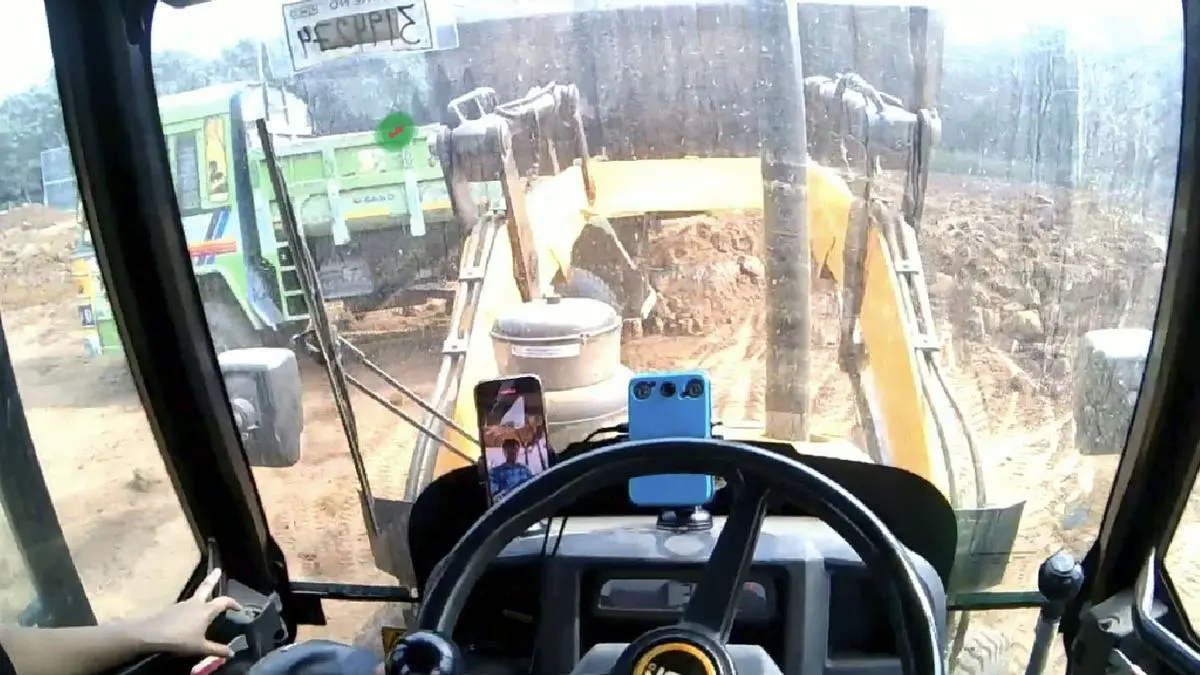
LOOK SHARP. To help heavy machinery operators guard against fatigue, ParvAI sensors monitor their eye condition and movements
Eyes are windows to the soul — this ancient poetic thought is moving from the realm of philosophy to precise science, inside the IIT-Madras Research Park.
ParvAI, an AI-driven eye-tracking venture, is helping companies differentiate between a routine operation and a catastrophic accident.
Founded by Prof Raj Srinivasan and Prof Babji Srinivasan, faculty members at IIT-Madras, ParvAI (parvai in Tamil means sight) may be only four years old but the technology’s roots stretch back over a decade to a research challenge thrown by the Department of Atomic Energy.
Today, ParvAI services customers in nuclear safety, logistics and, potentially, soon in paediatric healthcare.
“The idea is that we can understand what people are thinking by looking at their eyes,” explains Prof Raj Srinivasan. Combining the use of precision cameras, algorithms and geometry, ParvAI’s systems infer the precise area on which an operator’s attention is focused.
In the control room of a nuclear power plant, for example, when something goes wrong, it can be a time of extreme stress for the operators. ParvAI’s technology monitors operators to ensure they aren’t suffering from “attention tunnelling”, a psychological condition where a person becomes so focused on one task or alert that they miss a more important alarm elsewhere.
The technology’s uses are many. On the hot and humid coasts of India, crane operators at ports work in airless cabins under the sweltering sun, loading and unloading huge containers. To help the operators guard against fatigue, ParvAI’s sensors monitor the dilation of pupils or look for a change in the blink rate that signals the onset of sleepiness or inability to process an overload of information. This sets off an alarm before a container can slip and fall.
In logistics, the company also helps clients monitor warehouse equipment and fleet drivers. “If an Uber driver is reversing but looking through the front windshield, they aren’t doing things correctly,” says Srinivasan. “Our AI doesn’t just track the eye; it also ensures the person’s behaviour is commensurate with his or her task.”
Mental health screening
ParvAI is working on a product to help evaluate paediatric mental health. Srinivasan says India has too few doctors. To help diagnose developmental disorders in children, ParvAI is developing a tablet-based screening tool for primary health centres (PHCs).
By having a child play a simple game on a tablet, the system tracks its gaze and facial expressions to determine if its cognitive development is on track for its age. This enables a preliminary diagnosis within minutes, helping refer to specialists children who show a deviation from normal behaviour.
The company has received patents for its technology in India and the US, and is awaiting a European patent.
It has also designed a product for the media industry. Similar to the soundbar-like device placed on top of a television, the gadget can help broadcasters gauge the viewer’s level of engagement with an advertisement or show. Current rating systems offer broad estimates, but ParvAI’s tech can highlight whether viewers are actually looking at the screen or if they have turned to their phones or talking to others in the room.
More Like This
Published on May 4, 2026







