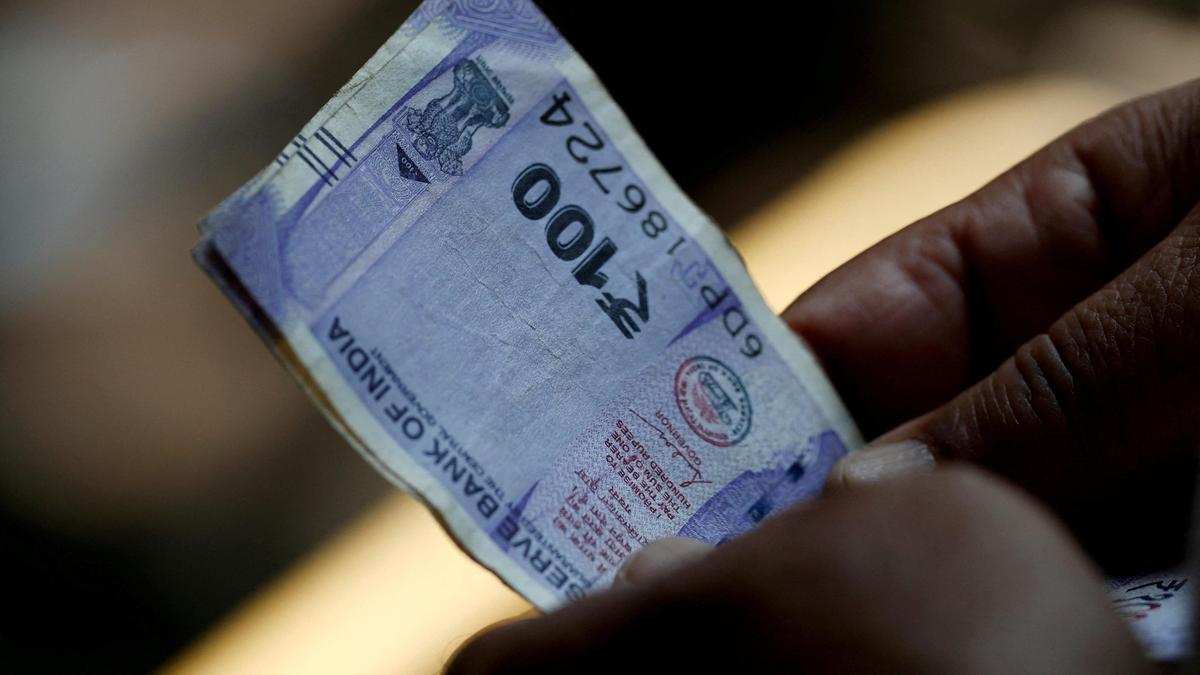
In the calendar year so far, the rupee has depreciated about 5 per cent (or about 425 paise) against the US dollar
| Photo Credit:
The rupee on Tuesday came within a whisker of the psychologically crucial 90 to a dollar mark, with the currency testing an all-time intraday low of 89.95 and closing at a record low of 89.87.
The Indian currency (INR) is being buffeted by FPI selling in the equity market, importer demand, short-covering by speculators, delay in clinching the tariff deal with the US, possibility of a repo rate cut and reduced RBI intervention, among others.
In the calendar year so far, the rupee has depreciated about 5 per cent (or about 425 paise) against the US dollar (USD).
The Indian unit on Tuesday closed down about 32 paise against the previous close of 89.5475 per dollar. Amit Pabar, MD, CR Forex Advisors, observed that with the RBI not actively defending levels, every round of dollar demand is pushing the rupee lower.
“The RBI had protected the 88.80 level for many days, but allowed it to break on 21 November. Since then, the central bank has stepped in only briefly to control sharp moves, and again today it allowed another 15-20 paise fall. This shows the RBI is allowing a slow and gradual depreciation while preventing excessive volatility. With 90 being a key psychological and technical level, the focus now shifts to how firmly the RBI manages this zone,” he said.
Pabari noted that the coming sessions will reveal whether the slow-depreciation trend continues, or whether a more active defence emerges around 90.
Anindya Banerjee, Head Commodity and Currency, Kotak Securities, said USD-INR extended its rise towards the 90 mark, driven by continued short-covering from speculators and sustained importer demand.
He opined that the 90 level is a major psychological barrier — and a cluster of buy-stop orders likely sits above it. “This is precisely why the RBI must remain active below 90; if the pair starts sustaining above this zone, the market could quickly shift into a higher trending phase towards 91.00 or even higher. At this stage, it is essential for the central bank to prevent speculators from becoming too comfortable with a one-way trend, as that can trigger an unnecessary spike in USD-INR volatility,” said Banerjee.
According to Pabari’s assessment, “the market now seems to be settling into a broader 88.90–90.20 band. Historically, whenever the rupee breaks a key level, it tends to stabilise in a new range — earlier shifts from 81–83 to 83–85 and later 86–88 followed the same pattern.”
The break above 89 has likely pushed USD-INR into a fresh consolidation zone between 88.90 and 90.20, he added.
Published on December 2, 2025







