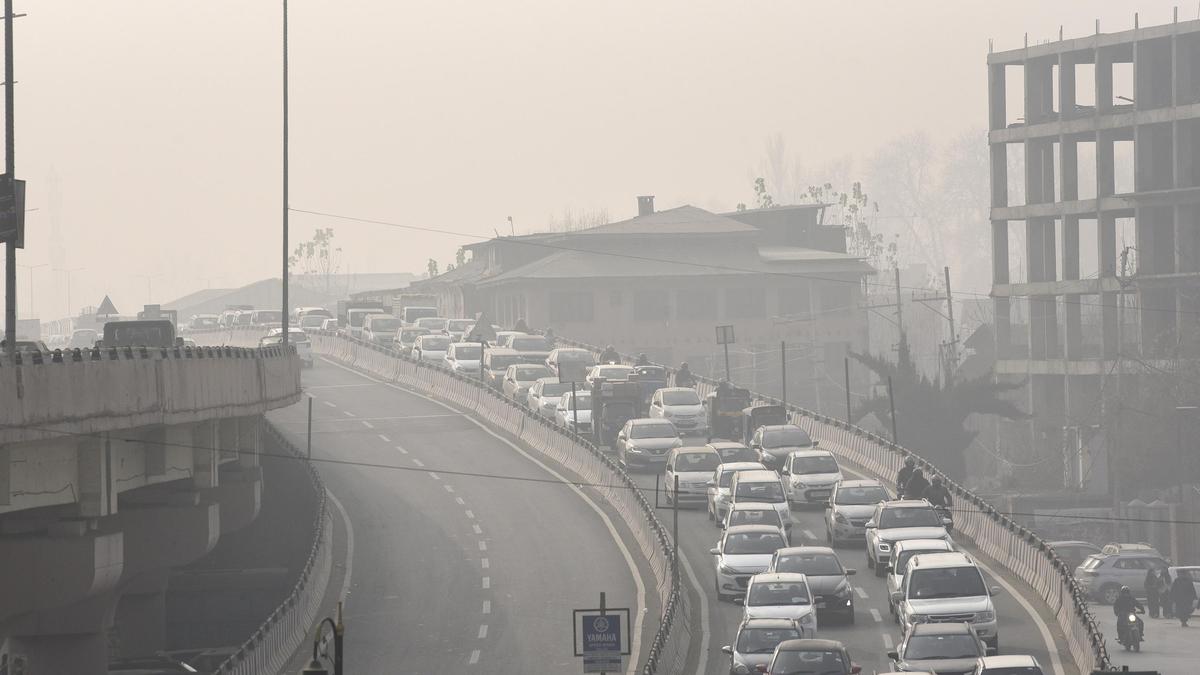
A prolonged dry spell in the Valley, marked by the absence of rainfall or significant wind movement, has worsened the situation, allowing pollutants to linger and accumulate
| Photo Credit:
ANI
Kashmir’s image as a clean-air haven is fading, with air quality in the Valley sliding from moderate to poor levels in recent days.
Last week, Srinagar’s air quality deteriorated to “poor” with the Central Pollution Control Board (CPCB) recording an Air Quality Index (AQI) of 212, driven mainly by fine particulate matter. PM2.5 levels averaged 209 micrograms per cubic metre, peaking at 284, while PM10 averaged 162.
The data indicates a steady build-up of particulate pollution in the summer capital, which has long relied on its traditionally cleaner mountain air.
A prolonged dry spell in the Valley, marked by the absence of rainfall or significant wind movement, has worsened the situation, allowing pollutants to linger and accumulate. Without precipitation to cleanse the atmosphere, particulate matter remains suspended closer to the ground, creating dense haze and reducing visibility.
Each year, Kashmir is enveloped in thick smoke in late autumn as farmers burn abscised twigs and leaves in orchards to produce charcoal for winter heating. This year witnessed paddy farmers in several areas burning stubble, a practice more common in other northern States such as Punjab and Haryana. The seasonal burning releases large amounts of PM2.5 and PM10, soot, volatile organic compounds and other harmful gases.
Experts warn that unless the practice is curbed and cleaner alternatives encouraged, the Valley may face long-term health consequences.
Mohammad Yousoof Dar, Associate Director and Head of the Pulmonology Department at Paras Hospital in Srinagar, told businessline that patient numbers rise sharply during this period as pollution spikes.
“During this season, we see around a 20–30 per cent increase in respiratory patients,” he said, citing aggravated asthma, COPD, bronchitis and other pollution-related conditions. He added that rising pollution also contributes to cardiovascular diseases.
Another health expert said the conventional practice of burring the agricultural waste needed to be curbed .
Locals said that there has been a dramatic shift over the last decades in the Valley’s air quality.
Ghulam Nabi,(70) a resident of Srinagar, recalled a time when the Valley was celebrated for its pristine breeze. “A few years ago, Kashmir was known for its clean air. We never imagined wearing masks because of pollution,” he said, watching the grey haze settle over the city. “Now, by evening, the air feels heavy and makes it hard to breathe,” he added.
Published on December 8, 2025







