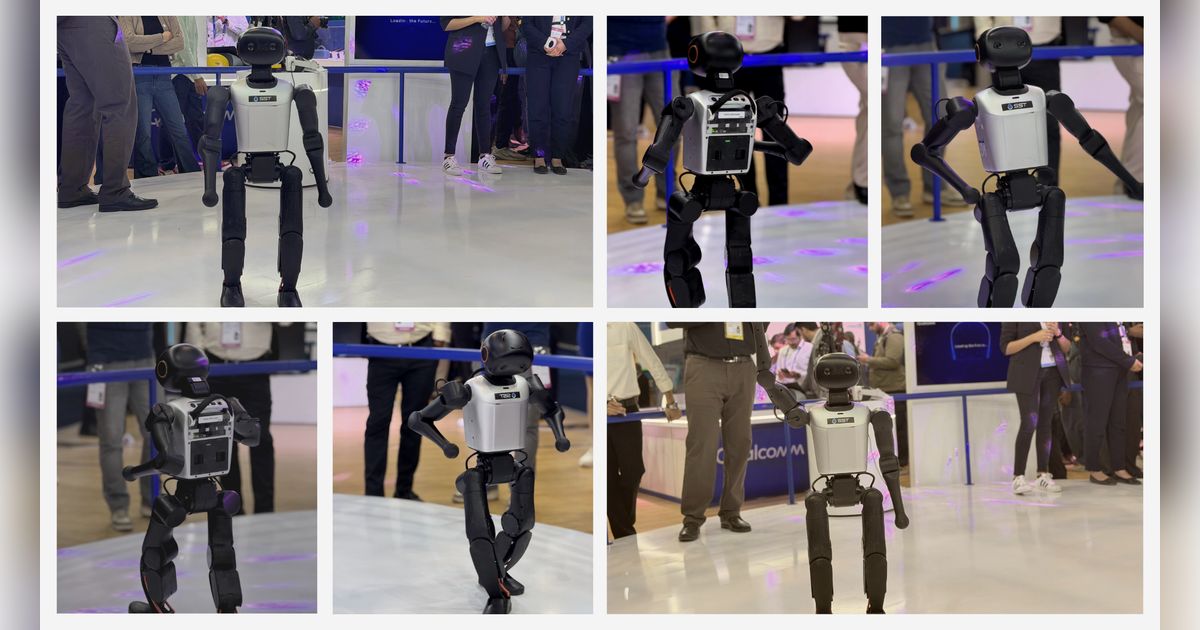
The company demonstrated a suite spanning hardware, software and artificial intelligence, describing it as an end-to-end stack aimed at accelerating deployment of physical AI systems. According to Qualcomm, the platform is designed for a range of applications, including household robots, industrial autonomous mobile robots (AMRs) and full-size humanoids.
Dragonwing IQ-10 processor for humanoids and AMRs
At the event, Qualcomm introduced its first dedicated robotics processor, the Dragonwing IQ-10, targeted at full-size humanoid robots and advanced AMRs. The company said the processor is engineered to deliver energy-efficient performance for complex robotics workloads.
Qualcomm stated that the processor forms the foundation of its broader robotics architecture, enabling scalable performance across multiple robotic form factors.
Modular architecture and AI data flywheel
During a live demonstration of a humanoid robot, the company outlined its general-purpose robotics architecture, which integrates heterogeneous edge computing, mixed-criticality systems, software frameworks, machine learning operations and what it described as an AI data flywheel.
Qualcomm said the modular design allows robots to adapt to different environments and perform real-world tasks using integrated vision, audio and motion capabilities. The stack, it added, has been optimised to scale across platforms while maintaining industrial-grade reliability.
The company described its approach as end-to-end and modular, enabling deployment across diverse operational settings.
Focus on priority tasks in key industries
Qualcomm said it is adopting a task-based approach to robotics, concentrating on 10 priority real-world tasks across logistics, manufacturing and retail. These include item picking, case stacking, line sequencing and inventory scanning.
According to the company, focusing on clearly defined, high-demand tasks will enable faster commercial deployment in sectors where automation requirements are increasing.
Building on ADAS experience
Qualcomm said its robotics strategy builds on its experience in multi-criticality AI systems developed for Advanced Driver Assistance Systems (ADAS).
“Our stack is built on what we’ve already accomplished with our ADAS team and now we’re going to continue building on it and continue training our models on a loop so that they’re constantly learning and evolving,” the company said.
Qualcomm added that its humanoid systems are deployment-ready, supported by a partner ecosystem and developer tools aimed at accelerating adoption across industries.







