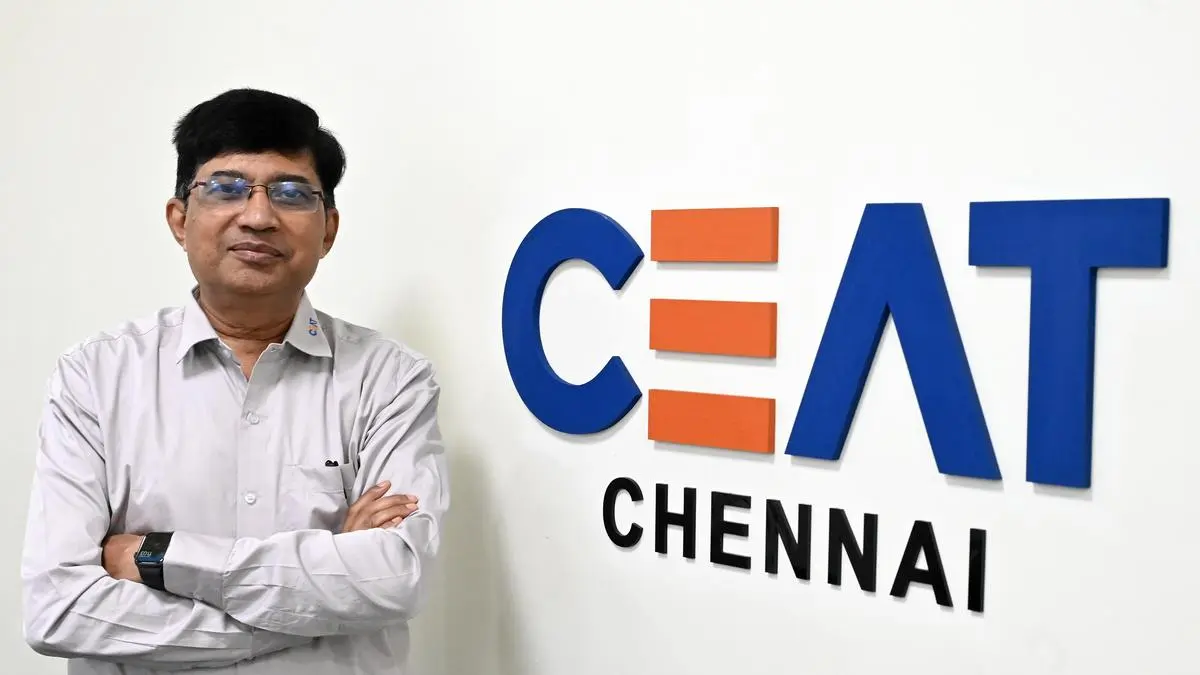
Jayasankar Kuruppal, Senior Vice President- Manufacturing, CEAT.
| Photo Credit:
BIJOY GHOSH
Tyre maker CEAT Ltd plans to invest a fresh ₹1,300 crore to expand passenger car radial (PCR) tyre capacity at its Chennai manufacturing facility, taking the cumulative investment at the plant to ₹4,800 crore—surpassing its original commitment of ₹4,000 crore. The company has already invested about ₹3,500 crore in the facility.
The expansion will add around 35 lakh tyres annually, increasing total PCR capacity from 95 lakh units to about 1.3–1.4 crore tyres, depending on the product mix. The enhanced capacity is expected to be operational by the first half of FY28. Civil works are likely to begin in the coming months, with equipment orders already placed, said Jayasankar Kuruppal, Senior Vice President (Manufacturing).
Located in Kanchipuram district near Chennai, the 63.4-acre facility currently produces passenger car radial tyres, truck and bus radial (TBR) tyres and two-wheeler tyres.
The plant commenced operations in February 2020 with PCR and two-wheeler tyre lines, and later added a TBR line in September 2024, expanding its product portfolio. In parallel with the PCR expansion, CEAT is also doubling TBR capacity from 5 lakh to 10 lakh tyres annually.
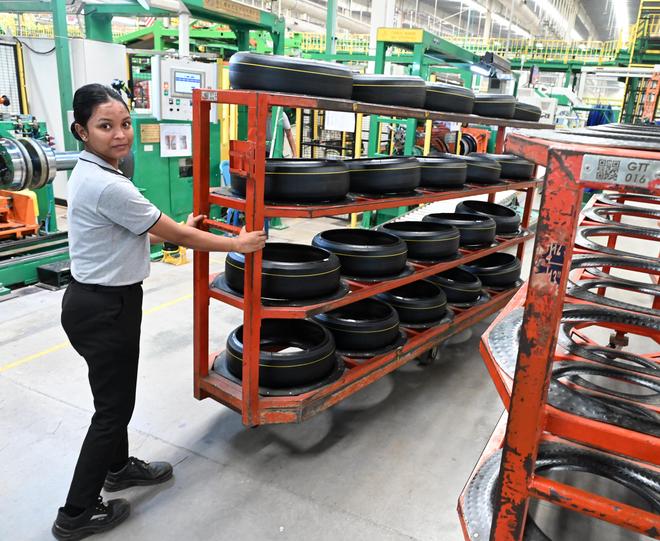
Women employees at CEAT tyre facility .
| Photo Credit: BIJOY GHOSH
At present, the Chennai unit produces about 20,000–22,000 passenger car tyres per day and operates at 80–85 per cent capacity utilisation. It employs around 1,500 people across three production lines, he said.
Kuruppal said that the facility has also emerged as a key export hub, with nearly 40 per cent of its PCR output shipped to markets such as Europe, the Middle East and Latin America. The company is also expanding its presence in the US market. CEAT began exports from the plant in 2017 with about 10,000 tyres per month, with volumes steadily rising since.
The plant’s location near major OEM hubs in southern India—home to companies such as Hyundai Motor Company, Renault-Nissan and Daimler AG, along with two-wheeler makers like Yamaha Motor Company, TVS Motor Company and Royal Enfield—was a key strategic factor.
Productivity in Chennai plant is about 30 per cent higher than some of its older plants, driven by newer machinery and Industry 4.0 technologies. With the latest investment, CEAT expects the Chennai plant to play a larger role in its growth strategy, catering to both domestic demand and export markets, he said.
Published on March 17, 2026







