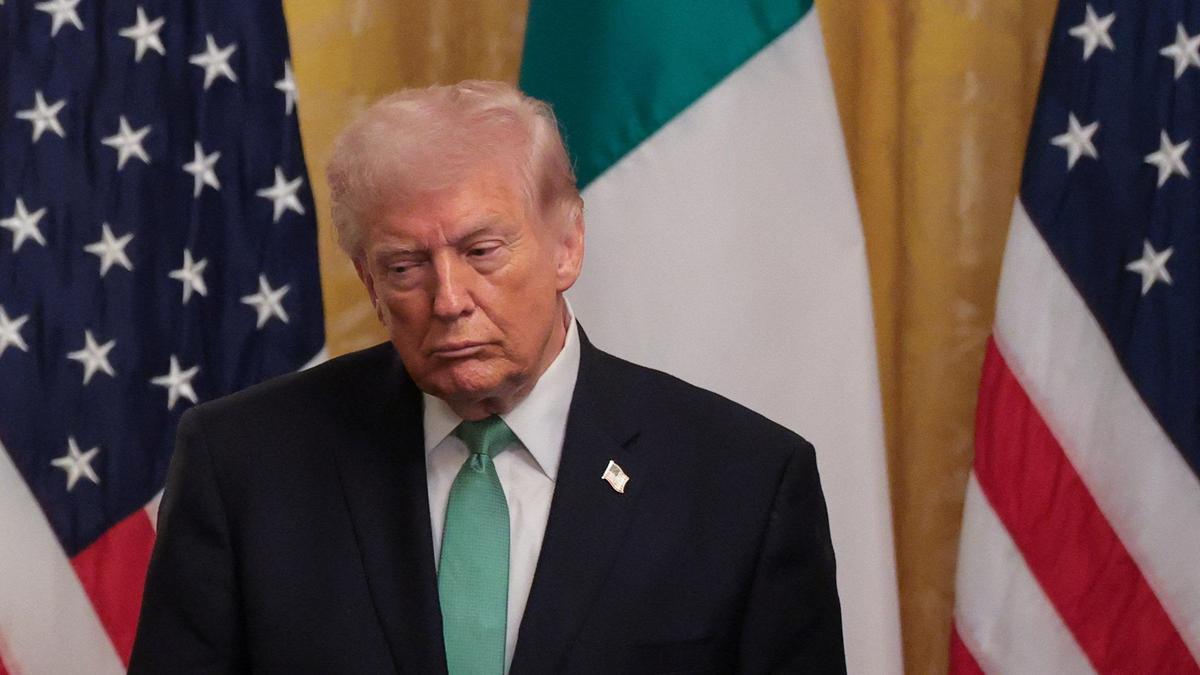
U.S. President Donald Trump
| Photo Credit:
KYLIE COOPER
US senators get a chance on Wednesday to question top aides to President Donald
Trump in public about national security nearly three weeks into
the Iran war as the Senate intelligence committee holds its
annual hearing on worldwide threats to the United States.
The hearing is likely to focus on the Middle East conflict
that began on February 28, as lawmakers – including some of
Trump’s fellow Republicans as well as Democrats – have said they
want more information about a war that has killed thousands of
people, disrupted the lives of millions and shaken energy and
stock markets.
Democrats in particular have complained that the
administration has not kept Congress adequately informed about a
conflict that has cost U.S. taxpayers billions, and demanded
public testimony rather than the classified briefings held in
the past two weeks.
The testimony from officials including Director of National
Intelligence Tulsi Gabbard and CIA Director John Ratcliffe is
also likely to touch on the shock announcement on Tuesday that a
top aide to Gabbard had resigned, citing the war.
Joe Kent, who headed the National Counterterrorism Center,
is the first senior official in Trump’s administration to resign
over the conflict.
The Office of the DNI oversees the counterterrorism center
and Kent is close with Gabbard, who has kept a low profile since
the Iran war began.
“I cannot in good conscience support the ongoing war in
Iran. Iran posed no imminent threat to our nation, and it is
clear that we started this war due to pressure from Israel and
its powerful lobby,” Kent wrote in a letter posted to social
media.
The White House rejected Kent’s assertion, saying his letter
included “false claims.”
REPUBLICANS, DEMOCRATS DIFFER
Senator Tom Cotton of Arkansas, who chairs the committee,
said on Tuesday that the military campaign had been
“extraordinarily successful” and it would take time to achieve
the administration’s goals for Iran, but he was confident the
U.S. would do so.
“In the end, we will have defanged the Iranian regime, their
missile forces, their drones, their missile launchers, their
manufacturing capability will be ended. Their nuclear program
will once again be pulverized,” Cotton said.
Cotton said he felt the campaign was carefully planned, a
contrast with Democrats and other critics who have said Trump
did not seem to have planned for actions like Iran closing the
Strait of Hormuz, a critical energy shipping lane.
Questions have swirled around what Trump was told before he
decided to join with Israel in striking Iran.
Sources familiar with U.S. intelligence reports have said
Trump was warned, for example, that attacking Iran could trigger
retaliation against U.S. Gulf allies despite his claims on
Monday that Tehran’s reaction came as a surprise.
Trump’s assertion followed other administration claims that
have not been backed by U.S. intelligence reporting, such as
that Iran would soon have a missile capable of hitting the U.S.
homeland and that it would need two to four weeks to make a
nuclear bomb.
Trump was also briefed ahead of the operation that Tehran
would likely seek to close the Strait of Hormuz, according to
two other sources familiar with the matter.
Senator Mark Warner of Virginia, the committee’s Democratic
vice chairman, called the conflict a war of choice.
“There was no imminent threat to the United States, and I
don’t believe there was even an imminent threat to Israel from
Iran,” he said on CBS’ “Face the Nation” on Sunday.
The House of Representatives intelligence committee is due
to hold its worldwide threats hearing on Thursday.
Published on March 18, 2026







