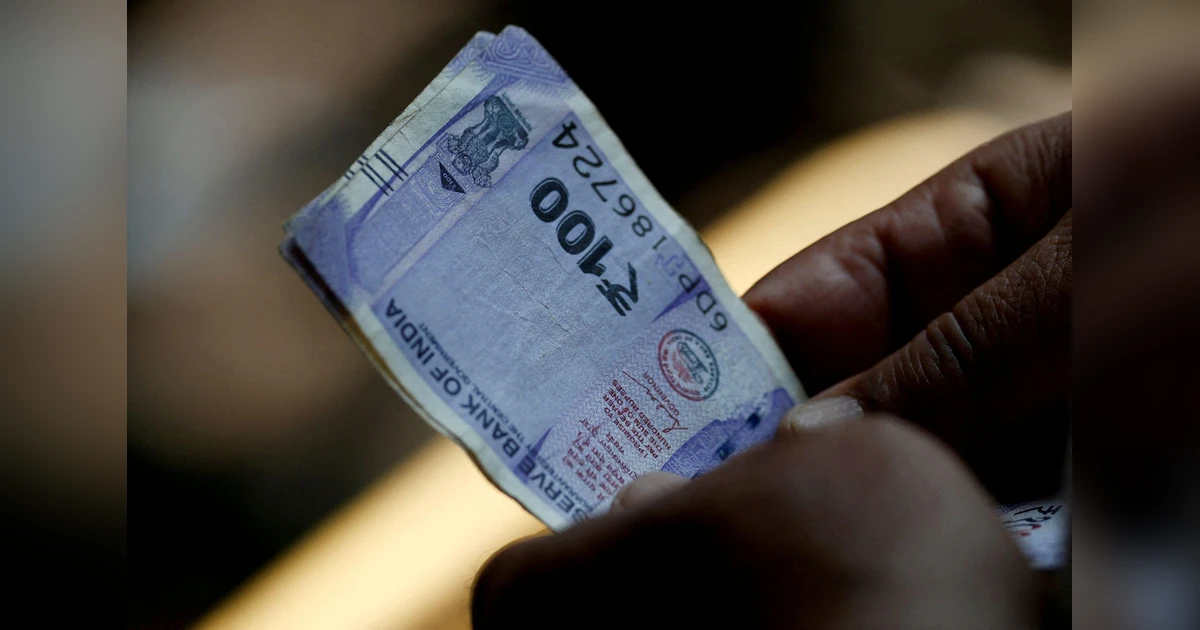
The rupee plunged to a record low of 93.72 against the dollar, declining 1.15 per cent in a single session — the steepest single-day fall since 24 February 2022 — weighed down by elevated crude oil prices and strong dollar demand from oil marketing companies and foreign portfolio investors. Intraday, the Indian unit touched a low of 93.77/$.
The Indian unit depreciated 8.8 per cent against the dollar this financial year so far, the worst since FY14 when it weakened by 9.37 per cent. So far in March, it has weakened 2.92 per cent.
Forex traders said that without the intervention of the Reserve Bank of India (RBI), the rupee would have probably fallen to 95 per dollar on Friday. They estimated that the RBI might have sold dollars worth $4 billion–$5 billion.
The Indian crude oil basket price surged to around $156 per barrel, intensifying the pressure on the domestic currency. Since the crisis in West Asia, the Indian crude oil basket price has risen 120 per cent. The dollar index, which gauges the greenback’s strength against a basket of six currencies, was trading 0.35 per cent higher at 99.58.
“The rupee move today was entirely on the back of the move in energy prices. It was the biggest single-day move in over four years. There is a threat to energy supply (both Brent as well as LNG) as the war escalates and production sites are being targeted,” said Abhishek Goenka, founder and CEO of IFA Global.
Apart from surging crude oil prices, which threaten to worsen the current account deficit, a ballooning short forward book has been another factor for the currency’s fall.
“Market got to know that RBI had $107 billion (by mid-March) of oversold positions, which it will be required to buy in the coming days, though at least 30 per cent of these are for a period of more than two years,” said Anil Kumar Bhansali, executive director and head of treasury, Finrex Forex Advisors. The dollar deficit in the forward book was $68.4 billion by the end of January.
When these positions start maturing, the RBI will have to buy large amounts of dollars, which will increase demand for dollars. This creates more downside risk for the rupee, meaning it is more likely to weaken than strengthen — even if the war ends sooner than expected, Bhansali added.
“It seems the RBI has limited ammunition to protect the rupee, given that it is already short around $100 billion in forwards, in NDF and onshore combined,” Goenka said, adding that given the uncertainty around how long the war will continue and risks to energy supply, the RBI may want to use its ammunition judiciously.
Foreign fund outflows also weighed on the currency, experts said.
“Both FDI and FPI outflows are weighing on the financial account. In particular, we note one of the factors contributing to the negative FPI picture is weak foreign sentiment towards Indian equity markets,” Barclays said in a note. “Since the onset of the Middle East conflict, equity outflows have accelerated ($8.4 billion MTD), while FAR bond flows have also turned negative (-$836 million MTD), both of which have contributed to renewed INR pressure,” the note said, adding that in the current environment, the prospects of a sustained bounce-back in equity capital inflows remain weak.
Dealers said the Indian unit is likely to remain under pressure and the central bank can only slow the pace of depreciation but cannot reverse the direction.
India’s foreign exchange fell for the second consecutive week with $7 billion decline for the week ended 13 March, 2026, to $ 709.8 billion. After hitting an all time high of $728.5 billion for the week ended 27 Feb, 2026, reserves declines around $19 billion in the last two weeks indicating dollar sales by the central bank to curb volatility in the foreign exchange market since the onset of the West Asia conflict.







