If the headline sounds like the title of a Robert Ludlum novel, the story behind it is just as exciting.
Tokamaks are doughnut-like devices that are the core of nuclear fusion reactors. The ring-shaped vacuum chamber magnetically confines plasma (hot gas of free electrons, which are negatively charged, and positively charged ions). The particles, whose pressure is balanced by the external magnetic field, can only spiral inside the ring, rather than fly off; in the ensuing traffic jam, some collide, fuse and produce energy.
Tokamaks are typically very large — for example, the one used by the International Thermonuclear Experimental Reactor (ITER) in France has a radius of 6.2 m.
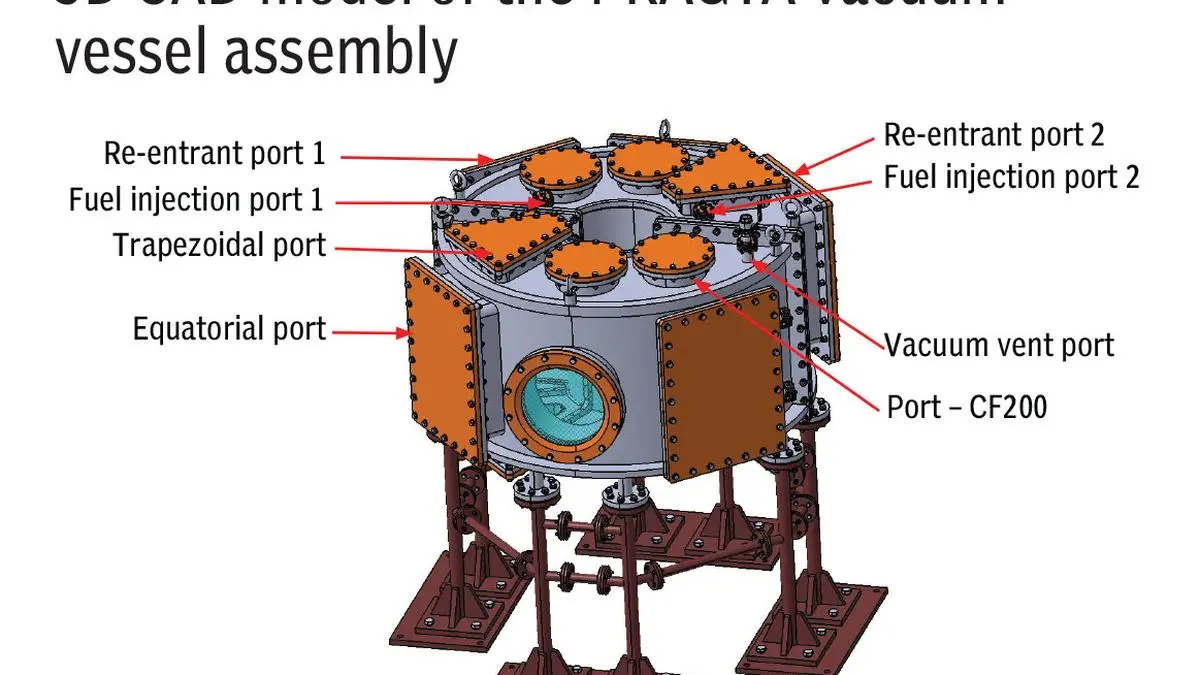
Now, a Bengaluru-based startup, Pranos Fusion, has developed a tiny tokamak device with a radius of just 40 cm. It has called it PRAGYA.
PRAGYA is India’s first privately developed tokamak and also the smallest. The country has three more (under the Institute of Plasma Research, Gandhinagar) — ADITYA-1, ADITYA-U and SST-1, which, incidentally, is special as it uses superconducting magnets.
Pranos Fusion raised $4,17,000 in May 2025 from Rahul Seth, an angel investor. That money has been put to good use.
PRAGYA is essentially a test bed. It is not a breakthrough in fusion physics but, nevertheless, a significant milestone because multiple tests (and training) can be done on it, which can lead to a breakthrough.
“This is a small, compact tokamak designed as a precursor to a larger tokamak, with scientific exploration and development of critical human resources as a core objective,” says a paper produced jointly by scientists at Pranos, Jawaharlal Nehru Centre for Advanced Scientific Research (Bengaluru), and the Indian Institute of Science (Bengaluru).
The paper mentions investigations into ‘magnetohydrodynamic stability of plasma’, superconducting magnets and auxiliary heating, among the tests possible on PRAGYA.
Pranos is one of the three private Indian companies working on fusion energy, which is generally considered a big-bucks game. Hyderabad-based Hylenr and Anubal Fusion of Bengaluru are the other two. All three recently raised funds, which indicates investors are willing to bet on fusion energy.
More Like This

Published on March 23, 2026







