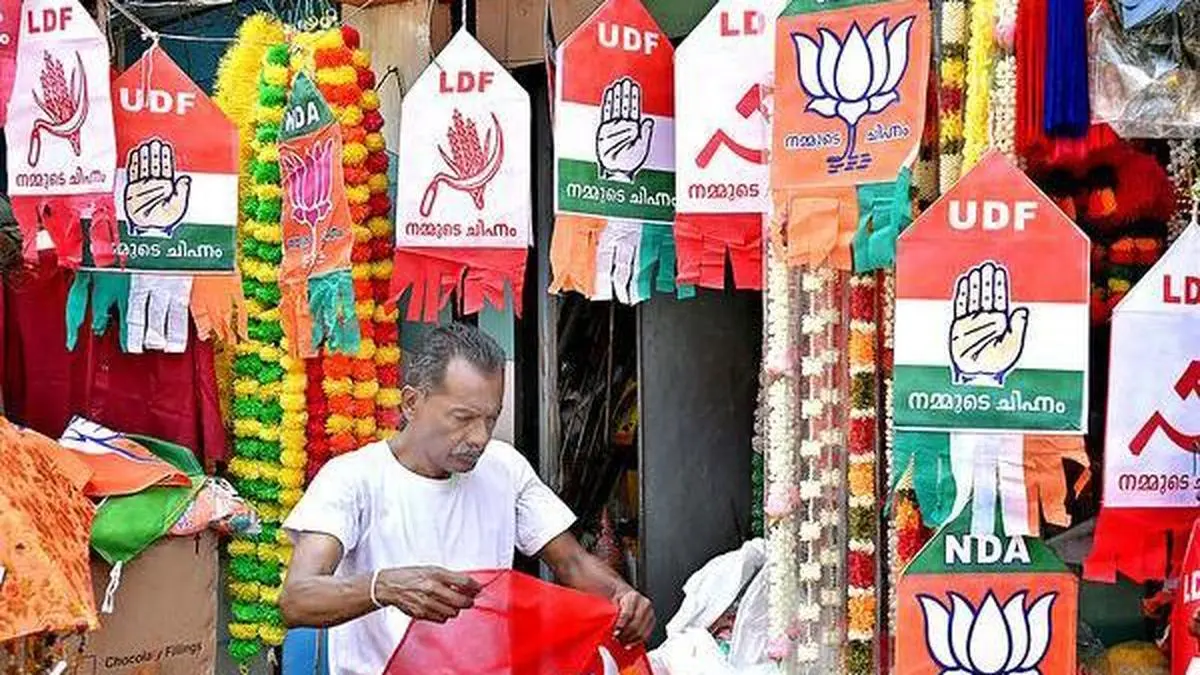
A worker arranging election materials of different political parties at a publicity materials store in Chalai market, Thiruvananthapuram
The Bharatiya Janata Party-led National Democratic Alliance has muscled its way to disrupt the near ritualistic two-front rivalry between the Left Democratic Front (LDF) and the United Democratic Front (UDF) in Kerala. This time, that familiar script faces disruption, with NDA pressing hard to transform the Assembly Elections into a three-cornered contest in the southern State.
Hardly have elections in Kerala promised a contest as competitive as the one now unfolding, with all three fronts striking aggressive postures early in the campaign. The incumbent LDF aims for a historic third consecutive term in what remains its last major bastion, while the Opposition UDF faces a fight to reclaim ground it considers familiar turf. The BJP, meanwhile, hopes to expand its footprint sufficiently to turn the contest triangular, and potentially force a hung Assembly that could allow it to play kingmaker.
The CPM-led LDF has set an ambitious target of winning 110 seats in the 140-member Assembly (it holds 99 in the outgoing House), while the Congress-led UDF is eyeing a tally of over 100 seats (from 41 at present). The BJP-led NDA, whose best showing so far has been one seat each in the Assembly and Lok Sabha, is seeking to push its tally into double digits, a threshold that could significantly alter post-election arithmetic.
The BJP’s attempt to break the LDF-UDF duopoly received a morale boost in the recent municipal polls, where the NDA scored a symbolic breakthrough by capturing the prestigious Thiruvananthapuram Corporation. The victory was significant enough for Prime Minister Narendra Modi to travel to the State to celebrate the win and address a rally, a move widely interpreted as signalling the party’s determination to expand its organisational base in Kerala.
Whether the electorate is ready for such a transition remains uncertain. The unusually short campaign window, among the briefest in the State’s history until polling day on April 9, leaves little time for course correction. Compounding this are logistical setbacks, including the fallout from SIR, which affected several BJP strongholds, including parts of Thiruvananthapuram.
Early campaign turbulence has also taken a toll on the UDF, where prolonged wrangling over candidate selection stretched across four days, costing valuable campaign time. Its rivals watched closely as the Opposition struggled to close ranks. Adding to the campaign uncertainty, a cooking gas shortage across parts of the State has threatened disruption to restaurants and street food vendors, an issue with the potential to influence voter sentiment at the grassroots level.
Signs of strain have surfaced within the ruling LDF as well. Internal dissensions, particularly in traditional strongholds such as Kannur, have dented the image of unity long associated with the Communist Party of India (Marxist). At least 10 senior LDF leaders, including former MLAs and a minister, have switched sides to contest under rival banners, hinting at fractures within the cadre base.
cadre fatigue
Analysts point to growing signs of political wear and possible cadre fatigue as the LDF attempts to secure a third straight term, a feat never before achieved in Kerala’s electoral history. The Congress-led UDF, for its part, continues to grapple with factionalism and leadership tussles that have periodically undermined its campaign momentum.
This evolving churn has created space for the NDA to position itself as a viable third alternative. Local body polls held in December, often viewed as a semi-final ahead of Assembly elections, provided a template for campaign strategies. While the UDF registered strong overall gains, the NDA’s capture of the Thiruvananthapuram Corporation stood out as a politically significant breakthrough, even though its vote share gains remained modest. The LDF, which performed below expectations in these polls, sought to stabilise its position by granting Assembly tickets to as many as 56 sitting MLAs, signalling continuity as a campaign theme.
anti-incumbency pressures
With anti-incumbency pressures, Opposition factionalism and an emboldened BJP seeking to expand its base, Kerala’s electoral landscape appears to be moving beyond its traditional binary. Whether that shift translates into a durable three-front contest, or merely reshapes margins within the existing order, will determine if this election marks a structural turning point in the State’s politics
Published on March 23, 2026







