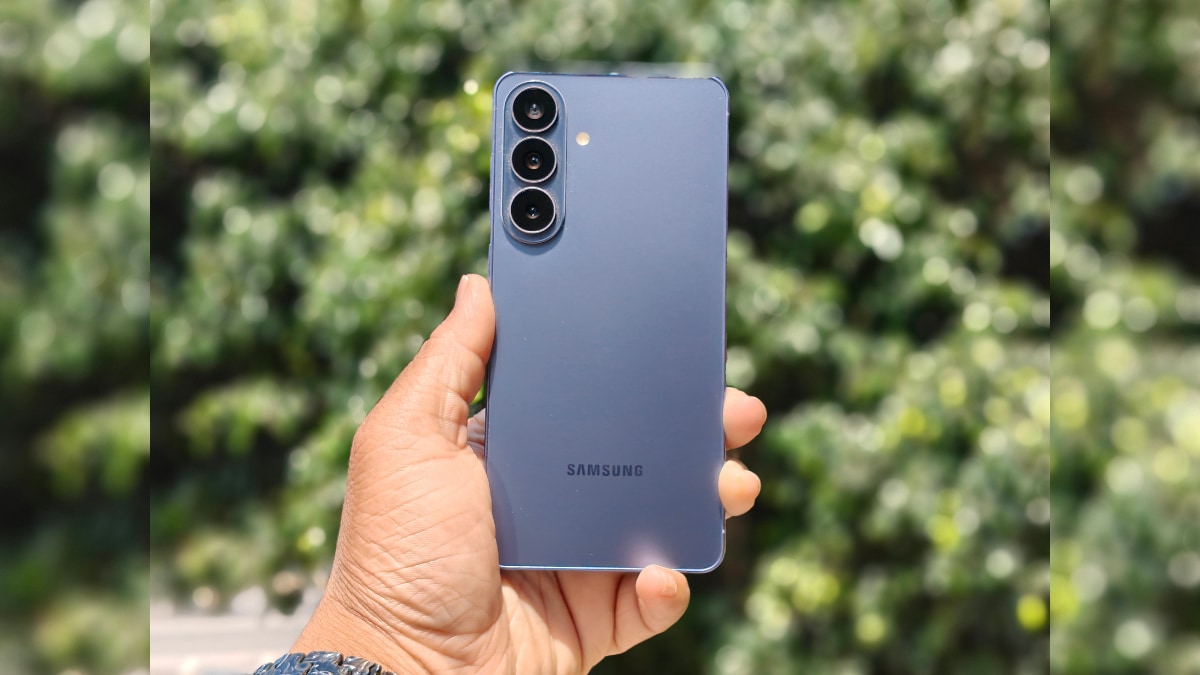
Samsung launched the Galaxy S26 series last month, comprising the Galaxy S26, S26 Plus and S26 Ultra. Within this lineup, the Plus model does not try to replicate the Ultra experience. Instead, it sits as a step up from the standard Galaxy S26, offering a larger display and a bigger battery, while keeping the overall experience familiar.
That positioning makes it a more practical upgrade rather than an ambitious one. But does that translate into a better day-to-day experience, or does it end up feeling like a slightly stretched version of the standard model? I have been using the Galaxy S26 Plus for a while now, and here is what it feels like in regular use.
Design
The Samsung Galaxy S26 Plus largely carries forward the design language of the Galaxy S25 Plus, with one notable change—the camera module. Unlike the previous model, where the sensors sat on the back panel itself, the S26 Plus introduces a raised camera island.
This change brings a couple of practical issues. The raised module tends to collect dust easily, and because the sensors are placed close together, cleaning it is not always straightforward. It also affects usability on flat surfaces. The phone wobbles noticeably when placed on a table, which makes even simple interactions slightly inconvenient.
In terms of dimensions, the device features a 6.7-inch display and measures 158.4mm in length and 75.8mm in width. It is not particularly easy to use with one hand, which is expected at this size. However, the large display works in its favour for media consumption.
The device weighs around 190 grams, which makes it feel slightly on the heavier side, though not unmanageable. The rounded edges help with grip, and despite its size, it remains reasonably comfortable to hold for longer periods.
Display and audio
The Galaxy S26 Plus features a 6.7-inch QHD+ display, which is the same resolution that you get on the Ultra model, while being slightly smaller in size. In everyday use, the panel performs as expected from a flagship Samsung device.
Colours appear vibrant without feeling overly aggressive. Reds and greens stand out, while blacks retain good depth. The display is well-suited for watching content, scrolling through social media, or general use.
Brightness is another strong point. At lower levels, the screen can get dim enough to be slightly difficult to use in very dark environments. On the other end, peak brightness ensures that the display remains readable even under direct sunlight. Outdoor visibility during navigation or general use is not an issue.
The audio output is equally dependable. The stereo speakers get loud enough and maintain clarity across different scenarios. While watching shows or videos, dialogue remains clear without needing headphones. In games such as BGMI, directional audio is good enough to pick up cues like footsteps, which adds to the experience.
Camera
The Samsung Galaxy S26 Plus features a triple-camera setup, including a 50MP main sensor, a 12MP ultra-wide lens, and a 10MP telephoto camera with up to 3x optical zoom.
The main camera performs reliably in daylight conditions. Images come out detailed, with vibrant colours and a decent dynamic range. In low-light scenarios, the output softens slightly, but colour accuracy is largely maintained.
The telephoto lens delivers consistent colour tones, though detail levels are not as strong as some other flagships, such as the OPPO Find X9 Pro, which is priced similarly. It remains usable for everyday zoom shots, but does not stand out.
The ultra-wide camera is less consistent. It tends to lean towards warmer tones and can oversaturate colours in certain lighting conditions, particularly indoors or under artificial light.
Portrait shots are handled well, with good edge detection and subject separation, even around finer elements like hair. The front camera also delivers acceptable results, though a slight warm tint can be noticeable at times, especially during video calls.
For video, the smartphone offers a stable and clear output. Colours remain consistent, and exposure is handled well. It supports 4K recording at 60fps and 8K at 30fps, giving enough flexibility for most users.
Performance
The Galaxy S26 Plus is powered by Samsung’s Exynos 2600 chip, paired with 12GB of RAM and up to 512GB of storage.
In everyday use, performance is smooth. App switching is quick, multitasking works without interruptions, and the overall experience feels responsive. Whether it is browsing, social media, or general usage, the phone handles it without any noticeable lag.
However, thermal management remains a concern.
During lighter tasks like scrolling through Instagram, the device starts to warm up slightly. It is not immediately uncomfortable, but it is noticeable. Under heavier workloads, the issue becomes more prominent.
While playing games like BGMI, the device heats up significantly to a point where it becomes uncomfortable to hold after a while. Interestingly, even casual games resulted in similar levels of heat buildup, which makes the issue harder to ignore. This is not limited to heavy gaming—it appears more broadly during extended usage.
One UI 8.5 and Galaxy AI
The Galaxy S26 Plus runs Android 16-based One UI 8.5, and the software experience is one of its stronger aspects.
The interface feels polished and consistent. Animations are smooth, navigation is fluid, and there are no noticeable rough edges during everyday use. A lot of this comes from how One UI integrates with Galaxy AI features.
The Quick Panel is now fully customisable, allowing users to rearrange toggles and controls based on preference, which adds a layer of flexibility.
Bixby also feels improved this time. It handles context better and responds in a more practical way compared to earlier versions. It no longer feels like a feature you would actively avoid.
Features like Now Nudge add subtle suggestions based on usage. While not essential, they can be useful at times without feeling intrusive.
The AI-powered image editing tools are also worth noting. Features like “describe to edit” can deliver surprisingly accurate results. In one instance, replacing a lettuce leaf with a slice of a tomato in an image of a burger worked cleanly without obvious artefacts. However, this consistency is not guaranteed across all scenarios.
Battery
The Galaxy S26 Plus packs a 4,900mAh battery, which remains unchanged from its predecessor.
With moderate usage, the device delivers around 12 to 14 hours of battery life. With lighter usage, it can stretch beyond a full day.
Charging speeds are also similar to before. A full charge takes about an hour, while a quick 15-minute charge can add roughly 20–25 per cent. It is reliable, but not particularly fast compared to some competitors.
Verdict
-
Price: Rs 119,999 onwards
However, it falls short in areas that matter for long-term usability. The heating issues during both light and heavy usage are difficult to overlook. The redesigned camera module also introduces practical inconveniences, from wobble to dust accumulation.
This is a phone that works well for general use and media consumption, but it is not ideal for users who prioritise sustained performance, especially in gaming. It remains a well-rounded flagship, but some rough edges are hard to ignore.
Samsung Galaxy S26 Plus: Unboxing







