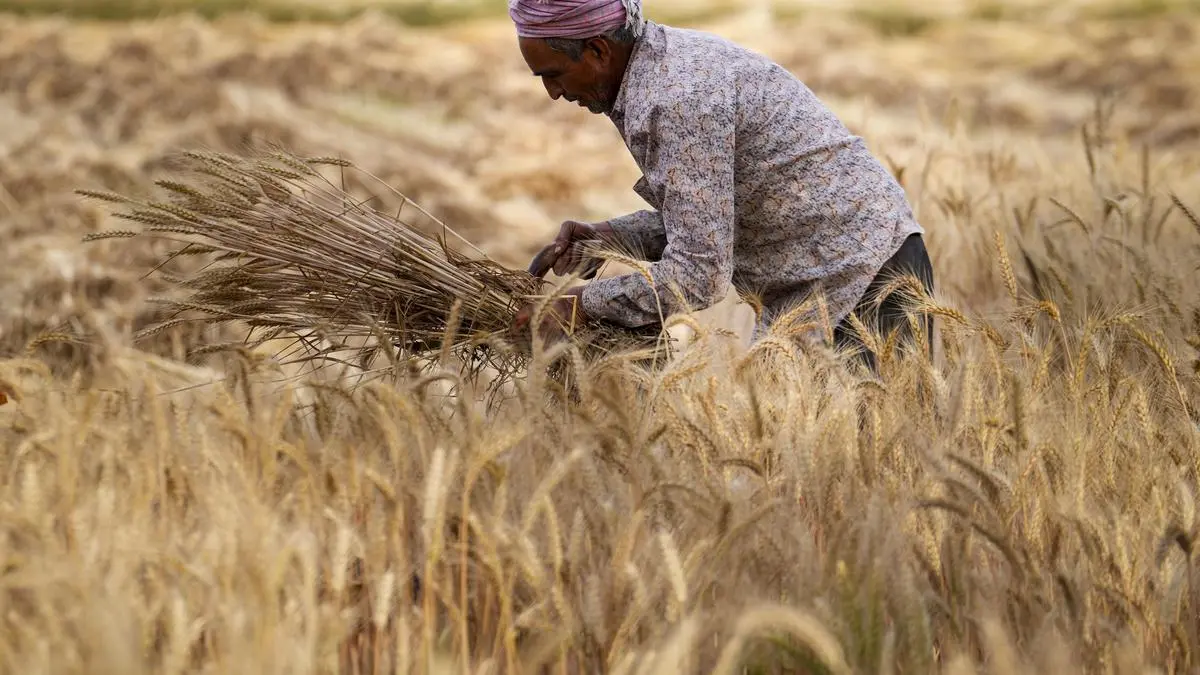
A worker carries harvested wheat crop at a farm, in Loharu, Haryana
| Photo Credit:
PTI/KAMAL KISHORE
The Indian government has started wheat procurement in the new season from Wednesday, with 17,883 tonnes of the grain being bought for buffer stocks. This comes after the government permitted early purchase of the grain in some States. As the target is to buy 30.336 million tonnes (mt) by June 30, the market prices and weather will be crucial two factors to decide if it can be met.
According to latest official data, the Centre has bought 17,818 tonnes of wheat from Rajasthan as on March 31, where purchases were scheduled for the period between March 10 and June 30. In the year-ago period, Rajasthan had contributed 38,379 tonnes to the Central Pool.
However, the procurement which was allowed also in Madhya Pradesh from March 15 and in Uttar Pradesh from March 17 and in Gujarat from March 4, only 65 tonnes were bought from Uttar Pradesh — 59 tonnes from west UP and 6 tonnes from east UP.
Target similar to last season’s buy
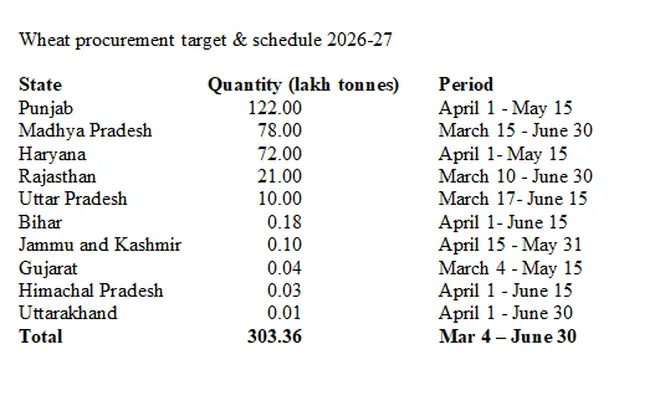
The government has set a target to buy 12.2 mt of wheat from Punjab, 7.8 mt from Madhya Pradesh, 7.2 mt from Haryana, 2.1 mt from Rajasthan, one mt from Uttar Pradesh, 18,000 tonnes from Bihar, 10,000 tonnes from Jammu and Kashmir, 4,000 tonnes from Gujarat, 3,000 tonnes from Himachal Pradesh, and 1,000 tonnes from Uttarakhand .
In 2025-26 marketing season (April-June), the Centre had procured a total of 30.035 mt of wheat, which included 11.928 mt from Punjab, 7.774 mt from Madhya Pradesh, 7.143 mt from Haryana, 2.137 mt from Rajasthan, 1.027 mt from Uttar Pradesh, 18,000 tonnes from Bihar, 4,000 tonnes from Gujarat, 3,000 tonnes from Himachal Pradesh, and 1,000 tonnes from Uttarakhand.
“For the first time, the procurement target has been fixed as per the actual quantity bought by the government, which shows the policy shift from an open-ended purchase to as per requirement and storage space available. However, this may be an exceptional year and its continuity is uncertain as any price drop will put pressure on the government to buy whatever quantity farmers bring in,” said a former top official of FCI.
Bearish demand
He said currently, market prices are low, the government is yet to set up procurement centres at all places as harvesting is yet to start in many places. The demand from stockists and traders are currently bearish after they lost money last year by buying at higher rates and it may change depending on the crop production and its quality after damage from rainfall, hailstorm and higher temperature in some pockets, he said.
Against the minimum support price of ₹2,585 per quintal, the all India average price at agriculture market yards (mandis) was ₹2,379/quintal and in Madhya Pradesh ₹2,295/quintal, in Rajasthan ₹2,502/quintal, in Gujarat ₹2,637/quintal and in Uttar Pradesh ₹2,348/quintal on March 30, according to Agmarknet portal.
The Food Ministry has asked procurement agencies to ensure that the arrangements of allotment of mandis, posting of staff, availability of gunnies, sufficient moisture meters, weighment equipment, analysis kit, deputing squads, setting up of Control Rooms, lifting/quick movement of wheat and its safe storage, monitoring of day to day progress, timely payment to the farmers, availability of storage space, procurement as per specifications are put in place in advance, before the commencement of procurement.
Moisture meters
“Concerted efforts should be made for achieving the targets and responsibility for achieving the targets may be assigned upto the level of other Divisional Managers and field officials,” the Food Ministry said.
“The moisture meters (for Moisture determination) with printer facility duly calibrated with Hot air oven method available with Regions shall be put to use effectively in the procurement operations. A copy of print out, shall be pasted in the moisture register, systematically. Relevant instructions issued by QC Division relating to usage of moisture Meter with printing facility circulated to all regions/zones must be followed scrupulously,” it said.
Published on April 1, 2026







