Nothing has always walked a slightly unusual line. On one hand, it wants to stand out with transparent backs, blinking lights, and software that feels like it belongs in a design studio more than a specification sheet. On the other hand, it has been quietly trying to prove that it can also make genuinely good smartphones, not just interesting ones.
The “a” series has always been where those two ideas meet. It takes the personality of Nothing’s flagship phones and tries to make it more practical, more accessible, and more usable for everyday users.
Having used a bunch of Nothing phones in the past, including last year’s Phone 3a series devices, flagship Phone 3 and the newer Phone 4a, the new Nothing Phone 4a Pro feels like a shift in approach.
This is not just a more powerful version of the Phone 4a. It feels like Nothing is trying to grow up a little, without completely letting go of what made it different in the first place.
What the Nothing Phone 4a Pro feels like
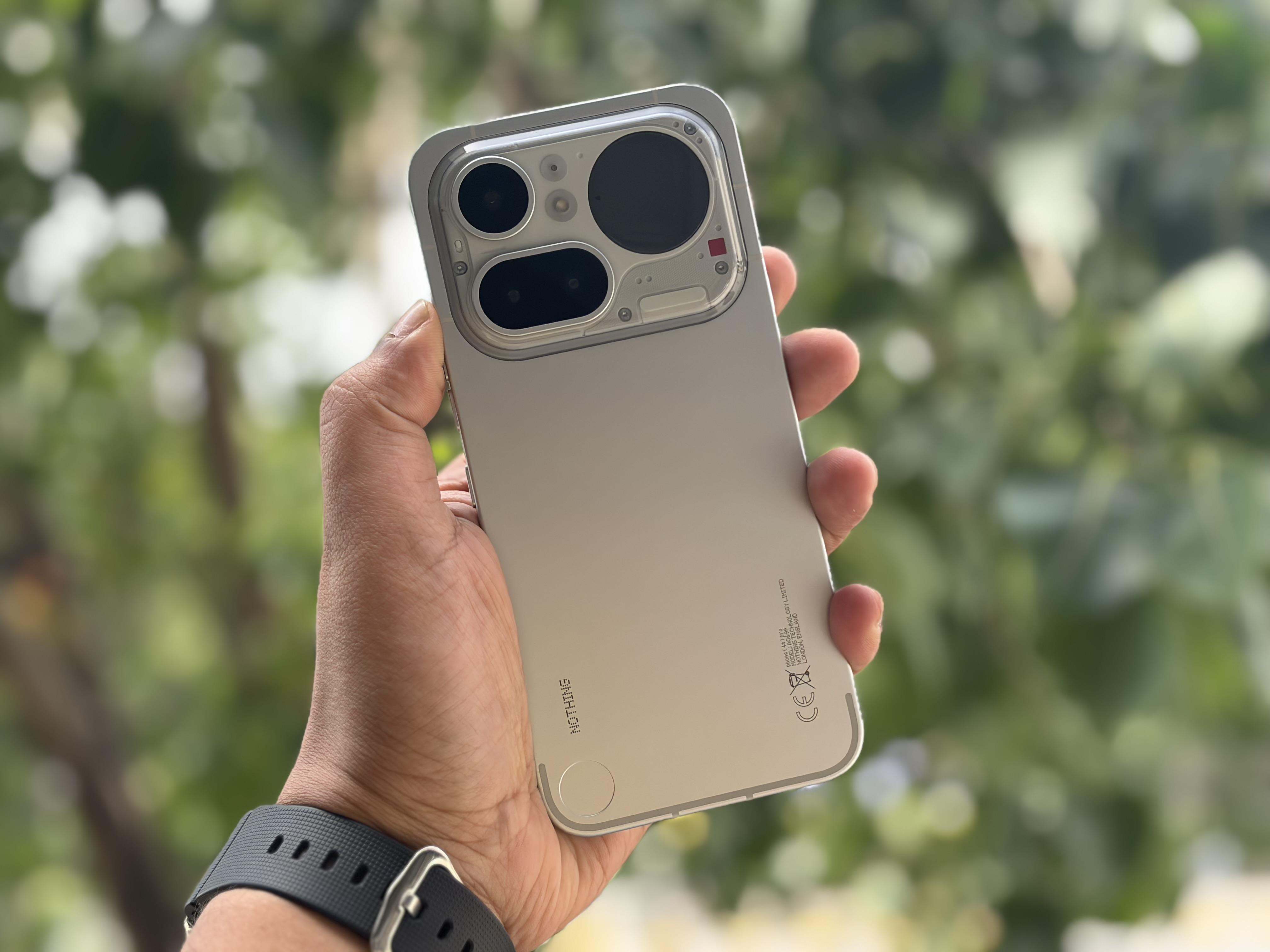
For the first time, Nothing goes with a full aluminium unibody. The moment you pick it up, it feels different. More solid, more conventional, and in some ways, more “serious” than previous Nothing phones.
But then you turn it around, and it is still very much a Nothing phone.
The back is dominated by a wide camera plateau that stretches across the top, housing the cameras and the Glyph Matrix display. There is still a hint of transparency here — exposed screws, layered elements, and that small red recording light — just enough to retain that industrial, slightly geeky aesthetic.
The Glyph Matrix on the Phone 4a Pro works a bit differently than it did on the Nothing Phone 3. While it looks larger and more readable, it features fewer LEDs and does not have a dedicated control button for switching functionalities. It can show timers, notifications, volume levels, and even small visual cues that reduce the need to constantly flip the phone, but there are fewer Glyph Toys to play around with.
In hand, this is easily the most premium-feeling “a” series phone so far. The weight is noticeable, but well-balanced. It does not feel awkward to use, even with one hand, and the wider camera plateau helps reduce the usual wobble when placed on a table.
That said, there are small inconsistencies. The thin plastic border around the display slightly takes away from the otherwise premium feel, especially when you compare it to the flush finish on the Nothing Phone 3.
The design is also… divisive.
It still looks unique; there is no doubt about that. But it does feel like Nothing is dialling down its earlier transparency-heavy identity in favour of something more mainstream. It is less flashy, more controlled. Whether that is a good thing depends on what you expect from a Nothing phone.
On the front, things are more straightforward. The large AMOLED display is sharp, bright, and extremely smooth thanks to the higher refresh rate. Scrolling feels effortless, touch response is quick, and outdoor visibility is strong enough for comfortable use.
What is the experience like
Powered by the Snapdragon 7 Gen 4, Phone 4a Pro is not chasing benchmark numbers, but in everyday use, that does not really matter. Apps open quickly, multitasking feels smooth, and the phone handles regular usage without any friction. Even during extended use, it manages to stay consistent with no random slowdowns or stutters.
Gaming performance is decent, but clearly not the focus. It can handle titles like BGMI without much trouble, but longer sessions do bring some heat and minor drops in consistency. It is capable, just not built for sustained heavy loads.
The software continues to be one of the strongest parts of the experience.
Nothing OS remains clean, minimal, and visually cohesive. The monochrome design, subtle animations, and lack of unnecessary clutter make it feel lighter than most Android skins.
The Essential Space and Essential Key remain for organising things — screenshots, notes, voice recordings — and make them easier to access later.
Alongside this, the Essential apps layer continues to add a bit of personality to the experience. Similar to the Phone 4a, you can access and use widgets created by others directly on your home screen. Some of them are genuinely useful, like a sticky note widget that lets you quickly jot things down without opening an app, while others lean more towards experimentation — from system monitors to retro-style clocks. There are even a few that exist purely for the nostalgia factor.
They do not fundamentally change how you use the phone, but they add a layer of customisation and character that fits well with Nothing’s overall approach.
The camera is where things get a bit more complicated.
The main camera delivers good results in daylight. Colours look natural, dynamic range is controlled, and images feel more consistent compared to Nothing Phone 3a series devices. Meanwhile, the telephoto camera now offers 3.5x optical quality zoom shots and also makes portraits look better.
But the consistency is not always perfect. There are moments where colour tuning feels slightly off, or where detail processing becomes a bit aggressive. The ultra-wide camera still feels like the weakest link, especially when compared to the main sensor.
Low-light performance is improved, but not class-leading. It handles scenes realistically without over-brightening them, which is good, but you do lose some sharpness in the process.
Overall, it is a better camera system than before, just not one that completely stands out in this segment.
Battery life is quietly reliable. The 5,080mAh battery comfortably lasts a full day with regular use. It is not trying to break records, but it does what it needs to without creating anxiety.
Should you buy it?
The Nothing Phone 4a Pro feels like a step forward, but also a slight shift in identity.
It is more premium, more refined, and more balanced than previous “a” series phones. The design feels sturdier, the performance is more consistent, the cameras are slightly better, and the overall experience is more complete.
At the same time, it feels a little less bold. The transparency is toned down, the quirks are more controlled, and the phone feels closer to mainstream flagships than earlier Nothing devices did.
That is not necessarily a bad thing.
If you want a phone that still looks different but behaves more predictably, the Phone 4a Pro makes a strong case. It is easily one of the most well-rounded devices Nothing has made in this segment.







