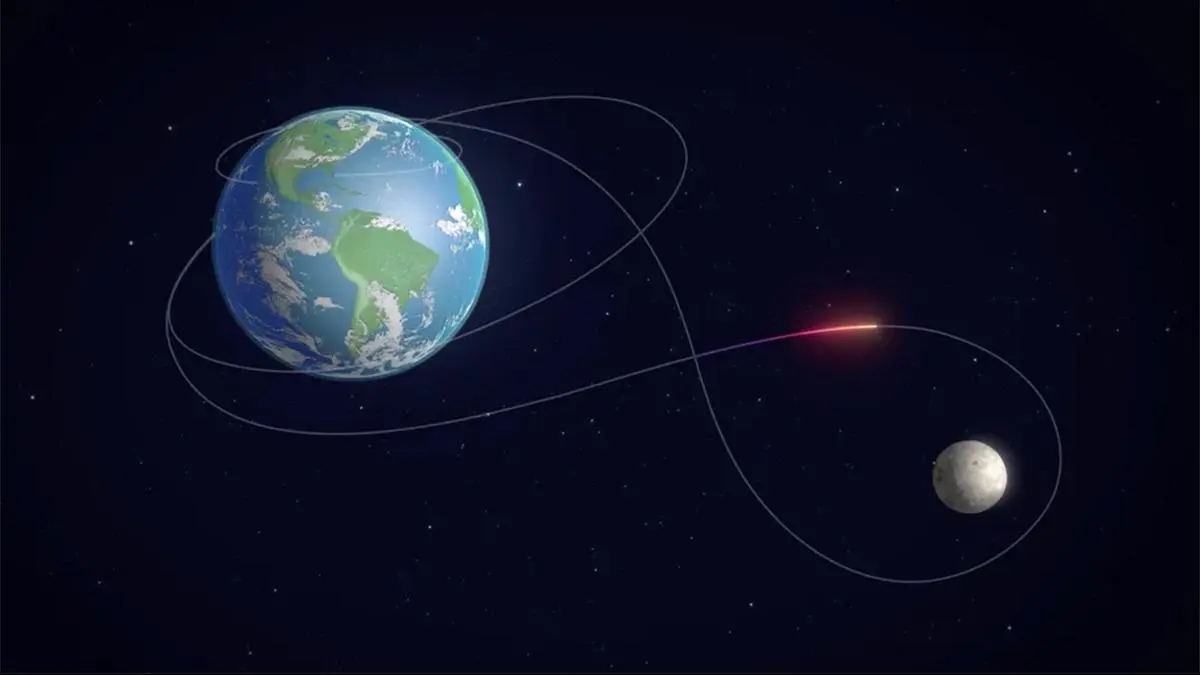
The Artemis 2 mission will fly a figure-eight pattern that will take the crew around the Earth and then around the moon
| Photo Credit:
NASA/JSC/Goddard
As you are reading this, three Americans (including a woman) and a Canadian are hurtling moon-ward on an epochal mission, whose success will ginger up global deep-space activities.
Apollo, after whom the moon missions between 1969 and 1972 were named, was the son of Zeus, the mythical Greek king of gods, and Leto.
More than half a century after the last Apollo mission, it is the turn of twin sister, Artemis, to lend her name to a moon mission.
Artemis-2 is truly wow. Since the Orion capsule — the temporary residence of the four astronauts — will circle the moon without entering the moon’s orbit, the team will go farther than any human ever has — close to 4,00,000 km from the Earth to the moon, and nearly 4,000 km beyond the far side of the moon — slightly exceeding the record set by Apollo 13.
Like Apollo 8, which took humans around the moon for the first time ever, Artemis-2 will fly by the moon during its 10-day mission.
Along the way, it will have to brave many demons such as van belt radiation, unexpected solar storms and galactic cosmic rays, and guard against even the tiniest of errors in navigation that could lead it astray.
And its return to the earth’s atmosphere will be anything but easy — zipping in from that distance, the speed at re-entry will be far more than in a low-earth orbit mission, calling for ultra-advanced heat shields.
The success of Artemis-2 will mean that humans will walk again on the moon soon.
More Like This


Published on April 6, 2026







