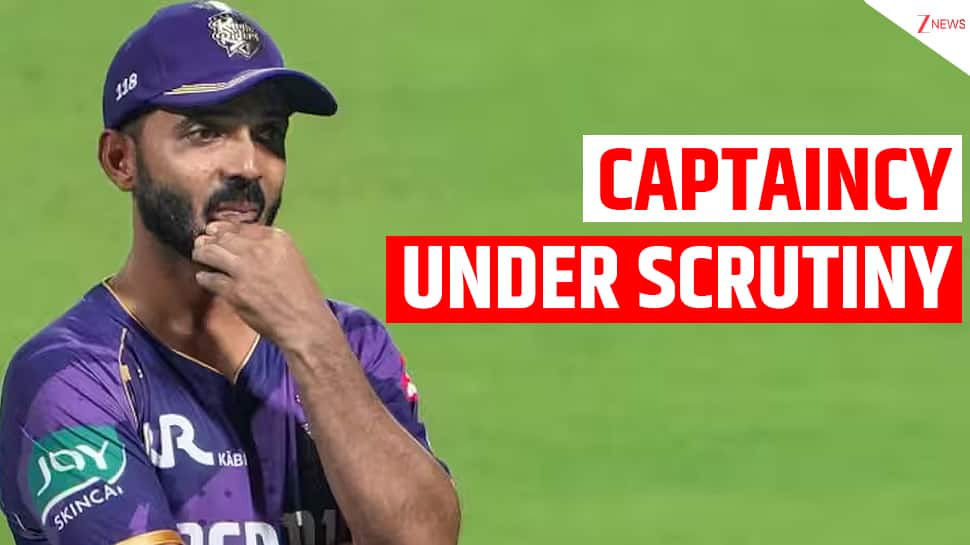
Ajinkya Rahane finds himself at the centre of a familiar IPL storm. Kolkata Knight Riders are winless after five games in IPL 2026, rooted to the bottom of the table, and the captain is inevitably the first name under the scanner. The question, however, is not just whether Rahane should step down, but whether that move would actually fix what is clearly a multi-layered problem.
There is no escaping the numbers. Rahane’s IPL captaincy record, hovering around a 32 percent win rate, is among the weakest for captains with sustained opportunities. His stint with Rajasthan Royals had flashes of promise but ultimately fizzled out, and his time at KKR has so far followed a similar arc. Results matter in a league as unforgiving as the IPL, and right now, KKR are not just losing, they are drifting.
The defeats this season have exposed deeper tactical inconsistencies. Against Mumbai Indians, they failed to defend a massive total. Against Sunrisers Hyderabad, the chase fell apart under pressure. Close contests against Lucknow Super Giants and Chennai Super Kings slipped due to questionable decision-making at key moments. These are not isolated errors. They point to a lack of clarity in planning and execution, something that inevitably reflects on leadership.
Yet, to reduce KKR’s struggles purely to Rahane’s captaincy would be a simplistic reading of a complex situation. One of the striking aspects of this season has been Rahane’s own batting. He has looked assured, composed, and at times the only stabilising presence in an otherwise inconsistent top order. Removing captaincy from a player who is contributing with the bat carries its own risks, especially in a fragile dressing room.
It is also important to understand how modern IPL teams function. Decisions are rarely made in isolation. Coaches, analysts, and support staff play a significant role in shaping strategy. Figures like Abhishek Nayar are deeply involved in match planning and tactical calls. When a team repeatedly gets its combinations wrong or struggles with role clarity, it reflects a collective failure rather than that of a single individual.
Then there is the question of alternatives. Rinku Singh is often mentioned as a future captain, and rightly so given his temperament and match-winning ability. But leadership in the IPL is as much about tactical maturity as it is about temperament. Rinku is still finding his rhythm this season. Handing him the captaincy mid-crisis could burden him unnecessarily and disrupt his primary role as a finisher.
KKR’s larger issues are structural. Their high-profile signings have not delivered consistently, their Indian pace resources have been hit by injuries, and even their trusted spin department, led by Varun Chakravarthy, has lacked its usual bite. There has also been visible confusion around batting roles, with constant shuffling preventing any settled combination from emerging. These are not problems that a captaincy change alone can solve overnight.
Historically, mid-season captaincy changes in the IPL tend to be reactive rather than transformative. Teams that succeed usually do so with clarity of roles and a settled leadership group. KKR, in contrast, appear to be searching for answers on the go. Removing Rahane now might offer a short-term emotional release, but it risks adding another layer of instability to an already unsettled campaign.
From an experienced cricketing lens, the more pragmatic approach would be to persist with Rahane for the remainder of the season while quietly preparing for a transition. Strengthening the leadership core, involving senior players more actively in decision-making, and giving defined roles to key individuals could yield better results than a sudden leadership overhaul.
The debate around Rahane’s captaincy is valid and, given the results, inevitable. But the answer is not as straightforward as replacing one name with another. KKR’s decline this season is a reminder that in T20 cricket, leadership is only as strong as the system around it. Fix the system, and the captain often looks better. Ignore it, and no captain will look good enough.







