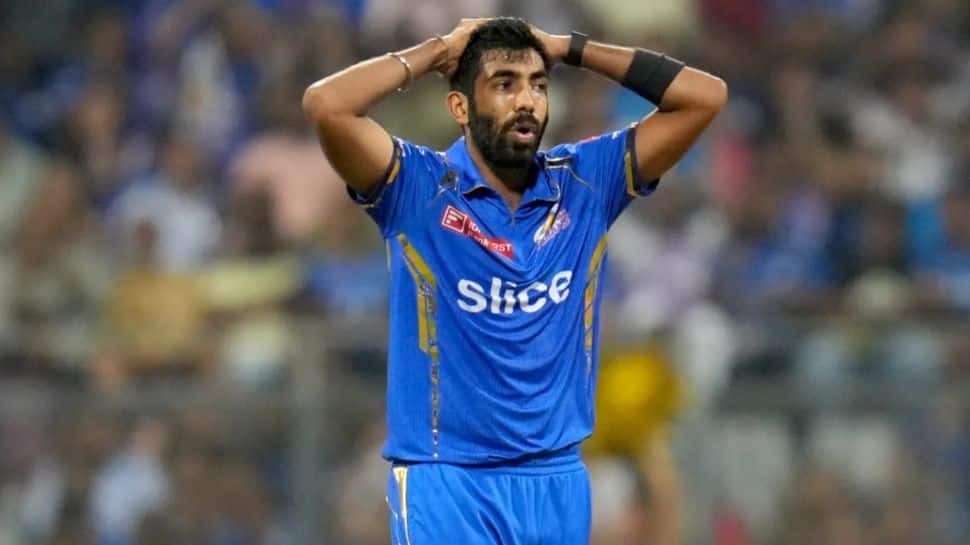
Jasprit Bumrah’s wicketless run in IPL 2026 is not a sudden collapse but a combination of tactical drift, workload management, and how teams are now playing him. Across his first five matches for Mumbai Indians, Bumrah has gone without a single wicket, something unprecedented in his IPL career. More importantly, batters are no longer looking to dominate him, they are simply neutralising him. That shift alone explains a large part of this downturn. From years of observing elite fast bowlers, this phase looks less like decline and more like a recalibration gone slightly off track.
The Biggest Red Flag: Overuse of Variations
The most glaring issue is Bumrah’s current bowling mix. Former India cricketer Irfan Pathan pointed out that nearly 40 to 45 percent of his deliveries this season have been slower balls. That is unusually high for a bowler whose biggest weapon has always been pace deception rather than pure variation.
Bumrah at his peak thrived on contrast. A 140+ kmph yorker followed by a disguised slower ball made him unplayable. Now, with his average speed hovering closer to 130 kmph, that contrast has diminished. The slower ball is no longer a surprise. It is expected.
For a batter at this level, predictability is everything. Once they sense a pattern, even the best bowlers start to look ordinary.
Batters Are Playing Him Differently — And Winning
This is where the tactical battle has tilted. Earlier, teams feared Bumrah. Now, they are respecting him, but in a calculated way.
Instead of attacking him, batters are doing three things:
- They are seeing off his spell
- They are avoiding high-risk shots
- They are targeting other bowlers
This approach has effectively removed Bumrah from the game as a wicket-taking threat. In T20 cricket, if you are not taking wickets, you are not dictating terms.
It is a subtle but critical shift. Bumrah hasn’t necessarily bowled poorly in every game, but he hasn’t forced mistakes either.
Lack of Pressure From the Other End
Mahela Jayawardene made an important point recently. Bumrah’s effectiveness has always been tied to pressure from the other end.
Right now, Mumbai Indians are not picking early wickets consistently. That allows opposition teams to play Bumrah safely because there is no scoreboard or psychological pressure forcing risky shots.
In his peak IPL seasons, Bumrah often came on when wickets had already fallen. Batters had to take chances. Today, they don’t.
That changes everything.
Workload Management and Subtle Fitness Impact
Bumrah’s recent history cannot be ignored. His time at the BCCI Centre of Excellence was focused on managing recurring back concerns, something that has troubled him over the past few years.
Fast bowling is rhythm-dependent. Even a slight drop in intensity or confidence in the body can affect:
- Run-up speed
- Release point
- Seam position
- Execution under pressure
What we are seeing right now is not a breakdown, but a bowler operating at 85 to 90 percent of his peak. At this level, that small drop is enough to lose the edge.
Former India cricketer Mohammad Kaif has already flagged long-term concerns about workload and longevity. While that may be premature, it does highlight how finely balanced Bumrah’s body has to be managed.
Tactical Misuse by Mumbai Indians
There is also a strategic dimension that cannot be ignored. Under Hardik Pandya, Bumrah’s usage has lacked consistency.
He has been rotated between:
- Powerplay overs
- Middle overs containment
- Death overs control
While versatility is a strength, great bowlers also need defined roles. Bumrah, at his best, is a strike bowler. This season, he has often been used as a defensive option to control runs rather than break partnerships.
That shift in intent is visible in his lengths and aggression levels.
The Numbers Tell a Story — But Not the Full One
His IPL 2026 figures so far:
- 0 wickets in 5 matches
- 164 runs conceded
- 19 overs bowled
- Economy rate around 8.6
On paper, the economy is not disastrous. But for a bowler of Bumrah’s calibre, wickets are the real currency. That column reading zero is what makes this phase stand out.
Why This Isn’t Panic Territory Yet
Having tracked Bumrah since his early IPL years, one thing is clear. He is a rhythm bowler. When he finds it, the turnaround is often sudden.
We have seen this pattern before in shorter dips:
- A minor tweak in release point
- A slight increase in pace
- A shift in field setting
And suddenly, he goes from wicketless to unplayable within a week.
There is no technical flaw here that looks irreversible. The issues are tactical and situational, which are far easier to correct.
How Bumrah Can Turn This Around
The path back is straightforward, though execution will be key.
He needs to bowl quicker, not necessarily at full throttle, but enough to restore the pace differential that makes his variations lethal.
He must reduce his slower ball usage and go back to attacking lengths, especially with the new ball.
Mumbai Indians need to use him as a strike weapon, not just a defensive shield.
And crucially, the team needs wickets at the other end. Without that, even the best bowler becomes predictable.
The Bigger Picture: A Phase, Not a Fall
Every fast bowler, no matter how great, goes through a phase like this. For Bumrah, this is happening under the IPL spotlight, which amplifies everything.
But the fundamentals remain intact:
- His action is still repeatable
- His control is still elite
- His game awareness is still among the best
What has dipped is impact, not ability. And in cricket, that is often the easiest thing to regain.







