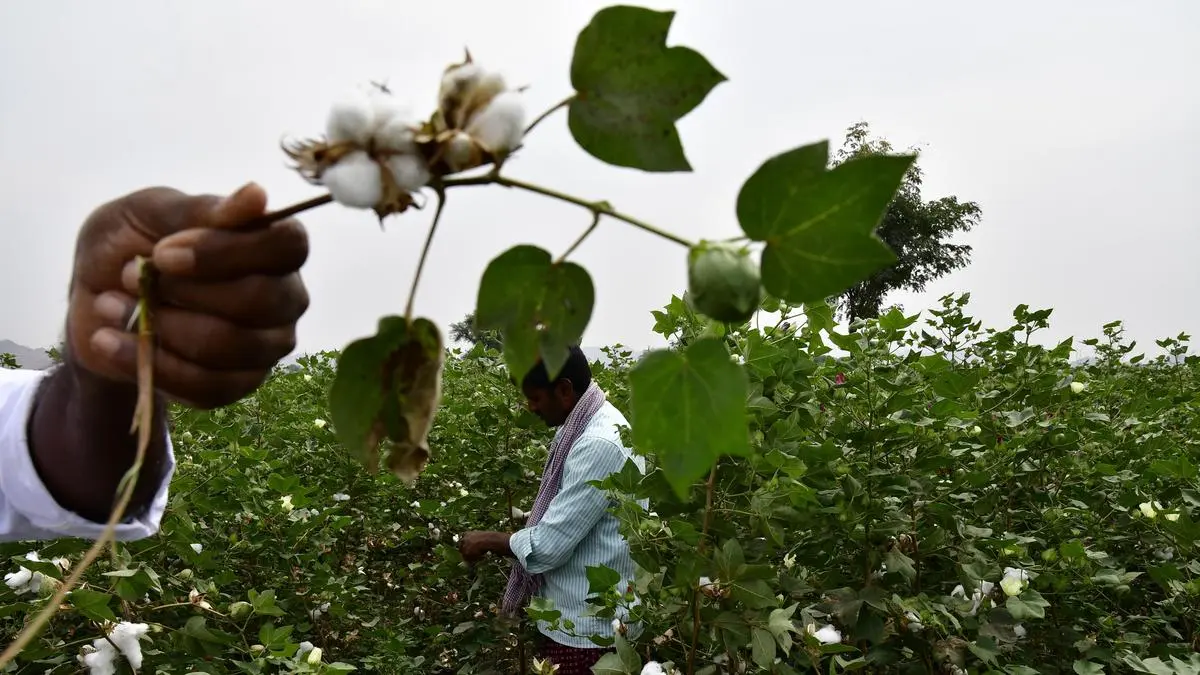
The MRP was introduced in 2016 and the need for it was felt after farmers were sold Bt cottonseeds at much higher rates.
| Photo Credit:
MURALI KUMAR K
The Union Agriculture Ministry has not changed the maximum retail price (MRP) of Bt cottonseed price for Bolgard I and II varieties for the upcoming kharif season, keeping those same as in 2025-26.
Last year, the government fixed the MRP of Bolgard II at ₹900/packet (of 450 gram), up from ₹864/packet in 2024-25. The MRP of Bolgard I remains at ₹635/packet since price control of Bt cotton seed was introduced in 2016.
In a late night gazette notification on April 23, the agriculture ministry said that after taking into consideration the recommendations made by the concerned ‘Committee’, the maximum sale price of Bacillus thuringiensis (Bt) cotton seeds for a packet (475 grams Refugia-in-Bag seeds containing minimum 5 per cent and maximum 10 per cent non-Bt Cotton) shall be same as notified on March 27, 2025 for the financial year 2026-27.
businessline had reported last month that taking a cue from past instances, there might not be an increase in the maximum retail price this year.
There was a precedence in 2019-20 when the MRP of Bolgard II was kept unchanged at ₹710/packe. Since the last year’s MRP saw a hike of over 4 per cent compared with only 1 per cent hike in 2024-25, non-increase in price may not impact the industry much. But the seed industry was said to have requested for a proportionate hike as per general inflation, sources said.
The government held stakeholders meeting on the issue of Bt cotton MRP in March as it is a legal obligation under the Cotton Seeds Price (Control) Order, 2015 to notify the MRP each year whether there is an increase or not.
The RSS affiliate Bharatiya Kisan Sangh had opposed fixing MRP for Bt cotton, saying due to the price fixation of Bt cotton seeds the non-GM cotton is getting sold at very low rates of ₹300-400/packet. It said that since the pest resistance capacity to Pink Bollworm (PBW) of Bt cotton is questionable, there was no need to declare price for Bt cotton.
The MRP was introduced in 2016 and the need for it was felt after farmers were sold Bt cottonseeds at much higher rates. Official sources said that if prices were not fixed, farmers might again be charged higher and this Order is the maximum cap and not a floor price.
Pesticide use
In a written reply in the Lok Sabha in February, Union Minister of State for Agriculture Ramnath Thakur said that about 95 per cent area under cotton cultivation is occupied by Bt cotton.
However, he also said that PBW has developed resistance against Bt protein and is becoming a major pest in all cotton-growing areas. At the same time the minister admitted that Bt cotton has continued to control one major cotton pest [American bollworm (Helicoverpa armigera)].
Sucking pests are also surging in the cotton ecosystem over the years, he said adding farmers now spend more on pesticides than during initial period of Bt-cotton introduction.
Bt-cotton adoption is shown to be a poor indicator of yield trends, he said and added that it was a strong indicator of initial reductions in pesticide use.
Published on April 24, 2026







