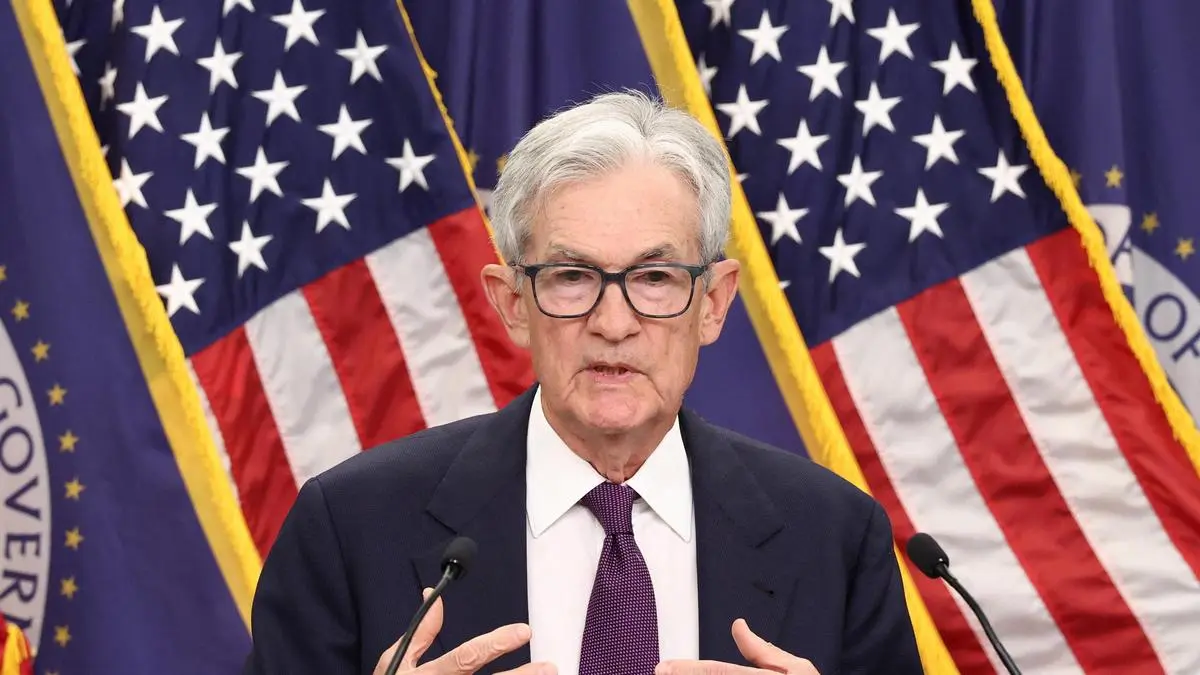
U.S. Federal Reserve Chair Jerome Powell speaks during a press conference following a two-day meeting of the Federal Open Market Committee (FOMC), at the U.S. Federal Reserve in Washington, D.C., U.S., April 29, 2026.
| Photo Credit:
KEVIN LAMARQUE
Jerome Powell said he plans to remain on the board of the Federal Reserve after his term as chair ends next month “for an undetermined period of time,” citing the “unprecedented” legal attacks against the central bank by the Trump administration.
“I worry these attacks are battering this institution and putting at risk the things that really matter to the public,” Powell said at a press conference after the Fed announced its decision to keep its benchmark interest rate steady.
Move blocks Trump from filling key Fed board seat
Powell’s decision to stay denies President Donald Trump a chance to fill a seat on the central bank’s seven-member governing board with his own appointee. The Senate Banking Committee earlier approved Powell’s successor as chair, Trump appointee Kevin Warsh, on a party-line vote. Powell would continue as a Fed governor, possibly until January 2028.
Probe into Fed renovations remains unresolved
U.S. Attorney for the District of Columbia Jeanine Pirro said on X Friday that her office was ending its probe into the Fed’s extensive building renovations because the Fed’s inspector general would scrutinize them instead. But she added that her office could reopen the investigation if “the facts warrant doing so.” Apparently that didn’t bring Powell the closure he felt is needed.
“I’m waiting for the investigation to be well and truly over with finality and transparency,” he said. “I’m waiting for that and i will leave when i think it appropriate to do so.”
Fed holds rates steady amid internal divisions
The Fed Wednesday left its benchmark interest rate unchanged for the third straight meeting but signaled it could still cut rates in the coming months, moves that attracted the most dissents since October 1992. Three officials dissented in favor of removing the reference to a future cut, while a fourth, Stephen Miran, dissented in favor of an immediate rate cut.
The dissents underscore the level of division on the Fed’s 12-member rate-setting committee ahead of the end of Powell’s term as chair on May 15.
Global uncertainties and inflation concerns persist
“Developments in the Middle East are contributing to a high level of uncertainty about the economic outlook,” the Fed said in a statement after its two-day meeting. “Inflation is elevated, in part reflecting the recent increase in global energy prices.”
Warsh eyes sweeping changes, but faces inflation hurdle
Warsh has promised “regime change” at the central bank and may make sweeping changes to its economic models, communications strategies, and balance sheet. He has argued in favor of rate cuts, as Trump has demanded, but he will likely find it harder to implement the rate cut s with inflation topping 3%, above the Fed’s target of 2%.
Dissenting voices highlight policy split
The three officials who dissented against hinting that the Fed may reduce borrowing costs were Beth Hammack, president of the Federal Reserve Bank of Cleveland; Neel Kashkari, president of the Minneapolis Fed; and Lorie Logan, president of the Dallas Fed. Miran was appointed to the Fed’s Washington board by Trump last September. The regional Fed bank presidents have historically been more likely to dissent, while the Washington-based governors more often support the chair.
The dissents could renew tension between the Trump administration and the bank presidents, who White House officials have previously criticized.
‘Two Popes’ scenario may deepen tensions
Powell’s decision to stay on could worsen tensions with the Trump administration and would create what some analysts refer to as a “two Popes” scenario, with a chair and former chair both on the Fed’s board. In that case, divisions among policymakers could increase, if some decided to follow Powell’s lead rather than Warsh’s.
Powell dismissed the notion that his staying on could cause dissension, saying, “My intention is not to interfere.”
Murky economic outlook complicates Fed’s path
The unusual situation comes while the economy remains unusually murky, putting the Fed in a difficult spot. Inflation has jumped to 3.3%, a two-year high, as the war has sharply raised gas prices. That makes it harder for the central bank to reduce rates. The Fed typically leaves rates unchanged, or even raises them, if inflation is worsening.
At the same time, hiring has ground almost to a halt, leaving those without jobs frustrated by the difficulty of finding new ones. Typically, the Fed cuts rates when the job market is weak, to spur more spending and job gains.
But layoffs also remain low, as employers appear to be following a “ low-hire, low-fire ” strategy. Many Fed officials have suggested that as long as the unemployment rate is low, the central bank doesn’t need to cut rates to spur more spending and hiring. Unemployment declined to 4.3% in March, from 4.4%.
Published on April 30, 2026







