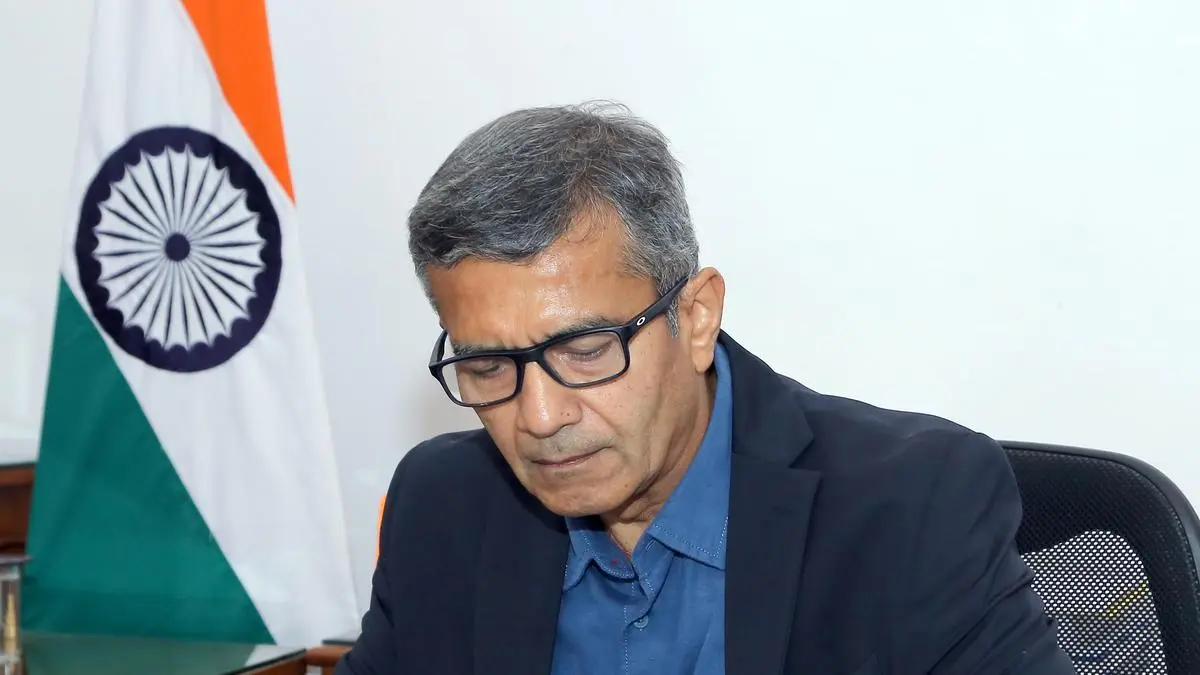
Defence Secretary Rajesh Kumar Singh
Defence Secretary Rajesh Kumar Singh on Thursday said the procurement process for India’s Advanced Medium Combat Aircraft (AMCA) is progressing, with a Request for Proposal (RFP) likely to be issued soon to shortlisted private sector players, marking a significant push towards indigenous fighter jet production.Speaking at the ANI National Security Summit 2.0 in the national capital, Singh highlighted that the fifth-generation AMCA programme is moving ahead and is expected to gather pace once the tender is floated.”The procurement process is on, the RFP hopefully will be released soon to the shortlisted bidders who happen to be from the private sector and hopefully that will then pick up pace,” he said.
India explores sixth-gen fighter collaboration
On future combat aviation plans, the Defence Secretary indicated that India is also exploring partnerships for developing sixth-generation fighter aircraft, given the scale of investment required. He noted that the government has reached out to two ongoing international three-country programmes and expressed willingness to collaborate.”We’ve made it clear… that we are interested and we could consider partnering them for a sixth generation fighter program. Let’s see what the response is,” Singh said.
Defence strategy: competition and production redundancy
Addressing concerns over the absence of Hindustan Aeronautics Limited (HAL) from key upcoming aerospace projects such as AMCA and Rafale-related production, Singh said diversifying production capabilities is strategically beneficial. “Most of our major defence producers in the world, the US, the Russians, the Chinese, all have two fighter production lines in two separate companies, sometimes both are public in China, but they do have two.”
Defence Secretary added, “I would imagine that putting all your eggs in one basket is not a good idea and you should have at least some levels of limited competition which is why we are perfectly happy we would have been perfectly happy if HAL was there in AMCA, but even if they are not I would imagine they this is the prototype stage, so at the production stage they could still get their chance. In terms of Rafale and what happens there we’ll see, but on the whole I would prefer redundancy and having separate production lines hedging your bets across different industry partners, rather than being confining yourself to one particular case because then supply chain vulnerability also tends to get concentrated.”
IAF capability gaps and procurement pipeline
He added that efforts are underway to plug critical gaps in the Indian Air Force, including fighter aircraft, refuellers and Airborne Warning and Control System (AWACS), with contracts for all three categories expected to be signed within the next year.”But for the time being, we will be focusing on their existing play, which is ensuring that their critical gaps in terms of fighter aircraft, in terms of refuellers and in terms of AWACS, all three are met. All three categories we’ve put on the procurement cycle, it is a long cycle, all of you are aware, but all three are in the procurement cycle now, and hopefully we’ll be signing contracts in about a year or so for all three categories,” Singh added.
DRDO on Ghatak UCAV development
Meanwhile, speaking on unmanned combat air vehicles, DRDO Chairman Dr Samir V Kamat said the Ghatak UCAV will be comparable to a stealth fighter in capability.”They will be like fighters, they would be a stealth fighter… about a 13-ton class… LCA type fighter aircraft,” Kamat said, adding that a recent proposal cleared by the Defence Procurement Board envisages induction of around 67 such systems.
Published on April 30, 2026







