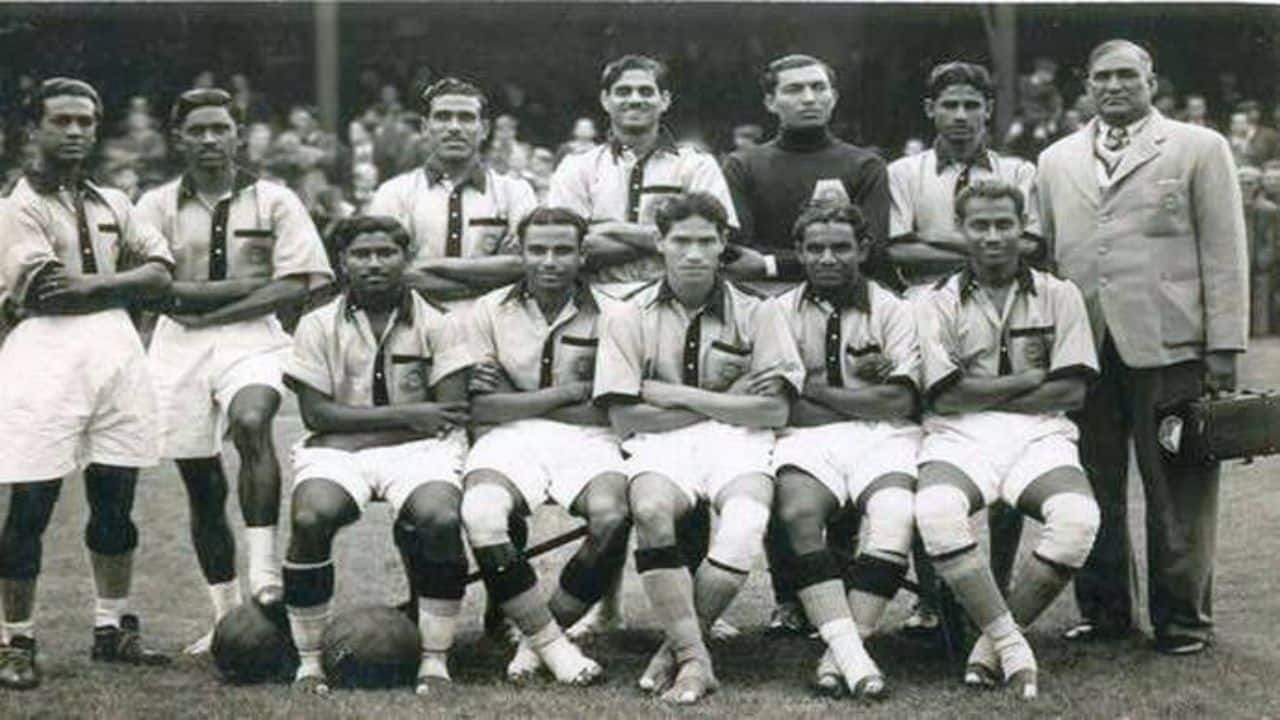
New Delhi: India’s greatest World Cup story is not about a famous victory or a heartbreaking defeat. It is about a tournament the country qualified for but never played.
In 1950, India earned a place at the FIFA World Cup in Brazil. The team had its ticket, a place in the draw and opponents waiting. It was set to face Italy, Sweden and Paraguay. Everything was in place for the country’s debut on football’s biggest stage. Then, in a move that continues to be debated more than seven decades later, India pulled out before the tournament began.
It is one of the most puzzling chapters in Indian sporting history.
The 1950 World Cup was the first tournament after a gap of 12 years. The Second World War had forced the cancellation of the 1942 and 1946 editions. Only 33 countries entered the qualification process for the tournament in Brazil. India was placed in a qualifying group along with Burma, now Myanmar, and the Philippines.
Before a ball could be kicked, both Burma and the Philippines withdrew from the qualifiers. Their exit meant India automatically secured a place in the World Cup.
For the first and only time in history, India had qualified for football’s biggest stage. When the final draw was conducted, the team was placed in Group 3 along with Sweden, Italy and Paraguay.
Could India have made an impact?
The question has fascinated football followers for decades. Late football journalist Novy Kapadia wrote that India’s group was not impossible to get through. Paraguay was not among the strongest teams in the competition at the time. Italy arrived in difficult circumstances and even saw coach Vittorio Pozzo resign after reaching Brazil.
According to Kapadia, Sweden was the strongest side in the group, but India could have competed for second place and, at the very least, gained priceless international experience.
Whether India would have progressed is impossible to know. What is certain is that the tournament could have changed the course of Indian football.
When Indian football earned respect on world stage
Indian football did not enjoy the international exposure it has today, but the team had earned respect for its style of play.
At the 1948 London Olympics, the country pushed France all the way before losing 2-1. The performance caught attention across the football world.
Players such as Ahmed Khan, S. Raman, M.A. Sattar and S. Mewalal had become popular names among football followers. Many of them were known for their dribbling skills and attacking football.
For many fans, the defining image was that of Indian players competing barefoot. During the London Olympics, several Indian footballers played without boots, although right-back Taj Mohammed wore them.
Why did India pull out?
This is where the story becomes complicated. There has never been a single clear explanation for the team’s withdrawal from the 1950 World Cup.
The official reason given by the All India Football Federation (AIFF) was disagreement over team selection and insufficient preparation time.
Over the years, another explanation became widely accepted. Many believed the FIFA refused to allow players to compete barefoot.
Football historians and researchers, however, have challenged that claim.
Kapadia and senior sports journalist Jaydeep Basu both argued that the barefoot theory does not stand up to scrutiny.
In his book ‘Box to Box: 75 Years of the Indian Football Team’, Basu wrote that the FIFA had no objection to Indian players playing barefoot. The players from the 1948 Olympic squad reportedly carried football boots in their travel bags and simply chose when to wear them.
At the time, playing with heavily bandaged feet instead of boots was not unusual in several parts of the world. The practice continued in some countries until the mid-1950s.
Was money the real reason?
Another popular explanation is that India could not afford the trip to Brazil. Research suggests that financial difficulties do not explain the withdrawal either.
According to Basu’s book, several state football associations had offered to contribute towards travel expenses.
Kapadia also wrote that Brazilian organisers had contacted Indian football officials and expressed willingness to cover most of the team’s costs.
ALSO READ: FIFA World Cup 2026 kicks off in style with grand opening ceremony in Mexico – See Pics
Brazil had its own reasons. Several countries, including Scotland, France, Turkey and Czechoslovakia, too had withdrawn from the tournament. Organisers were eager to keep participating teams in the competition.
Kapadia also wrote that Brazil was keen to host a team from the country of Mahatma Gandhi and Jawaharlal Nehru.
By May 16, 1950, India had even announced its World Cup squad. The plan was for the team to leave for Brazil on June 15 and play its opening match against Paraguay on June 25.
Then everything changed.
The withdrawal came soon after, leaving behind a mystery that still has no complete answer.
Did officials misjudge the opportunity?
Many football historians believe administrators of that era did not fully understand what the World Cup would eventually become.
At the time, hockey was India’s dominant sport. Olympic success was viewed as the highest achievement available to any athlete.
India was also preparing for the 1951 Asian Games in New Delhi, where expectations were high.
The World Cup did not carry the prestige it enjoys today. It had not become the international sporting spectacle that now captures billions of viewers.
There may have been another factor as well.
Under rules of that era, participation in the World Cup could result in players being classified as professionals. Professional players were often barred from competing in events such as the Olympics and Asian Games, which followed amateur regulations.
Some countries found ways around those restrictions, but Indian officials may not have been fully aware of the options available.
That concern may have influenced the decision to stay away from Brazil.
More than seven decades later, the 1950 World Cup is a story of what might have been. Every four years, when the world gathers to watch football’s biggest tournament, many Indian fans are reminded that there was once a moment when their country had a place at the table and chose not to take it.







