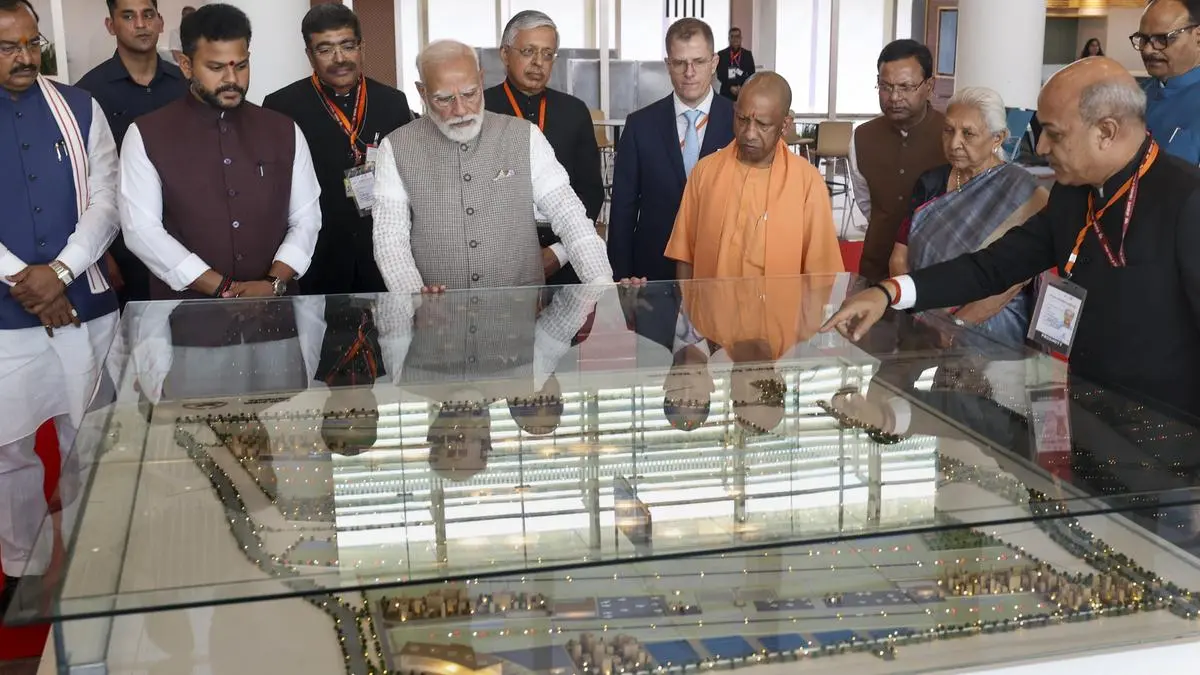
Prime Minister Narendra Modi, Uttar Pradesh Governor Anandiben Patel, Union Civil Aviation Minister Kinjarapu Ram Mohan Naidu, Chief Minister Yogi Adityanath, Deputy CMs Brajesh Pathak and Keshav Prasad Maurya and others during the inauguration of the first phase of the Noida International Airport at Jewar, in Gautam Buddh Nagar district.
| Photo Credit:
–
The inauguration of Noida International Airport’s phase I in the Jewar township of Greater Noida by Prime Minister Narendra Modi on Saturday marked a new milestone in the National Capital Region’s aviation landscape.
The project is expected to usher in a new phase of integrated, airport-led urban development in the NCR.
As per industry experts, it signals the emergence of the “aerotropolis” model, where airports function as economic hubs driving connectivity, investment, and urban expansion.
The airport becomes the third aviation hub in the NCR after Indira Gandhi International Airport and Hindon Airport, strengthening the region’s multi-airport system.
Video Credit: Businessline
At the inauguration ceremony, large crowds gathered in Jewar in attendence , reflecting strong public interest.
Residents, industry representatives, and officials attended in significant numbers with many travelling from nearby districts.
Among them, Sachin Mehra, a 19-year-old attendee, highlighted employment opportunities expected from the project, particularly in aviation, ground handling, technical services, and hospitality.
Video Credit: Businessline
Meanwhile, Kamal Devgan, a resident of Greater Noida, said the airport would ease travel significantly, reducing dependence on Delhi’s airport, which is nearly 100 kilometres away for many passengers.
For large parts of western Uttar Pradesh, it will reduce dependence on distant hubs while easing congestion at Delhi’s existing airport infrastructure.
Beyond the inauguration, experts emphasised its wider economic significance.
Speaking to businessline from Mumbai, Jagannarayan Padmanabhan, Senior Director and Global Head (Consulting) at CRISIL Market Intelligence & Analytics, the airport marks a structural shift from a single-airport dependency model to a multi-airport aviation system in the NCR.
He said this shift will enhance capacity, resilience, and accessibility, particularly for eastern NCR and western Uttar Pradesh. He added that the airport is supported by strong infrastructure linkages, including the Yamuna Expressway, Eastern Peripheral Expressway, and connectivity to the Delhi–Mumbai Expressway.
Accordingly, this integration is enabling the development of an aerotropolis, with early signs visible in logistics hubs, industrial clusters, and manufacturing zones across the region
In addition., Kiran Jain, Chief Operating Officer of Noida International Airport, said airports act as catalysts for regional economies by driving employment, trade, and investment beyond their immediate boundaries.
She added that such infrastructure attracts industries and strengthens surrounding economic ecosystems through improved global connectivity.
Furthermore, the airport is also expected to improve access to key tourism and pilgrimage destinations, including Agra, Mathura, Vrindavan, and the Buddhist circuit, supporting regional tourism growth.
Notably, construction of the airport began in 2022 and has progressed over 37 months. The project involved more than 22.5 lakh tonnes of aggregates, over 22,000 tonnes of reinforcement steel, 14,000 tonnes of structural steel, and around 2.8 lakh cubic metres of concrete.
The project recorded over 80 million man-hours without any serious injury, reflecting strong safety standards.
Designed to handle millions of passengers annually in its initial phase, the airport is expected to expand significantly over time.
In its first phase, the airport — with one runway and one terminal — will have the capacity to handle around 12 million passengers annually.
However, commercial operations will not begin immediately. After approval of the Airport Security Programme, it is expected to take approximately 30–45 days for the first domestic flight to commence. International operations are likely to follow a few months after domestic services are launched.
The inauguration follows the airport securing security clearance from the Bureau of Civil Aviation Security and receiving an aerodrome licence from the Directorate General of Civil Aviation.
Published on March 28, 2026







