Sensex | Nifty | Stock Market Live Updates 9th December 2025: Stock to buy today: Jindal Stainless (₹766.20) – BUY

Sensex | Nifty | Stock Market Live Updates 9th December 2025: Stock to buy today: Jindal Stainless (₹766.20) – BUY


Stack of money coin business financial growth with trading graph,global economic,trader investor,graph money of block chain stock market cryptocurrency selling and buy with price chart data graph istock photo for BL
| Photo Credit:
iStockphoto

tock Market today | Share Market Live Updates – Find here all the live updates related to Sensex, Nifty, BSE, NSE, share prices and Indian stock markets for 9th December 2025. 

Series of supports are there in the ₹752-744 region. Moving average indicators are giving positive signals. That strengthens the bullish case to see more rise. Immediate resistance is at ₹777.

The stock can break this resistance in the coming days. Such a break can take Jindal Stainless share price up to ₹830 in the coming weeks.

Traders can buy Jindal Stainless shares now at ₹766. Accumulate on dips at ₹754. Keep the stop-loss at ₹734. Trail the stop-loss up to ₹772 as soon as the stock goes up to ₹780. Revise the stop-loss higher to ₹785 and ₹795 when the price touches ₹798 and ₹810 respectively. Exit the longs at ₹820.

(Note: The recommendations are based on technical analysis. There is risk of loss in trading.)

  • December 9, 2025 06:50

    Stock Market Live Updates: Subscribe to our portfolio newsletter and more

    Subscribe to The Hindu Business Line Newsletter for Latest News and Insights

    Stay updated with the latest news and insightful analysis by subscribing to The Hindu Business Line Newsletter. Get access to curated content covering a wide range of topics, including business, finance, economy, technology, and more.

  • December 9, 2025 06:49

    Stock Market Live Updates: From our newsletter – New labour codes: Impact on your salary, EPF and gratuity

    New Labour Codes: Impact on Your Salary, EPF and Gratuity

    Discover how India’s new labour codes affect your salary, EPF, gratuity, and financial strategies for contract and gig workers.

  • December 9, 2025 06:46

    Stock Market Live Updates: Day Trading Guide for December 9, 2025: Intraday supports, resistances for Nifty50 stocks

    Day Trading Guide for December 9, 2025: Intraday supports, resistances for Nifty50 stocks

    Day Trading Guide gives you the key intraday supports and resistances to watch out for on the Nifty Futures and other widely traded stocks such as Reliance Industries, Infosys, HDFC Bank, TCS, SBI

  • December 9, 2025 06:38

    Stock Market Live Updates: Stock to buy today: Jindal Stainless (₹766.20) – BUY

    The short-term outlook is bullish for Jindal Stainless. The price action on the daily chart indicates that the stock is getting very good support around ₹744. 

    Series of supports are there in the ₹752-744 region. Moving average indicators are giving positive signals. That strengthens the bullish case to see more rise. Immediate resistance is at ₹777. 

    Stock to buy today: Jindal Stainless (₹766.20) – BUY

    Series of supports are there in the ₹752-744 region. Moving average indicators are giving positive signals. That strengthens the bullish case to see more rise. Immediate resistance is at ₹777.

Published on December 9, 2025


Source link

Telangana targets to contribute 10% to GDP by 2047

Telangana targets to contribute 10% to GDP by 2047


Telangana Chief Minister A Revanth Reddy address during inauguration of Telangana Rising Global Summit 2047 at Bharat Future City in Kandukur Mandal, Rangareddy district on Monday
| Photo Credit:
NAGARA GOPAL

Telangana Chief Minister A Revanth Reddy has said the State government targetted to contribute 10 per cent to the country’s Gross Domestic Product (GDP) by 2047.

“We comprise around 2.9 per cent of India’s population but contribute about 5 per cent to the country’s GDP now. We want to become $1 trillion economy by 2034, and by 2047, we would like to increase it to 10 per cent when the State’s economy reaches $3 trillion,” he said.

Three regions

Addressing the inauguration of the Telangana Rising Global Summit at Kandukur near here on Monday, he said the government would divide the State into three regions — Core Urban Region Economy, Peri Urban Region Economy, and Rural Agriculture Region Economy.

Representatives from over 40 countries and States have attended the summit. Karnataka Deputy Chief Minister

Citing the example of Guang-Dong province in China, he said that the region achieved a very high growth rate in 20 years, attracting huge investments.

“We are inspired by China, Japan, Germany, South Korea and Singapore as we embark on our journey to reach the $3-trillion economy,” he said.

Telangana Industries and IT Minister D Sridhar Babu said the State recorded a GSDP (Gross State Domestic Product) growth rate of 10.1 per cent in 2024–25, higher than the national average of 9.9 per cent.

The State’s per-capita income reached ₹3.79 lakh, about 1.8 times the national average. The industrial and manufacturing sectors grew by 7.6 per cent, compared with the national average of 6.6 per cent, while the services sector grew by 11.9 per cent, exceeding the national average of 10.7 per cent.

The Minister said Telangana’s Industrial GSVA (Gross State Value Added) rose from ₹2.46 lakh crore to ₹2.77 lakh crore, reflecting a 12.6 per cent growth rate.

He added that growth across key subsectors – manufacturing, construction, mining and quarrying, electricity, gas, water and utilities – surpassed national benchmarks, demonstrating the government’s performance in strengthening the industrial base.

He also listed a series of upcoming initiatives aimed at shaping the State’s future. “We are working on Telangana AI Innovation Hub, the AI-based Data Exchange Platform (TGDeX), AI University, and a Centre of Excellence in Quantum Technology,” he said.

Published on December 8, 2025


Source link

Telangana inks MoUs for ₹1.5 lakh crore investments in green energy

Telangana inks MoUs for ₹1.5 lakh crore investments in green energy


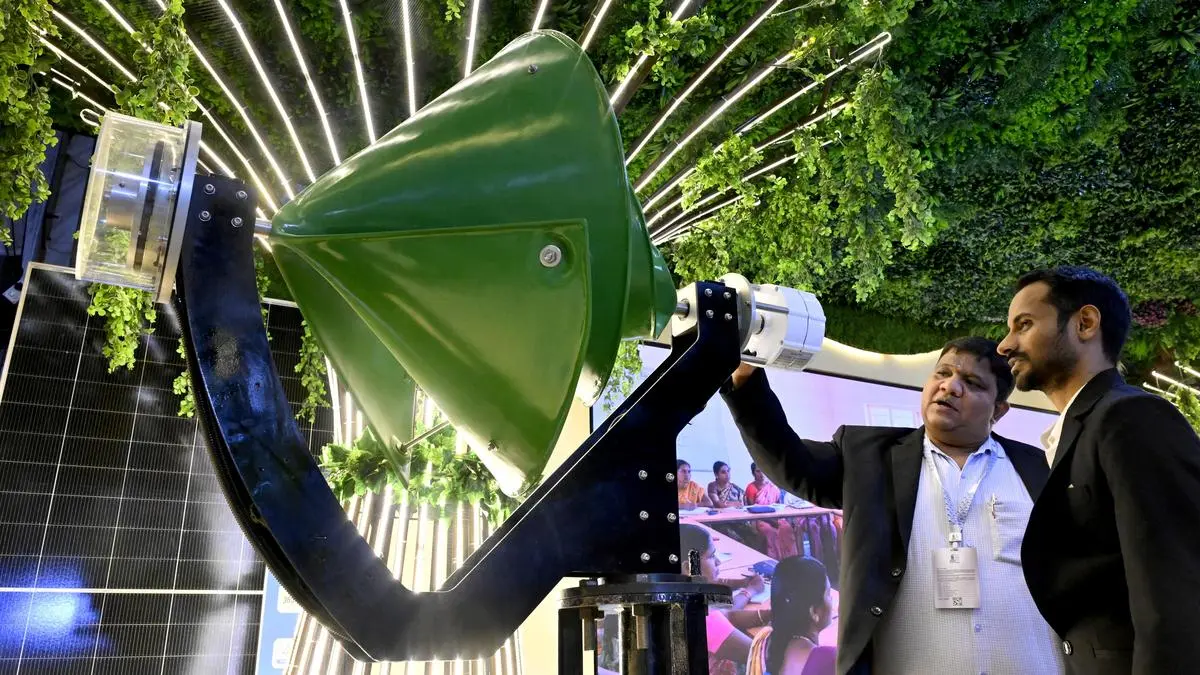
Delegates observing wind power technology during Telangana Rising Global Summit-2047 at Bharat Future City in Kandukur Mandal, Rangareddy district on Monday
| Photo Credit:
NAGARA GOPAL

The Telangana government has entered into memorandum of understanding (MoUs) with various companies for setting up Green Energy projects involving total investments of over Rs 1.50 lakh crore on Monday.

The MoUs inked on the first day of Telangana Rising Global Summit here included ₹31,500 crore investment by Axis Energy Ventures, ₹29,800 crore by Greenco,  ₹16,000 crore by Ecoren, ₹12,500 crore by AMR India, ₹5,600 crore by Astha Green Energy, ₹5,600 crore by Cerulean Energy and ₹2,500 crore by United Telecom, as per official information. 

The proposed investments have a potential to create about 1.60 lakh direct and indirect employment.

Published on December 8, 2025


Source link

India’s crude oil imports from US in November second highest since 2022

India’s crude oil imports from US in November second highest since 2022


Rising US share carries both strategic value and diversification strategies
| Photo Credit:
iStockphoto

India’s crude oil imports from the US during November 2025 rose to the second highest on record, since 2022, as refiners diversified cargoes while balancing trade sensibilities. The US became India’s fourth largest crude oil supplier for the second consecutive month in November 2025.

According to the global real time data and analytics provider Kpler, India’s crude oil imports from the US stood at 442,000 barrels per day (b/d) on a provisional basis last month, a 100 per cent growth on an annual basis. However, shipments declined more than 22 per cent m-o-m.

India imported 568,000 b/d in October 2025, the highest on record since the Covid-impacted 2022. Last month’s imports were the second highest on record, which is also higher than the country’s average shipments from the North American country.

India has so far on average imported around 316,000 b/d crude oil from the US in the current calendar year.

The US Energy Information Administration (EIA) data also showed rising US crude cargoes to India. For instance, during January-September 2025, Washington’s cumulative crude oil exports stood at 2.89 million barrels per day (mb/d), which is a record high for the period, barring 2021 (3.43 mb/d).

broader strategy

Rising US share carries both strategic value and diversification strategies. Higher energy imports from Washington will help narrow India’s trade deficit with the latter and fit into New Delhi’s broader strategy of diversifying energy supply chains. The increase in crude trade also reinforces energy cooperation between India and the US.

Sumit Ritolia, Kpler’s Lead Research Analyst for Refining & Modeling, told businessline “These flows were almost certainly contracted before the recent US sanctions on Rosneft and Lukoil, given the 45–55-day voyage time, meaning the spike was not sanctions-driven but instead part of India’s ongoing effort to diversify its crude slate and strengthen energy security.”

He emphasised that the increase was primarily economics-led—a favourable arbitrage window, a wider Brent–WTI spread, and muted Chinese demand made WTI Midland competitive on a delivered basis—but the November 2025 drop shows the limits of this opportunity.

“Looking at current export trends from the US to India, December (2025) crude imports are expected to fall further to 300–350,000 b/d, with levels likely easing toward around 300,000 b/d thereafter,” Ritolia anticipated.

Longer voyages, higher freight, and WTI’s lighter, naphtha-rich yield continue to constrain structural upside. Even so, the elevated US presence in India’s crude basket underscores the deepening strategic energy alignment between the two countries and supports India’s broader diversification strategy balancing security, economics, and geopolitics, he explained.

Published on December 8, 2025


Source link

City Union Bank, SalarySe partner for a credit card exclusively for salaried employees

City Union Bank, SalarySe partner for a credit card exclusively for salaried employees


R. Vijay Anand and V. Ramesh, Executive Directors, City Union Bank and SalarySe team of Mohit Gorisariya, Saumeet Nanda and Piyush Bagaria, Co-founders, SalarySe, at the launch of a salaried focused credit card in Chennai.
| Photo Credit:
Photo : Bijoy Ghosh

City Union Bank on Monday partnered with financial wellbeing platform SalarySe to launch the Level Up Credit Card, a credit card built exclusively for salaried individuals and powered by Credit on UPI technology.

“Aligned with the Reserve Bank of India’s vision to promote a cashless economy, the card is engineered to reward real-life spending patterns of working professionals through everyday UPI payments, online transactions, essential monthly bills and in-store purchases,” the companies said in a statement.

“Salary Day Bonus”

The Level Up Credit Card introduces a “Salary Day Bonus” feature, offering up to 37.5 per cent rewards on salary disbursement days, enabling employees to maximise returns on essential expenses coinciding with payroll cycles. Unlike conventional credit cards that concentrate rewards on select use cases, this offering integrates credit into the UPI ecosystem while maintaining credit access through employer-linked payroll verification.

The collaboration leverages SalarySe’s salary-powered financial infrastructure with City Union Bank’s trust and regulatory framework. Users can gain direct access to revolving credit lines within everyday UPI transactions, eliminating the need for standalone loan applications.

“Salaried individuals form the backbone of India’s consumption economy, and this collaboration with Salary Se aligns perfectly with our commitment to expand digital inclusion while encouraging disciplined credit usage,” Vijay Anandh R, Executive Director, City Union Bank, said.

Mohit Gorisariya, Co-founder of SalarySe, said, “With Credit-on-UPI, rewards designed around real life, luxury benefits like lounge access & lower forex markup and predictable financial flexibility, this product simplifies money for millions of working professionals and elevate their lifestyle.” Unlike conventional credit cards that concentrate rewards on select use cases, this offering integrates credit into the UPI ecosystem while maintaining credit access through employer-linked payroll verification.

The collaboration leverages SalarySe’s salary-powered financial infrastructure with City Union Bank’s trust and regulatory framework.

Users can gain direct access to revolving credit lines within everyday UPI transactions, eliminating the need for standalone loan applications.

“Salaried individuals form the backbone of India’s consumption economy, and this collaboration with Salary Se aligns perfectly with our commitment to expand digital inclusion while encouraging disciplined credit usage,” Vijay Anandh R, Executive Director, City Union Bank, said.

Published on December 8, 2025


Source link

Sberbank’s India fund creates rupee-to-Nifty corridor for Russian investors

Sberbank’s India fund creates rupee-to-Nifty corridor for Russian investors


In a move that could reshape how sanction-hit Russia deploys billions of stranded Indian rupees, state-owned Sberbank is launching a closed-ended mutual fund linked to the Nifty50, effectively opening a direct route for Russian investors to put their rupee surpluses into Indian equities.

The structure gives Moscow a way around its currency dilemma: when Russia sells crude oil to India, it receives payments in rupees parked in special vostro accounts that cannot be freely converted into dollars due to U.S. financial sanctions. The new product allows these idle balances to be channelled into Indian capital markets, turning an enforced rupee pool into an investment opportunity.

To start with, Russia’s Sberbank will launch a mutual fund linked to India’s Nifty50 Index, offering Russians diversified exposure to India’s largest and most liquid companies.

Gautam Kalia, Head Investment and Solutions, Mirae Asset ShareKhan, said India is encouraging Russia to reinvest the large rupee reserves accumulated from oil sales into productive sectors. These funds can flow into infrastructure projects like railways and logistics, energy, defence manufacturing, pharmaceuticals, fertilizers, and high-tech areas such as IT and automation, he said.

This strategy mirrors Japan’s long-standing model of infrastructure financing creating a win-win: Russia deploys its trapped rupee pool, and India gains capital for growth and modernisation.

In August, the RBI allowed authorised dealer category-I banks to open special rupee vostro account for their foreign correspondent banks without prior RBI approval. The central bank has also relaxed rules to let Russian firms invest in government securities, bonds and T-Bills, easing earlier curbs.

Led by crude oil imports, the trade turnover between Russia and India has seen remarkable growth over recent years, nearly quintupling to $68 billion in FY25 against about $13 billion in 2021. In FY25, India exported $4.9 billion to Russia but imported $64 billion, leaving a sharp trade gap of $59 billion; crude oil alone accounted for $50 billion.

Narinder Wadhwa, MD & CEO, Ski Capital Services, said similar to how Japan has historically financed major Indian infrastructure projects, Russia may explore long-gestation sectors such as energy, logistics, railways, ports and technology partnerships to deploy idle rupee balances productively.

However, he said returns from these projects in rupees are not helpful unless there is a sustainable avenue for repatriation or a long-term liquidity mechanism, which India has not yet clarified.

Sandeep Parwal, Founder of SPA Capital, said further liquidity in Nifty constituents will push valuations higher, raising entry risks for new investors while offering an exit window for existing shareholders.

Investment for development of infrastructure in India or monetizing the current operational infrastructure assets may be a superior alternative, he said.

Sberbank also plans to invest $100 million in technology, team expansion and new offices. The bank has already applied to the central bank to open branches in ten cities in three years. Its core IT platform — imported from Russia and re-engineered by hundreds of professionals in Bengaluru — is being aligned with Indian regulations.

Sberbank has become a critical bridge in Russia-India trade, cutting transaction time from weeks to under 10 minutes in 80% of cases, without needing a third-country currency.

Published on December 8, 2025


Source link

YouTube
Instagram
WhatsApp