Government ensuring widespread awareness, adoption of DPDP Act/Rules: Jitin Prasada

Government ensuring widespread awareness, adoption of DPDP Act/Rules: Jitin Prasada


Union Minister of State Jitin Prasada

Government on Wednesday said that it was ensuring widespread awareness and adoption of the Digital Personal Data Protection (DPDP) Act, 2023 and also simplified compliance framework for start-ups and certain data fiduciaries under DPDP Act and Rules.

“The Act and Rules provide for government to notify jurisdictions where transfer of personal data may be restricted. The government is also ensuring widespread awareness and adoption of the DPDP Act by educating citizens on their rights and responsibilities,” Minister of State for Electronics and Information Technology Jitin Prasada informed the Lok Sabha on Wednesday.

Digital outreach

Capacity-building initiatives, including workshops, conferences, expert sessions and digital outreach campaigns are also being undertaken, he said.

The DPDP Act and the Digital Personal Data Protection Rules, 2025 have been notified on November 13, 2025. They provide timelines for implementation of relevant provisions and in terms of the provision of the Rules, Digital Data Protection Board has been notified, Prasada added.

Meanwhile, responding to other queries in Parliament, Ashwini Vaishnaw, Minister of Electronics and IT, said that the DPDP Act, and the DPDP Rules, 2025, apply uniformly to all forms of digital personal data including personal images and data.

“The Act establishes a comprehensive framework that empowers individuals with specific rights over their personal data. It also lays down obligations for organisations (data fiduciaries) that determine the purpose and means of processing digital personal data. The government actively engages social media platforms and other stakeholders to counter deepfakes, morphed images and malicious synthetic content,” he said.

Multiple advisories

He said the government has also issued multiple advisories to social media intermediaries to ensure an open, safe, trusted and accountable digital ecosystem.

Intermediaries specifically are advised to strengthen detection and removal of unlawful and false content, including malicious synthetic media and deepfakes, he said, adding that mandatory labelling, watermarking and traceability mechanisms have been also proposed to clearly identify AI-generated manipulated content and prevent misinformation.

“Further, under the IT Rules (Amendment) 2025, intermediaries are required to remove or disable access to specified unlawful content within 36 hours of receiving actual knowledge through a court order or authorised government intimation,” Vaishnaw added.

Published on December 3, 2025


Source link

GJC requests Gujarat government for formation of vigilance committee

GJC requests Gujarat government for formation of vigilance committee


In order to guard against “unnecessary harassment, raids, and compliance pressures from certain enforcement agencies and local authorities”, the All India Gem and Jewellery Domestic Council (GJC) on Wednesday formally requested Gujarat government to establish a state-level Vigilance Committee dedicated to protecting interests of jewellers across the state.

“Jewellers across Gujarat have long voiced concerns about unnecessary harassment, raids, and compliance pressures from certain enforcement agencies and local authorities. While we fully support transparency and lawful practices, the absence of clear SOPs often leaves jewellers vulnerable to misinterpretation and exploitation. This is why we have demanded the formation of vigilance committees — to act as a bridge between jewellers and the government, ensuring that genuine traders are protected, while malpractice is curbed,” stated Rajesh Rokde, chairman, GJC who along with other members of body representing gem and jewellery businesses met Deputy chief minister of Gujarat, Harsh Sanghavi and presented a proposal.

“Our goal is to safeguard the industry from arbitrary actions, build trust with customers, and create a fair environment where jewellers can focus on their business without fear. In Maharashtra, where the Chief Minister, with the support of Chitra Tai Wagh, President of Mahila Morcha, had also demanded such SOPs to safeguard the jewellery business,” Rokde added.

This initiative will create a structured mechanism where jewellers and state government authorities will work hand-in-hand to prepare SOPs and collaborate to resolve issues, GJC stated.

Published on December 3, 2025


Source link

LIC launches Protection Plus, Bima Kavach plans

LIC launches Protection Plus, Bima Kavach plans


Bima Kavach is a non-par, linked, life, individual pure risk plan, which provides financial protection to the family of the insured in case of his/her unfortunate death during the policy term
| Photo Credit:

The Life Insurance Corporation of India (LIC) on Wednesday launched two new plans — Protection Plus and Bima Kavach. The corporation, in a statement, said Protection Plus is a non-par, linked, life, individual savings plan, which offers life insurance cover-cum-savings throughout the term of the policy.

Bima Kavach is a non-par, linked, life, individual pure risk plan, which provides financial protection to the family of the insured in case of his/her unfortunate death during the policy term.

Protection Plus

Besides providing life insurance cover, this plan offers flexibility to choose the type of investment fund, increase/ decrease the sum assured and pay top-up premiums. Partial withdrawal is allowed after five years from the date of commencement.

Under this plan, the proposer can choose the amount of premium he/she desires to pay, based on which the basic sum assured ill be decided. The base premium can be paid as regular pay or limited pay.

Bima Kavach

LIC said this plan offers flexibility to choose from two death benefit options – level sum assured and increasing sum assured. It also offers flexible premium payment options – single, limited and regular.

“The life assured can select a policy term, which can extend up to 100 years, ensuring long-term protection. There is also an option to receive the benefits in instalments, providing added financial convenience.

“Another key highlight of this plan is the option available to the life assured to enhance the life cover at predefined life-stage events (marriage or birth of a child), which is available under the level sum assured option with regular premium payment,” said LIC.

Published on December 3, 2025


Source link

India contracts over 100,000 tonnes of sugar for export, more likely amid weakening INR

India contracts over 100,000 tonnes of sugar for export, more likely amid weakening INR


After the government on November 14 permitted Indian sugar mills to export 1.5 million tonnes (mt) of sugar during the 2025-26 season (October-September), contracts have been completed for over 100,000 tonnes so far for spot delivery by mid-January with shipments started moving now, industry sources said.

After the permission, it was feared that Indian sugar would not be economically viable to compete globally, but with rupee now breaching the psychological barrier of 90 against dollar, t more contracts will likely be signed in the next few days, an industry expert said, adding these 100,000 tonnes were contracted when dollar was about ₹88.

Major destinations showing interest for Indian sugar include Afghanistan, Sri Lanka, Somalia, Yemen, Kenya and some other countries in the Middle East and Africa, trade sources said. While exporters are divided on the contractual prices, one exporter said the contracts were mostly at $440-450/tonne (FOB) from a port on the West Coast.

Uniform export quota

M Madan Prakash, Director at Chennai-based Rajathi Group that exports agri products, said prices for Kenya were $510 cost and freight, while for Bandar Abbas (Iran), they were $470 a tonne.

“There are good enquiries for Indian sugar from many nearby origins,” he said.

The Food Ministry last month allocated the quota on pro-rata basis among all the operational sugar mills based on their average production during last three sugar seasons. “All the sugar mills have been allocated an uniform quota of 5.286 per cent of their 3 years average production of sugar,” it said in the letter to all the mills.

As the government has permitted mills to export the quantity either themselves or through merchant exporters/refineries, many of the mills in Uttar Pradesh have sold their quotas to exporters and trade estimates put it at 30,000-40,000 tonnes.

Plea for more

The National Federation of Cooperative Sugar Factories (NFCSF) has requested the government to allow an additional 1 mt for exports, over and above already permitted 1.5 mt. “This move would not only help improve domestic market sentiment by firming domestic sugar prices, but will not adversely impact the current low international sugar prices in view of small trenches of Indian sugar entering global market,” it said last week.

The body of cooperative sugar factories has cited that against an expected domestic consumption of 29 mt and opening stock of 5 mt (as on October 1, 2025), India will have a balance of about 7.5 mt in sugar mills’ godowns and this would block huge funds mounting interest burden on mills.

Last week, the Ministry of Agriculture and Farmers Welfare in its first advanced estimate of kharif crops said sugarcane production is estimated to increase to 475.6 million tonnes from 454.6 million tonnes last year. Sugar production in the first two months of the current season, which began on October 1, increased by 50 per cent to 4.14 million tonnes.

(With inputs from Subramani Ra Mancombu, Chennai)

Published on December 3, 2025


Source link

Aerospace player Aequs’ IPO: Should you subscribe?

Aerospace player Aequs’ IPO: Should you subscribe?


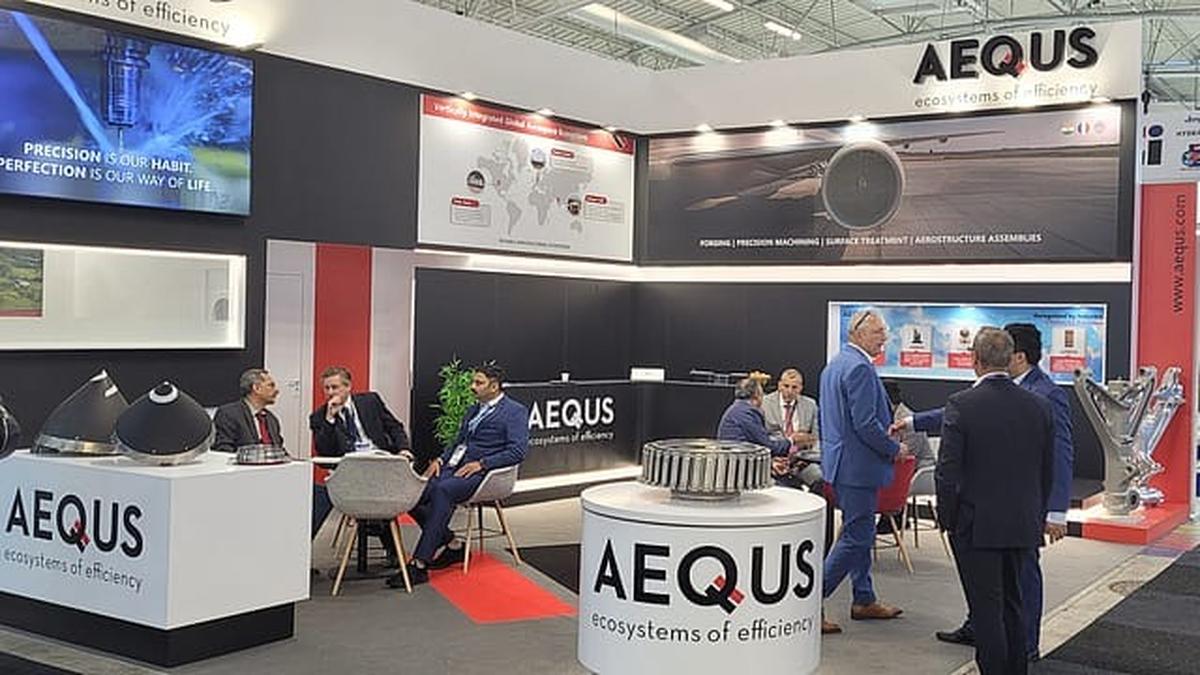
Aequs, which supplies parts to aircraft makers Airbus, Boeing and a few others, operates in the global aerospace market, estimated at $208 billion, per a Frost & Sullivan analysis in the RHP
| Photo Credit:
Aequs/X

The IPO of aerospace components manufacturer Aequs Ltd is open for subscription until Friday. It has a fresh issue of shares worth ₹670 crore. A couple of promoter entities and a few public shareholders are set to cash out in an offer for sale worth ₹252 crore. Stake of promoters and promoter group is expected to drop to 59.1 per cent post the IPO, from the current 64.5 per cent.

Of the fresh issue proceeds, ₹433 crore is earmarked for retiring debt and ₹64 crore for capex. The rest ₹173 crore is meant for possible acquisitions and general corporate purposes. Net debt to equity ratio of 1x as of H1 FY26 is set to drop to 0.1x post issue.

At the upper band, the IPO values the company at a FY25 EV/EBITDA of 110x, which is expensive for the reasons discussed later. Hence, investors can skip the IPO for now.

Industry

Aequs, which supplies parts to aircraft makers Airbus, Boeing and a few others, operates in the global aerospace market, estimated at $208 billion, per a Frost & Sullivan analysis in the RHP. This is expected to grow at a CAGR of 6 per cent until 2030. However, the market in India is set to grow at a faster rate of 13 per cent to reach ₹25,000 crore by 2030.

Globally, airlines are keen on expanding their fleet, as can be evidenced by the swelling order books of Airbus and Boeing. Their order backlog has grown at CAGRs of 18 per cent and 14 per cent between 2022 and 2024 respectively, to be worth a combined $1.1 trillion as of December 2024. Boeing’s order book stood at a higher $610 billion as of Q3 2025 versus $500 billion as of Q4 2024. Engine manufacturer RTX’s order book stands at $251 billion, having grown at a CAGR of 14 per cent between Q4 2022 and Q3 2025.

As these companies fulfil their backlog, orders could find their way to India, towards parts suppliers such as Aequs.

Business

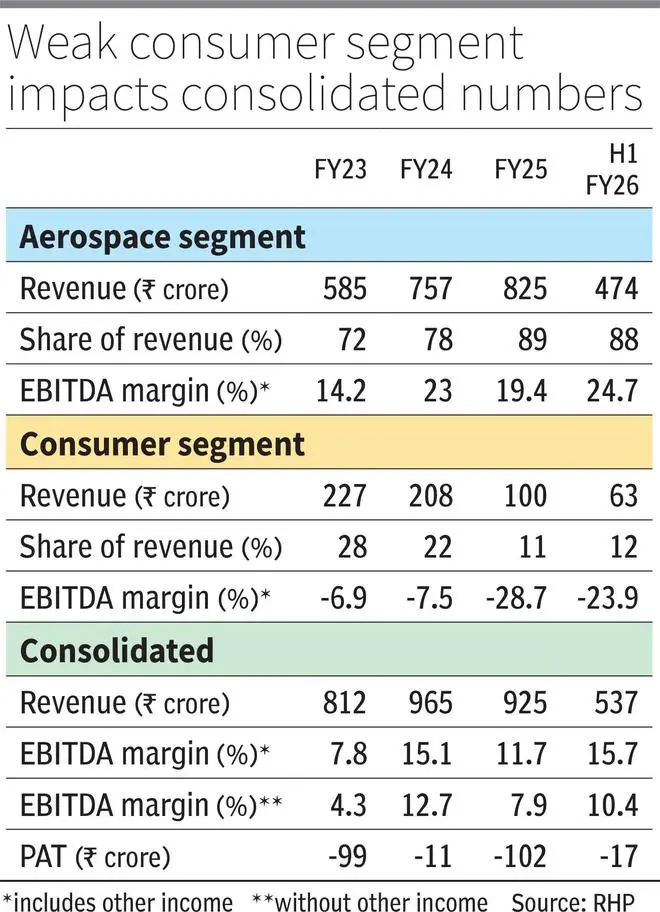
Aequs has two business segments – aerospace and consumer, which made 89 and 11 per cent of FY25 revenue.

Its aerospace portfolio is 5,000 products strong, which find use in aircraft engines, landing systems, structures, cargo and interiors. These products need precision manufacturing (up to 4 microns versus 10-50 microns for automotive components; 1 micron equals 0.001 mm), where Aequs has developed capabilities over the years.

The company supplies to Airbus and Boeing for their popular single aisle and long-range aircraft programmes (Airbus – A220, A320, A350; Boeing B737, B777, B787). Besides, it also has other clients such as Safran, Honeywell, Collins Aerospace and Bombardier, with whom it has maintained long-term relationships. This is an advantage, given aerospace OEMs generally take long time to onboard a supplier. Aequs has manufacturing facilities in India, France and the US.

In its consumer segment, Aequs manufactures toys for clients such as Hasbro and SpinMaster, and cookware and appliances for brands such as Wonderchef and Tramontina.

It is also foraying into manufacturing laptop enclosures for a global leader in consumer electronics, revenue recognition for which is yet to commence. Company has made an outlay of about ₹600 crore in this business. Management expects to be a beneficiary of the Centre’s Electronics Component Manufacturing Scheme, which is a turnover-based incentive programme.

In FY25, Aequs derived 11 per cent of consolidated revenue from India, 23 per cent from the US, 22 per cent from France, 12 per cent from Germany, 10 per cent from Sweden, 9 per cent from the UK, 7 per cent from Hong Kong and 6 per cent from other geographies. The company procures about half the inputs from outside India from countries including China, Korea, Taiwan, US, UK and France.

Overall capacity utilisation stands at 42 per cent in FY25 and 44 per cent in H1 FY26. The business is heavy on working capital needs as can be witnessed by the cash conversion cycle of about 200 to 250 days. Fixed Assets turnover ratio is between 1.5 and 1.7 times.

Financials, valuation

Aequs’s aerospace revenue has grown at a robust CAGR of 19 per cent between FY23 and FY25 to ₹825 crore. It further grew 20 per cent in H1 FY26 over H1 FY25. Segment EBITDA margin including other income (company includes other income in EBITDA) has been 14.2 per cent in FY23, 23 per cent in FY24, 19.4 per cent in FY25 and 24.7 per cent in H1 FY26.

The consumer segment, however, hasn’t been doing well, primarily due to lack of healthy demand from clients. Its share in overall revenue has dropped from 28 per cent in FY23 to 11 per cent in FY25, as revenue declined from ₹227 crore to ₹100 crore. In all periods reported in the RHP, this segment is loss making at the EBITDA level: -7 per cent in FY23 to -29 per cent in FY25.

Poor performance of this segment, coupled with interest and depreciation costs, meant Aequs not turning profit in any period from FY23 to FY25 and in H1 FY26, on a consolidated basis. Consolidated revenue and EBITDA, which includes other income grew 7 per cent and 31 per cent compounded, between FY23 and FY25.

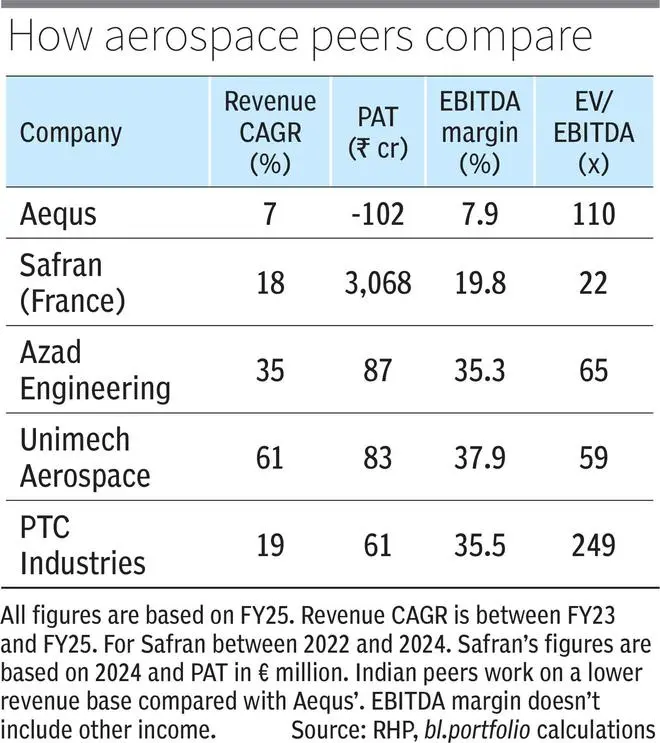
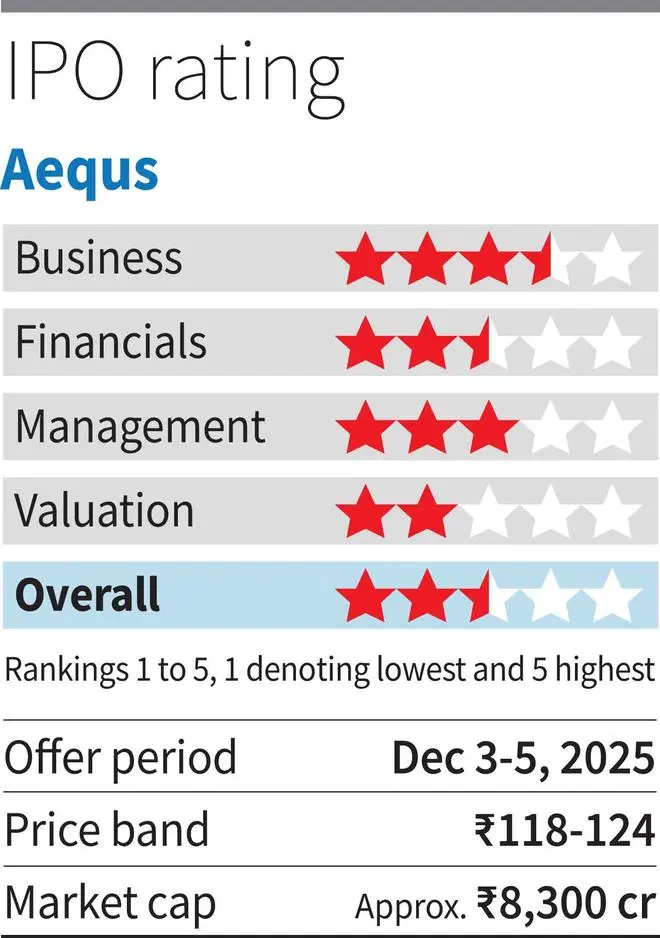
At the upper band, the issue values Aequs at a post-issue market cap of about ₹8,300 crore and an enterprise value of about ₹8,100 crore. The EV/EBITDA multiple works out to 110x on FY25 basis and 73x on H1 FY26 annualised basis (EBITDA without other income). Aerospace peers identified in the RHP include Azad Engineering, Unimech Aerospace and PTC Industries. They trade at multiples of 65x, 59x and 249x, respectively for EBITDA margins of 35 per cent, 38 per cent and 36 per cent in FY25. For comparison, Aequs margin was just 8 per cent (11.7 per cent including other income). Even the peers are not inexpensive when compared with French aerospace major Safran, which trades at 22x 2024 EBITDA.

The outlook for India in global aerospace seems optimistic and Aequs is well-positioned to tap this opportunity. However, the company’s valuation against the backdrop of its recent financial performance makes this argument a hard sell. Interested investors can, therefore, give the IPO a pass for now and watch out for better valuations and any recovery in the consumer segment, possibly driven by the laptop enclosures business.

Published on December 3, 2025


Source link

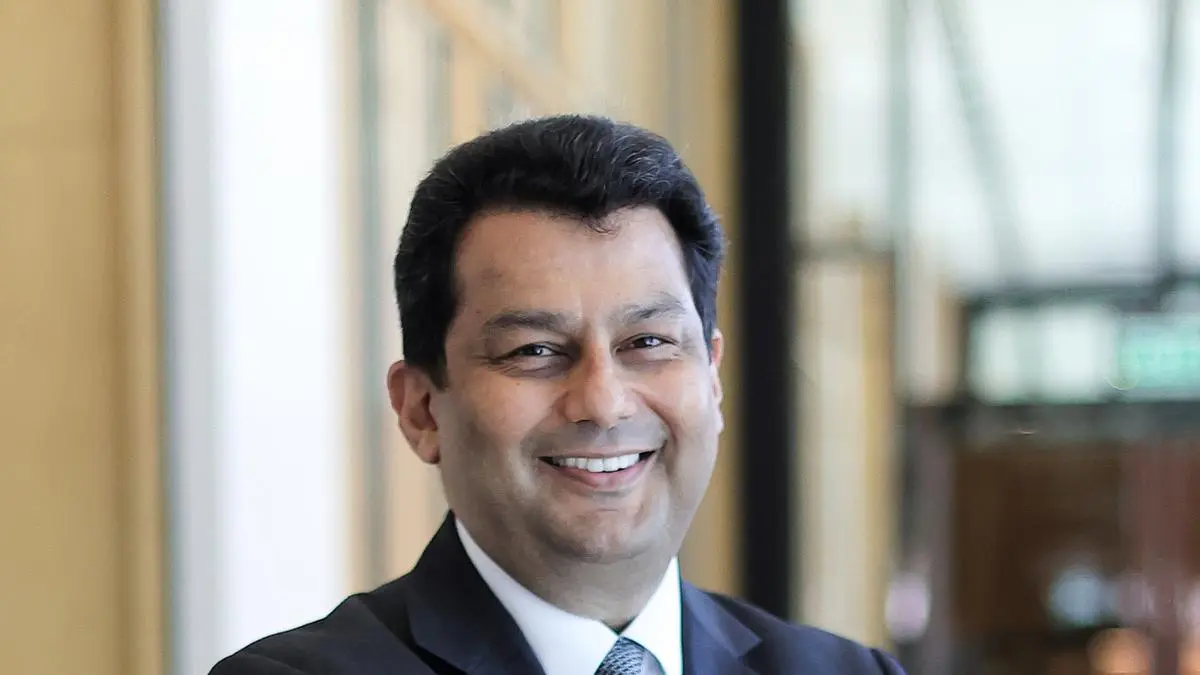
RBI approves Vikram Sahu as CEO of Bank of America in India for 3 years

RBI approves Vikram Sahu as CEO of Bank of America in India for 3 years


The Reserve Bank of India (RBI) has approved the appointment of Vikram Sahu as the chief executive officer (CEO) of Bank of America NA in India (BANA India) for three years. This is in addition to his current responsibilities as India Country Executive, according to an internal memo seen by businessline.

Kaku Nakhate, the earlier India CEO, has been appointed as chair of India and will focus on deepening relationships with key clients. Sahu will report to Jin Su, President of Asia Pacific.

“Since assuming the overall leadership of our India franchise earlier this year, Vikram has been focused on guiding our country leadership team, focusing on governance and regulatory matters, meeting key clients and reinforcing the bank’s responsible growth approach. As CEO of BANA India, he will chair the entity’s local management team, while remaining a member of our Asia Pacific Executive committee and chair of the India CLT. He will continue to have oversight of our strategic growth plan,” said the memo.

Published on December 3, 2025


Source link

YouTube
Instagram
WhatsApp