Fino Payments Bank CEO Rishi Gupta gets bail; bank says operations unaffected

Fino Payments Bank CEO Rishi Gupta gets bail; bank says operations unaffected


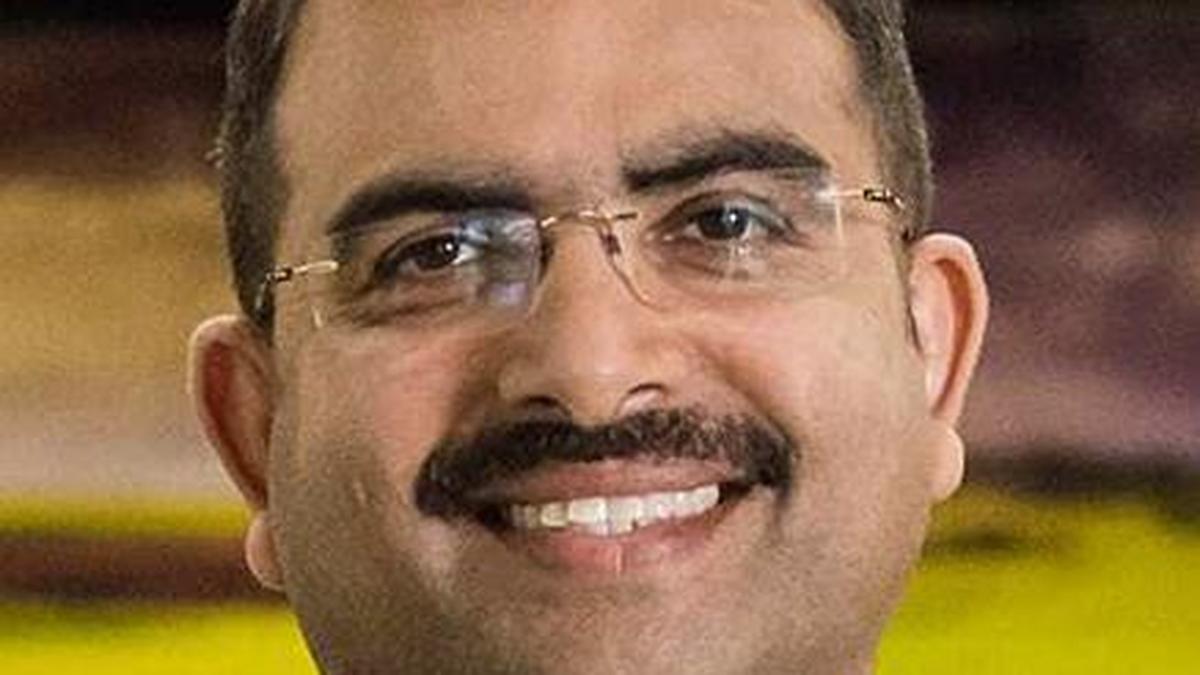
Rishi Gupta, MD and CEO of Fino Payments Bank, has been granted bail by a special court in Hyderabad in connection with an ongoing investigation involving program managers linked to multiple banks.

The Special Judge for Economic Offences, Nampally, Hyderabad, on Thursday granted bail to Rishi Gupta, MD & CEO, Fino Payments Bank (FPB).

The aforementioned case pertains to an ongoing investigation into certain program managers associated with multiple banks, including the Bank, and does not relate to the Bank’s GST compliance, FPB said in a regulatory filing.

Further, the Bank said it will continue to fully cooperate with the authorities. Gupta has been in judicial custody since late last month.

Operations remain stable, bank assures stakeholders

FPB said its operations remain stable and uninterrupted, and it will continue to serve its customers and stakeholders in the normal course of business.

“The Bank shall continue to engage constructively with regulators and stakeholders and shall make appropriate disclosures in accordance with applicable laws and regulatory requirements,” per the filing.

Ketan Merchant, Chief Financial Officer, FPB, in a statement issued on February 28, 2026, said: “…The Bank and its MD & CEO Rishi Gupta have nothing to do with the actions of the programme managers.”

Role of program managers explained

Shailesh Pandey, Chief Business Officer, FPB, in an analyst call, noted that the program manager is a payment service provider whose primary role is to identify merchants in the market and refer them to the bank for onboarding and end-to-end UPI payment services.

“The program managers fundamentally have multiple relationships where they provide different services to these merchants who require payment services, whether it is, you know, debit cards, credit cards, including UPI transactions. They integrate with multiple banks and Fino is also one of the banks with them, and we basically work with them for UPI collect services,” he said.

Interim CEO appointed amid developments

On March 06, 2026, FPB, in a regulatory filing, said its Board has approved the appointment of Ketan Merchant as Interim Chief Executive Officer of the Bank for carrying out the duties of MD&CEO as per provisions of Section 10B(9) of the Banking Regulation Act, 1949.

The aforementioned appointment was for a period not exceeding 4 months with effect from the date of approval of the Reserve Bank of India.

Special review initiated on GST compliance

The Bank has appointed a special consultant to conduct a special review of GST compliance and other aspects, as per the approved scope of work, based on the Audit Committee’s recommendation.

Published on March 27, 2026



Source link

Whistle-blower complaints rise across private banks in FY25

Whistle-blower complaints rise across private banks in FY25


As per RBI and SEBI requirements, banks are expected to have a well-defined whistleblower policy hosted on their site and must put in place vigilance mechanisms to give employees access to senior management and confidentiality

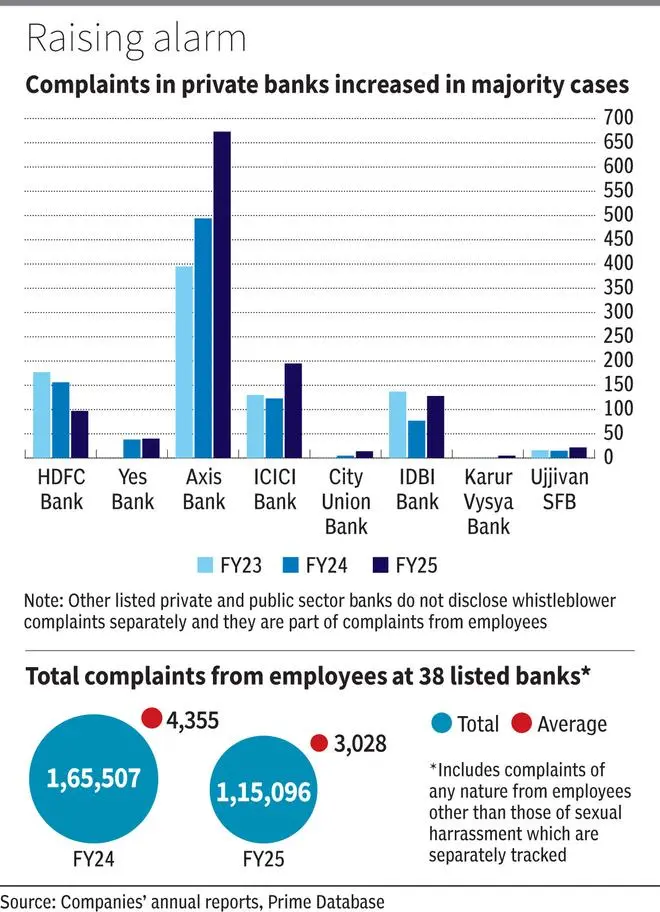
Whistleblower complaints across India’s private banks recorded a broad increase in FY25 with most major players including Yes Bank, Axis Bank and ICICI Bank reporting higher cases in the fiscal compared to FY24. HDFC Bank was the only bank among the top-tier players to report a dip in such complaints.

A businessline analysis of annual reports of listed private banks shows that only eight out of 23 banks reported whistleblower complaints separately, and seven out of the eight saw number of complaints increase in FY25, highlighting either improved internal reporting systems or rising governance concerns.

Axis Bank reported a significant jump to 673 complaints in FY25, up from 494 in FY24 and 395 in FY23. ICICI Bank also recorded a notable rise, with complaints climbing to 195 from 123 a year earlier. Interestingly, HDFC Bank, which is currently in the eye of the storm, saw number of complaints fall by 37 per cent on-year in FY25.

As per RBI and SEBI requirements, banks are expected to have a well-defined whistleblower policy hosted on their site and must put in place vigilance mechanisms to give employees access to senior management and confidentiality. However SEBI’s BRSR (Business Responsibility and Sustainability Reporting) does not require specific identification of such complaints and they get included under broader employee complaints.

Experts say higher whistleblower complaints may indicate a healthy, transparent culture or can also point to underlying governance lapses, in the absence of sufficient disclosures of the nature of complaints.

‘Risky and unrewarding’

Ramesh K Vaidyanathan, Managing Partner at BTG Advaya, said that as a concept, whistleblower complaints could relate to fraud, governance lapses and other unethical conduct. “Overall, compliance requirements exist, but real protection is minimal, making whistleblowing risky and unrewarding. Further, there is no uniform mandate to publicly disclose the number of whistleblower complaints in annual reports.”

Rupinder Malik, Partner, JSA Advocates and Solicitors, says the challenge lies in execution with issues around how complaints are triaged at the initial stage and whether matters are escalated appropriately. “There is a stronger regulatory and governance push now towards making these mechanisms more credible and trusted especially through clearer anti-retaliation safeguards, audit trails, and periodic reviews of how complaints are actually handled on the ground,” Malik added.

Separately, data from primeinfobase.com showed that total complaints from employees (excluding those relating to sexual harassment) fell by 30 per cent in FY25 across the 38 listed banks (public and private). This includes grievances of all kinds including those of governance.

Published on March 27, 2026



Source link

India’s tech spending expected to grow 13.4% in 2026; among highest in APAC: Report

India’s tech spending expected to grow 13.4% in 2026; among highest in APAC: Report


Total spending on technology will grow by 9.3 per cent
| Photo Credit:
ipopba

India’s tech spending will grow at 13.4 per cent in 2026, down slightly from 13.7 per cent in 2025, according to Forrester’s Asia Pacific Tech Market Forecast, 2026 To 2030.

As Asia Pacific’s fastest-growing market, India is being propelled by rapid cloud adoption and data localisation rules that are driving onshore infrastructure investment. Software investment is also rising as vendors embed AI capabilities into renewal pricing, while domestic enterprise demand continues to be the primary driver of India’s double-digit tech spending growth.

Forrester estimates that the APAC region will spend over $437 billion on acquiring new technology between 2025 and 2030. Total spending on technology will grow by 9.3 per cent, driven by investments in software, services, communications equipment and tech outsourcing, but cost pressures, regulatory fragmentation, tariffs, energy shocks, uneven regional growth, and talent shortages will reduce the real impact of that investment.

Across Asia Pacific, computer equipment will see the strongest growth at 13.7 per cent, boosted by hyperscalers’ investments in AI-optimized data centres and higher hardware prices tied to global component shortages. Software spending will grow 10.7 per cent, with adoption of agentic AI accelerating and vendors incorporating AI-enhanced capabilities into renewal pricing.

“India’s double‑digit technology spending growth is being propelled by a combination of cloud acceleration, regulatory clarity, and strong domestic demand,” said Ashutosh Sharma, Vice President and Research Director at Forrester. “With data localisation shaping infrastructure strategies and enterprises expanding AI‑ready platforms, the priority now is to digitise processes beyond core systems and build scalable data foundations. CIOs that balance compliance requirements with investments in automation and AI‑enabled capabilities will be best positioned to capture this next phase of growth.”

Tech spending is projected to grow 8.6 per cent in Australia, 10.7 per cent in China, and 6 per cent in Singapore in 2026. Across Southeast Asia, growth is expected at 12.5 per cent in Indonesia, 9.5 per cent in Malaysia, 12.3 per cent in the Philippines, 6.8 per cent in Thailand, and 15.4 per cent in Vietnam.

“Asia Pacific’s technology spending momentum remains strong, but the headline growth numbers mask a more complex reality,” said Frederic Giron, VP and Senior Research Director at Forrester.

“CIOs across the region are grappling with software inflation, hardware volatility, and increasing regulatory divergence that directly impact modernisation plans. The conflict in the Middle East adds a new macro headwind — sustained energy cost inflation will compress GDP growth across oil-dependent countries in Asia. The CIOs in those markets should expect IT budgets to come under pressure if the conflict lengthens. To navigate this environment, leaders must shift to highly targeted investments — prioritising automation, AI-enhanced platforms, and modernisation initiatives that deliver measurable productivity gains,” he added.

Published on March 26, 2026


Source link

BJP fielding RG Kar Hospital victim’s mother creates political row

BJP fielding RG Kar Hospital victim’s mother creates political row


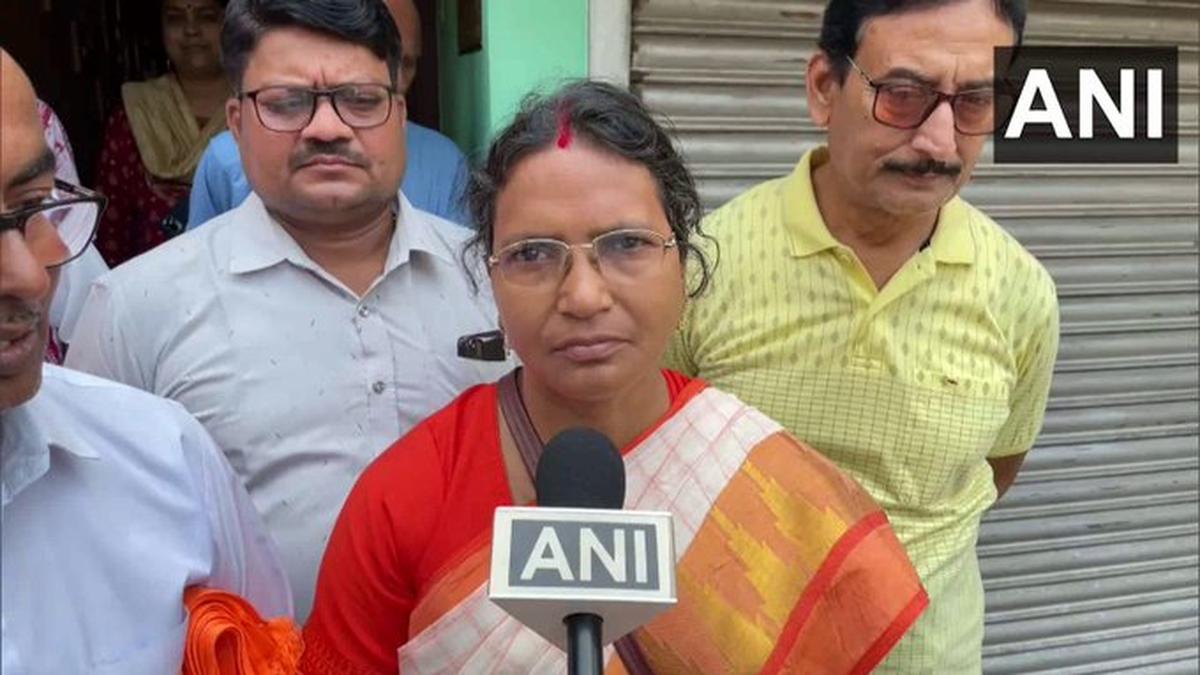
After the BJP fielded Ratna Debnath, mother of the RG Kar Hospital rape and murder victim to contest the Assembly elections, a major political row has erupted in West Bengal politics. After over one-and-half years of the brutal incident in Kolkata’s state-run RG Kar Medical College and Hospital, the major issue that had largely subsided has re-emerged in the State’s political and social arena.

public opinion

The matter has literally divided public opinion after Debnath decided to fight elections as a BJP candidate, with a section supporting her to turn her grief into a political battle, while others criticised her decision to politicise a movement that was mostly apolitical in nature.

Bengal witnessed waves of mass protests, involving various apolitical groups and citizens’ forums, demanding justice for the victim and severe punishment for everyone involved in the heinous crime. The body of the on-duty woman doctor was found in the hospital on August 9, 2024. After fielding Ratna Debnath from the Panihati constituency in North 24 Parganas district, the BJP said this is not just a candidature, it is a fight for justice.

“Let us not forget how the Mamata Banerjee government handled this horrific crime. From attempts to suppress the truth, erasing evidence, mishandling the autopsy, hurried cremation, failure to preserve samples for further forensic examination to tampering with the crime scene, serious questions were raised at every step,” said BJP leader Amit Malviya on social media platform X on Thursday.

“The people of West Bengal deserve accountability. They deserve a government that stands with victims, not one that appears to shield wrongdoing,” Malviya added. Suvendu Adhikari, the Leader of Opposition, met the Debnath family with party workers. The parents of the deceased doctor said their decision to align with the saffron party for the upcoming Assembly elections was driven by their continued fight for justice. And, they believe only the BJP can ensure justice for their daughter and provide safety and security to the women of the State.

Debnath will contest against Kalatan Dasgupta, the CPI-M candidate in the constituency, considered a Trinamool stronghold. Dasgupta was among the young Turks of the Left party, which was involved in the mass protests that followed the brutal incident. A political controversy erupted when the murdered doctor’s parents criticised the CPM-led Left, accusing it of benefiting politically from their daughter’s death and helping the Trinamool Congress remain in power.

“The Left fought for justice and to ensure safe nights and safe days for women in Bengal. And Rightists (BJP) have used the incident for their political benefit,” CPI-M State Secretary MD Salim told businessline.

“Now, it became a political battle, perpetrator of the crime on one side along with those who wanted to put it under carpet and never allowed a proper investigation, and on the other side, millions of people, including women, not seeing the cast, creed, language or identity of the victim. This was universal and the whole movement was Left-oriented,” said Salim, adding that in West Bengal a united Left resurgence started with such movements.

Tilottama Majumdar, a renowned Bengali author, observed that the victim’s mother has every right to turn her grief into a political battle to ensure justice for her young daughter. “Nobody in this world has gone through more pain than her. It is her right to fight an election and in today’s Bengal she could opt only for BJP, the main Opposition party,” said Majumdar.

“The BJP was trying to capitalise from the mass movement that Bengal saw after this gruesome incident. They were not able to. But, now they can. But, I don’t think this matter is now becoming a major political issue,” said political analyst Sabyasachi Basu Ray Chaudhury.

Published on March 26, 2026


Source link

Chennai Petroleum announces ₹8 per share interim dividend

Chennai Petroleum announces ₹8 per share interim dividend


The Board of Directors of Chennai Petroleum Corporation Ltd. on Thursday declared an interim dividend of ₹8 per equity share of face value ₹10 each for the financial year 2025-26.

The interim dividend will be paid to the eligible shareholders on or before April 25, 2026, the oil major said in an exchange filing.

The Board has also fixed Thursday, April 2, 2026, as the “record date” for the purpose of ascertaining the eligibility of shareholders for payment of the interim dividend.

Published on March 26, 2026


Source link

Crude oil supply for 4 months; LPG production up with shortfall down to 30,000 tons/day

Crude oil supply for 4 months; LPG production up with shortfall down to 30,000 tons/day


Gas flaring at an oil refinery.
| Photo Credit:
HHakim

The government on Thursday asserted that India’s energy supply is “fully secure and under control,” with two months’ worth of crude oil stocks and an equivalent volume of cargoes already secured for the next two months.

India’s liquefied petroleum gas (LPG) production has been ramped up to a record 50,000 tonnes per day, meeting over 60 per cent of the country’s requirement. This has reduced the net daily import requirement to 30,000 tpd.

“All retail fuel outlets have enough supplies. There is no shortage of petrol, diesel, or LPG anywhere in the country. The Ministry calls upon citizens not to be misled by a deliberately mischievous, coordinated campaign of misinformation that is being carried out to spread unjustified panic,” the Ministry of Petroleum and Natural Gas (MoPNG) said.

Robust stock cover

India has a total reserve capacity of 74 days, with actual stock cover currently at around 60 days — including crude, petroleum products, and strategic cavern storage — even as the West Asia crisis enters its 27th day.

All Indian refineries are operating at over 100 per cent utilisation, MoPNG noted.

“Nearly two months of steady supply is available for every Indian citizen regardless of global developments. The next two months of crude procurement has also been secured. India is completely secure for the coming months, and the quantity in strategic cavern storage becomes secondary in such a supply situation,” the Ministry added.

The Ministry said that under the LPG Control Order, domestic refinery production has been increased by 40 per cent, taking daily output to 50,000 tonnes against a requirement of about 80,000 tonnes.

Cargoes en route

“The net daily import requirement has consequently come down to only 30,000 tonnes. In addition, 800,000 tonnes of assured inbound LPG cargoes are secured and en route from the US, Russia, Australia and other countries, arriving across India’s 22 LPG import terminals,” it said.

Published on March 26, 2026


Source link

YouTube
Instagram
WhatsApp