Govt orders oil and gas firms to share data with PPAC

Govt orders oil and gas firms to share data with PPAC


India has ordered ​companies across its oil ‌and gas industry to ​submit ⁠detailed data on production, imports, stocks and consumption ‌to a central government agency, according ‌to a ‌government ⁠notification issued ⁠late on Wednesday.

The order designates the Petroleum ​Planning and ‌Analysis Cell (PPAC) as the body to collect and analyse ‌the information, and requires ​firms including producers, refiners, importers ⁠and distributors to report data at regular ‌intervals.

The order from the Ministry of Petroleum and Natural Gas said the move ‌aims to establish ​a centralised system to monitor the petroleum ⁠and natural gas ⁠supply chain more effectively ‌in the “public interest”.

Published on March 19, 2026


Source link

HDFC Bank says chairman exit may be over rift with management; stock falls

HDFC Bank says chairman exit may be over rift with management; stock falls


India ​largest private lender said on Thursday that the abrupt exit of its ‌chairman could be due to a rift between him ​and the management team, adding there were no material ⁠issues at the bank.

Shares of HDFC Bank fell as much as 8.7 per cent on Thursday after its non-executive Chairman Atanu Chakraborty resigned, citing differences over “values ‌and ethics”, which has raised governance concerns.

India’s central bank has approved the appointment of former long-time HDFC Group ‌executive Keki Mistry as an interim non-executive chairman for three ‌months, ⁠the bank said. Mistry told reporters and analysts on ⁠a call that there had been no discussion with regards to governance within the board.

On the call, he added that he was not aware ​of the issues raised by Chakraborty ‌in the resignation letter that the bank received on Wednesday and said there were “no power struggles within the bank”.

“There could have been a relationship issue between Chakraborty and management. That ‌may have manifested over a period of time,” Mistry said.

“Chakraborty’s ​resignation has nothing to do with operational profitability of bank,” he added.

The shares, which at the day’s ⁠low saw their steepest drop in more than two years, were the top drag on the benchmark Nifty 50 index, which ‌fell 2.3 per cent.

As of 9:30 a.m. IST (0400 GMT), the bank’s shares had pared some losses to trade 4.3 per cent lower.

Chakraborty, a former bureaucrat, was appointed as HDFC Bank’s chairman in April 2021 for a three-year term and reappointed in 2024 through May 2027.

“Certain happenings and practices within the bank, that I have observed over ‌last two years, are not in congruence with my personal values and ​ethics,” Chakraborty said in his resignation letter published on India’s stock exchanges, without elaborating. He could not be reached ⁠for comment.

“While governance standards have historically been strong for the bank, ⁠the current episode raises concerns about aspects that we may have limited insights, but could be material from ‌a stock multiple perspective,” said Kotak Institutional Equities in a note.

Published on March 19, 2026


Source link

Share Market Today: भारतीय शेयर बाजार में हाहाकार, खुलते ही 1953 अंक गिरा सेंसेक्स, निफ्टी 525

Share Market Today: भारतीय शेयर बाजार में हाहाकार, खुलते ही 1953 अंक गिरा सेंसेक्स, निफ्टी 525


Share Market Today: भारतीय शेयर बाजार में आज 19 मार्च को बड़ी गिरावट देखी जा रही है. बाजार खुलते ही सेंसेक्स में 1953 अंकों की भारी गिरावट आई और यह 74751 के स्तर पर खुला. वहीं, निफ्टी भी लगभग 525 अंक लुढ़ककर कारोबार कर रहा है. 

एशियाई बाजारों का बुरा हाल

गुरुवार को एशियाई बाजार भारी गिरावट के साथ लाल निशान में रहे. सभी प्रमुख सूचकांकों में नुकसान देखने को मिला. वॉल स्ट्रीट में रातोंरात गिरावट के बाद जापान का निक्केई लगभग 2.5 परसेंट गिरा और टॉपिक्स में लगभग 1.8 परसेंट की गिरावट देखी गई. वहीं, दक्षिण कोरिया का कोस्पी लगभग 2.6 परसेंट तक लुढ़क गया और कोस्डैक में भी करीब 1.7 परसेंट की गिरावट दर्ज की गई. ऑस्ट्रेलिया का S&P/ASX 200 भी कमजोर खुला और लगभग 1.5 परसेंट नीचे कारोबार करता नजर आया.

वॉल स्ट्रीट में भारी गिरावट

बुधवार, 18 मार्च को अमेरिकी शेयर बाजार में भारी गिरावट देखने को मिली. बाजार बंद होने तक सभी प्रमुख इंडेक्स अपने निचले स्तर तक पहुंच गए. डाउ जोन्स इंडस्ट्रियल एवरेज 768.11 अंक या 1.63 परसेंट की भारी गिरावट के साथ 46225.15 पर बंद हुआ. S&P 500 में भी 1.36 परसेंट की गिरावट आई और यह 6624.70 पर बंद हुआ. वहीं, Nasdaq Composite 1.46 परसेंट गिरकर 22152.42 पर बंद हुआ. बुधवार को अमेरिकी शेयर बाजार में गिरावट की दो बड़ी वजहें रहीं. पहली वजह- अमेरिकी फेड रिजर्व का ब्याज दरों को 3.50-3.75 परसेंट तक स्थिर रखना और दूसरी वजह- ईरान में युद्ध के चलते कच्चे तेल की कीमतों में 111 डॉलर प्रति बैरल से ज्यादा का उछाल. इससे दुनियाभर में महंगाई बढ़ने की आशंकाएं तेज हो गई हैं.  

कच्चे तेल की बढ़ी कीमतें

पश्चिम एशिया में बढ़ते तनाव के कारण कच्चे तेल की कीमतें 4 परसेंट तक बढ़ गई हैं. US West Texas Intermediate (WTI) कच्चा तेल लगभग 3.1 परसेंट बढ़कर 99.31 डॉलर प्रति बैरल के करीब पहुंच गया है. वहीं, Brent क्रूड ऑयल लगभग 4.1 परसेंट बढ़कर 111.59 प्रति बैरल पर है.

ये भी पढ़ें:

8वें वेतन आयोग पर बड़ी खबर! 31 मार्च तक बढ़ी डेडलाइन, सरकारी कर्मचारियों के लिए क्या है इसके मायने? 


Source link

World’s largest LNG plant in Qatar suffers extensive damage from Iran strike

World’s largest LNG plant in Qatar suffers extensive damage from Iran strike


FILE PHOTO: QatarEnergy’s liquefied natural gas (LNG) production facilities, amid the US-Israeli conflict with Iran, in Ras Laffan Industrial City, Qatar March 2, 2026.
| Photo Credit:
STRINGER

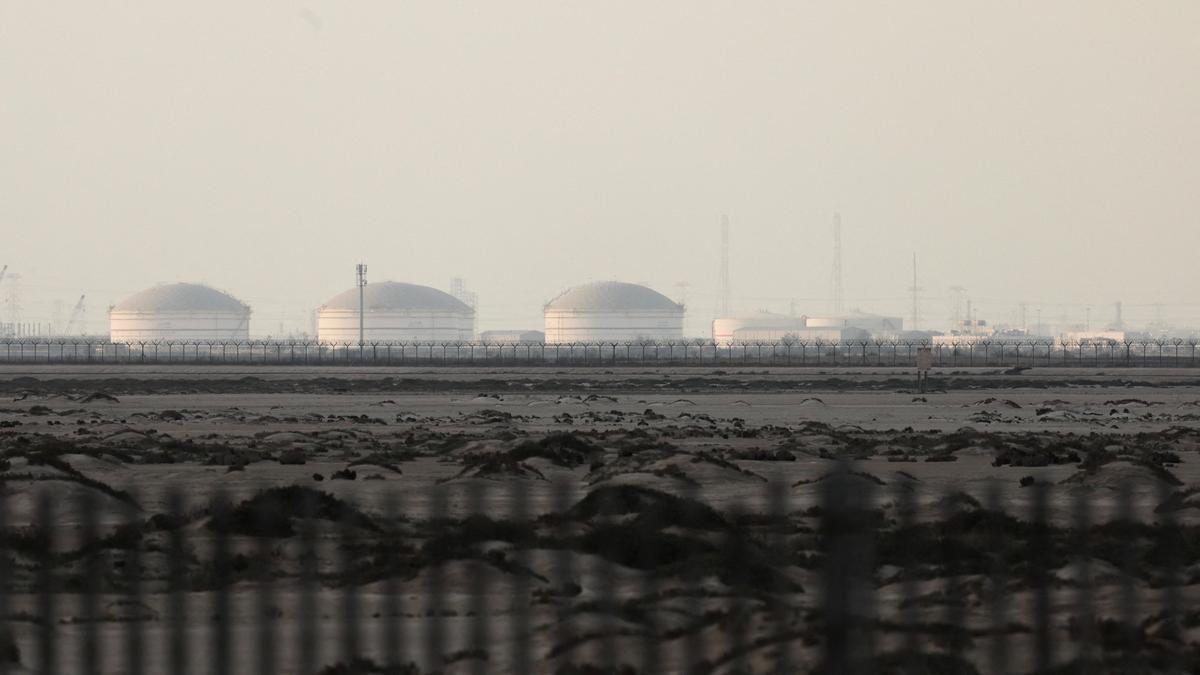
A Qatari complex housing the world’s largest liquefied natural gas export plant suffered “extensive damage” amid a sharp escalation of attacks on energy facilities across the Persian Gulf. 

The Ras Laffan Industrial City, home to the LNG plant that accounted for about a fifth of global supply before production was halted earlier this month, was hit by an Iranian missile after four others were intercepted, authorities said late Wednesday. Hours later, Abu Dhabi shut its Habshan gas facilities after they were hit by falling debris from an intercepted strike.

A subsequent attack on Ras Laffan early on Thursday led to a fire, which Qatari authorities said they were dealing with. QatarEnergy said in a statement that several of its LNG facilities were hit, causing sizable fires and extensive further damage. No casualties were reported. The US would retaliate if Qatar’s LNG facilities were attacked again, President Donald Trump said in a post on Truth Social.

Targeting oil, gas infra

The incidents mark yet another escalation in hostilities in the region and follow a string of attacks targeting oil and gas infrastructure in recent days. Crude and natural gas prices surged earlier in the day after Israel attacked Iran’s giant South Pars gas field. Tehran responded with a warning that several energy sites in Qatar, Saudi Arabia and United Arab Emirates had become “legitimate targets.” 

“A retaliatory attack on Ras Laffan is exactly what the global natural gas market feared the most,” said Tom Marzec-Manser, Europe gas and LNG director at consultancy Wood Mackenzie Ltd. “We’re yet to know which part of the industrial complex has been damaged, but either way it’s going to be bullish for gas prices when the market opens on Thursday.”

Brent oil futures extended gains after the attacks, rising as much as 5.1 per cent on Thursday.

State-controlled QatarEnergy said all personnel were accounted for at its LNG facility, which had been evacuated hours earlier. Qatar’s interior ministry said the fire caused by the strike was under control. 

Qatar “considers this aggression a dangerous escalation and a flagrant violation of the state’s sovereignty, as well as a direct threat to its national security and the stability of the region,” the Ministry of Foreign Affairs said in a social media post. It later ordered Iranian military and security attaches as well as affiliate staff to leave the country within 24 hours.

The Abu Dhabi Media Office said in a post on X that no injuries were reported at Habshan. Abu Dhabi National Oil Co operates one of the world’s largest onshore gas processing facilities there, with 14 trains able to produce more than 6 billion cubic feet of gas a day, enough to supply South Korea. 

The Saudi Defense Ministry also said the country had thwarted a drone attack targeting a gas facility in its eastern region. In a separate incident, shrapnel from a ballistic missile fell near a south Riyadh refinery.

Ras Laffan Industrial City covers 295 square kilometers in area (114 square miles), about one-third the size of New York City. As well as LNG processing, it’s also home to other gas-related facilities, including a gas-to-liquids plant, LNG storage, and condensate splitters, as well as an oil refinery.

The site was effectively cut off from the rest of the world by the throttling of tanker traffic through the Strait of Hormuz following US and Israeli attacks on Iran. Production was halted earlier this month after an Iranian drone attack, leading QatarEnergy to declare force majeure on deliveries, throwing the global LNG market into turmoil and sending buyers scrambling for alternative supplies.

The market impact has been particularly severe in Asia and Europe, as both regions rely on imported gas for power generation. The latest attacks have raised questions about how long supply will be impacted even once the strait reopens. 

“It’s now hard to see Qataris coming back to the market before the middle of the year and even that is ambitious,” said Ira Joseph, global fellow at the Center on Global Energy Policy at Columbia University.

Shell Plc, which has interests in some of Ras Laffan’s gas and LNG infrastructure, said it’s assessing any potential impact from the attack.

More stories like this are available on bloomberg.com

Published on March 19, 2026


Source link

Global energy shock from Iran war pushes nuclear and renewable expansion

Global energy shock from Iran war pushes nuclear and renewable expansion


The energy shock from the Iran war
has policymakers around the globe rethinking ways to reduce
long-term dependence on oil and gas ​imports, with proposals to
expand nuclear energy and renewables, grow strategic stockpiles
and domestic production, and diversify foreign sources of
supply.

Iran’s closure of the vital Strait of Hormuz shipping lane,
after the U.S. and Israel attacked on February 28, marks the
third time this decade that an ‌international energy shock has
forced governments to reckon with the risks of a world dependent
on the free flow of vast quantities of petroleum to fuel its
economic engine. It has also ​stoked the view that the fossil
fuel age must end, after pushback in recent years to ongoing
efforts to mitigate climate change.

“The issue of energy security has never been as acute as
now. Until a ⁠few weeks ago, markets took Gulf resources for
granted. That will not be the case going forward,” said Geoffrey
Pyatt, who was assistant secretary of state for energy resources
under Joe Biden and is now a senior managing director at U.S.
consultancy McLarty Associates.

The world’s biggest energy consumer nations are now back at
the drawing board: Europe last week unveiled new financial
guarantees for atomic power after decades of closing nuclear
plants. Other major importers are planning to source fuel from a
broader array of suppliers to hedge their risk.

In a timely article ‌about a potential blockage to Hormuz, a
department within China’s state planner, which shapes the
country’s economic strategy, said on the first day of the war
that the country should accelerate its renewable energy
transition, as well as expand its emergency reserves and source
more energy from alternative suppliers.

“Not only China, but around the world,” governments “will
reconsider their energy supply lines and production systems and
perhaps pay more attention to nuclear and ‌clean energy,” Wang
Jin, senior fellow at the Beijing Club for International
Dialogue, a think tank under the purview of the foreign
ministry, told Reuters.

China is already the world’s leading source of clean energy
technologies.

In the shorter-term, big consumer ‌nations ⁠have opted for a
record-sized coordinated release of emergency stocks, along with
requests by governments – particularly in Asia – for consumers
to conserve energy.

Around 20% of world oil and liquefied natural gas supply has
been blocked after ⁠Tehran effectively locked down Hormuz – the
main artery for Middle East fossil fuels headed to world
markets. The International Energy Agency has called it the worst
disruption to global energy supplies in history. Global crude
oil prices have surged to above $100 a barrel.

The crisis follows two previous major energy upsets of the
2020s: Russia’s 2022 invasion of Ukraine led Europe to slash its
dependence on Russian imports; and the 2020 COVID19 pandemic
that triggered a sudden, massive decline in world demand for
fossil fuels followed by a rebound that world’s top producers
were ill-prepared to meet.

ASIAN DEPENDENCE

Asia sources the vast majority of ​its oil and LNG imports
from the Middle East, making it the region most affected by ‌both
higher prices and physical supply disruption caused by the Iran
conflict.

The issue has revived support in some corners for nuclear
energy as a way to reduce regional reliance on power fueled by
natural gas and other fossil fuels.

In Taiwan, economy minister Kung Ming-hsin said on March 11
the island is considering restarting its last nuclear station,
which closed in May, after the main opposition party lambasted
the government following the start of the Iran conflict for
phasing out nuclear power. Around one-third of Taiwan’s LNG
supply comes from Qatar, whose production has been cut by the
fighting.

Tokyo had already been discussing the restart of reactors
idling since the 2011 Fukushima disaster, as Japan looks to
reduce the country’s large ‌dependence on energy imports. But
politicians have called on Prime Minister Sanae Takaichi to do
more to boost the industry since the start of the Iran war.

Taiwan’s economy ministry said the use of nuclear power ​must
be premised on ensuring nuclear safety. Taiwan will continue the
expansion of renewable energy and natural gas storage facilities
to increase safety reserves, it said. Japan’s industry ministry
did not reply to a request for comment.

In China, the world’s top buyer of Iranian oil, refiner
Sinopec has cut production by 10%. Beijing has also banned fuel
exports to help avert domestic shortages.

China has, however, been relatively ⁠insulated from the
crisis due to its ample emergency oil reserves and high rate of
electrification, with EVs representing more than half of its
domestic new car sales and its grid more than 50% powered by
renewable energy sources.

In the U.S., by comparison, EVs are less than 10% of the
market, while renewable power is around a quarter of the
nation’s electricity generation.

Jin, of the Beijing Club think tank, said China saw the Iran
crisis as an opportunity to create new avenues for cooperation,
and that Beijing ‌sought friendly, stable energy relations with
all producers.

China’s foreign ministry declined comment and the National
Development and Reform Commission did not respond to a request
for comment.

Government officials and company executives in Japan,
Taiwan, Bangladesh and Pakistan have said they also plan to
diversify their import sources and buy LNG on the spot market,
instead of relying on long-term contracts from the Middle East.

“A STRATEGIC MISTAKE”

The cost of the EU’s fossil fuel imports, meanwhile, has
risen by 6 billion euros since the start of the war, putting
massive upward pressure on the continent’s power prices.

Being “completely dependent on expensive and volatile
imports” of fossil fuels puts Europe at a structural
disadvantage to other regions, European Commission President
Ursula von der Leyen said in a March 10 speech, while putting
forward a new program to offer a 200 million euro guarantee for
private investments in innovative nuclear technologies.

Reducing the share of nuclear in the overall mix of power
supplies in Europe over the past 25 years “was a strategic
mistake,” von der Leyen said.

EU member states led by Germany had shut down nuclear plants
in recent decades amid worries about accidents and radioactive
waste, reducing generation to a 15% share of the trade bloc’s
total from about a third in 1990.

To shield residents and businesses from ‌spiking power costs,
the European Union is drafting changes to its carbon market to
try to curb CO2 prices, alongside state aid measures like
subsidies and tax breaks.

RUSSIAN PERKS

As the world’s largest oil and gas producer, the United
States is less concerned about domestic supply shortfalls. It
sources only ​a small amount of its imports from the Middle East.
But Washington is focused heavily on ways to tame global energy
prices while conducting the war.

A White House official said the disruption to Middle East
supply was a reason for countries to increase production of
fossil fuels, not replace them.

“The terrorist Iranian regime’s control over a chokehold
like the Strait of Hormuz has proven that our allies need ⁠to
invest in infrastructure to produce reliable, affordable, secure
energy sources like crude oil and natural gas,” said White House
spokeswoman Taylor Rogers.

Consumer price inflation is a key vulnerability for
President Donald Trump and his Republicans leading into
November’s midterm elections.

As part of efforts to ⁠boost global supply, the Trump
administration has eased sanctions on Russia to allow other
countries to purchase more Russian oil.

The Iran crisis may also prompt a reassessment of western
sanctions on Russian LNG, according to analysts, as the EU and
Asian importers struggle from the loss of supply since the onset
of the conflict.

LNG makes up 45% of the EU’s total gas imports, up from 20%
in 2021, before the 2022 Ukraine war led ‌European nations to
replace Russian pipeline gas.

“EU politicians are back on the backfoot,” said a gas trader
at Vitol, a commodity trading house. “This looks like 2022 all
over again.”

The EU’s ambitious plans for green energy could eventually
limit its exposure to oil disruptions. But it also risks
building a new dependency on China, said Bart Groothuis, a
member of the European Parliament and vice-chair for the
delegation for relations with Iran.

“We’re building new dependencies and new problems inside our
energy ​infrastructure by building dependencies, total
dependencies, on Chinese hard and software,” Groothuis said.

Published on March 19, 2026


Source link

Wall Street falls as Fed keeps rates steady amid rising oil prices and Iran war

Wall Street falls as Fed keeps rates steady amid rising oil prices and Iran war


A trader works, as a screen broadcasts a press conference by U.S. Federal Reserve Chair Jerome Powell following the Fed rate announcement, on the floor of the New York Stock Exchange (NYSE) in New York City, U.S., March 18, 2026.
| Photo Credit:
Brendan McDermid

Wall Street ended sharply lower on
Wednesday after the Federal Reserve held U.S. interest rates
steady and ‌projected only a single rate cut for the year as
officials took stock of ​economic risks from surging oil prices
and the U.S. and Israeli war with Iran.

New ⁠projections from U.S. central bank policymakers showed
the Fed’s benchmark overnight interest rate would fall by just a
quarter of a percentage point by the end of this year, with no
hint of timing.

Major stock indexes extended declines after ‌Fed Chair Jerome
Powell held a news conference and reiterated the uncertainty the
war creates for the economic outlook.

Economists had not expected the Fed to change its interest
rate.

“The Fed is ‌on hold. With inflation running above target and
the economy running above trend, and elevated ‌uncertainty ⁠about
the path of the Iran war, there is no argument for easing
policy,” said Michael ⁠Rosen, chief investment officer at Angeles
Investments in Santa Monica, California.

“The bigger challenge for the Fed, exacerbated by the war,
is balancing its dual mandate of full employment and low, stable
inflation. Should the war persist and oil prices remain high, it
will ​cause economic slowing. But easing monetary policy ‌would be
a mistake as that would only fuel inflation.”

Earlier, the U.S. Labor Department said the Producer Price
Index rose 3.4% year-on-year, exceeding economists’ 2.9%
forecast, with prices at risk of accelerating further as the
Middle East conflict lifts shipping and oil costs.
Brent crude extended gains and reached near $110 a ‌barrel after
an Iranian news agency reported that some facilities belonging
to Iran’s oil industry in ​South Pars and Asaluyeh were attacked.

The S&P 500 declined 1.36% to end the session at 6,624.70
points, its lowest close in nearly four months. It is now ⁠down
about 3% in 2026.

The Nasdaq declined 1.46% to 22,152.42 points, while the Dow
Jones Industrial Average declined 1.63% to 46,225.15 points.

All of the 11 S&P 500 sector indexes declined, led lower by
consumer staples, down 2.44%, ‌followed by a 2.32% loss
in consumer discretionary.
AMD gained 1.6% after agreeing with Samsung Electronics
to expand their strategic partnership on memory chip
supplies for AI infrastructure. Nvidia dipped 0.8%
after securing Beijing’s approval to sell its
second-most-powerful artificial intelligence chips in China.

Micron Technology tumbled 4.3% in extended trade
after the memory chipmaker projected quarterly sales above Wall
Street expectations and said it was boosting its fiscal 2026
capital expenditure plans.

Asset manager Apollo Global Management rose 2.1%,
rebounding from sharp losses in the previous week on private
credit quality concerns.
Lululemon surged ‌3.8% after the yoga-wear maker’s
quarterly results. Founder Chip Wilson, who is in a proxy battle
with the company, said lead ​director David Mussafer’s decision
to exit the board was “a step in the right direction”, and
reiterated the need for a “substantial” board refresh.
Macy’s jumped 4.7% after the department store chain ⁠said
it expected a comparatively smaller impact from tariffs in the
second half of the year and beat quarterly ⁠profit estimates.

Declining stocks outnumbered rising ones within the S&P 500
by a 5.2-to-one ratio.

The S&P 500 posted 17 new highs and 15 new lows; the Nasdaq
recorded 42 new highs and ‌218 new lows.

Volume on U.S. exchanges was relatively light, with 19.4
billion shares traded, compared to an average of 19.8 billion
shares over the previous 20 sessions.

Published on March 19, 2026



Source link

YouTube
Instagram
WhatsApp