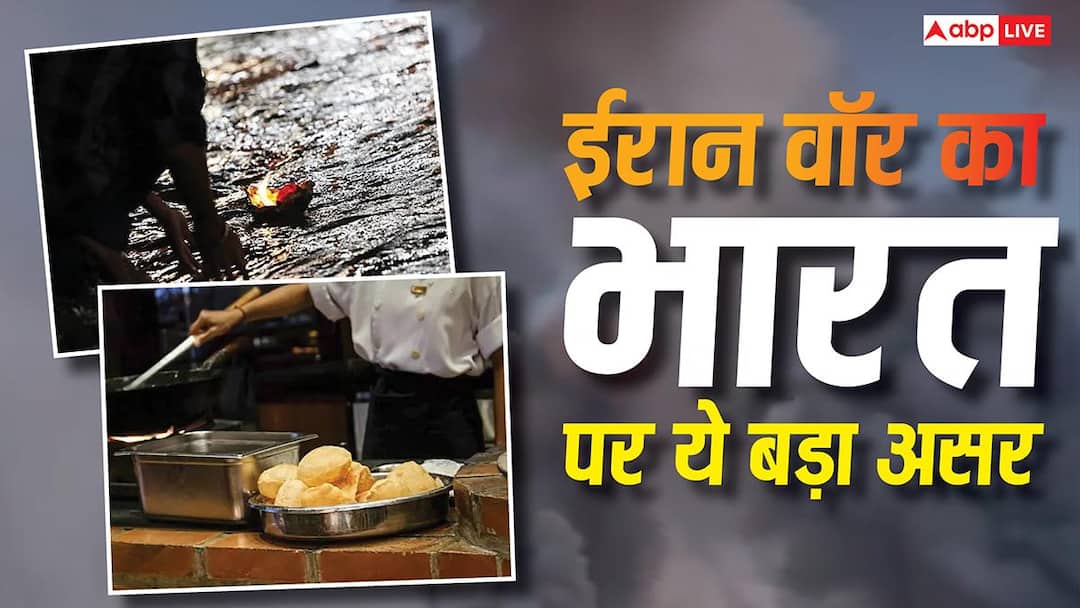
होटल-रेस्टुरेंट्स से लेकर अंतिम संस्कार तक… ईरान वॉर के भारत के ऊपर पड़े ये पांच बड़े असर

होटल-रेस्टुरेंट्स से लेकर अंतिम संस्कार तक… ईरान वॉर के भारत के ऊपर पड़े ये पांच बड़े असर


Middle East Tensions:  वेस्ट एशिया में जारी संघर्ष को लगभग दो हफ्ते हो चुके हैं, लेकिन हालात में अभी तक कोई ठोस सुधार नहीं दिख रहा है. न तो Iran की ओर से समझौते का संकेत मिला है और न ही United States या Israel की तरफ से तनाव कम होने के संकेत मिले हैं. इसी बीच कच्चे तेल की कीमतों में फिर तेजी देखने को मिल रही है. हाल ही में Crude Oil करीब 120 डॉलर प्रति बैरल के स्तर तक पहुंच गया था और अब फिर 100 डॉलर के पार कारोबार कर रहा है.

इस तनाव का सीधा असर भारत की अर्थव्यवस्था और आम लोगों की जिंदगी पर भी पड़ रहा है। आइए समझते हैं कि इस संघर्ष का भारत पर क्या असर हो रहा है.

1-गैस की बढ़ती किल्लत

युद्ध की वजह से वैश्विक ऊर्जा आपूर्ति प्रभावित हुई है. खासकर Strait of Hormuz के बंद होने से तेल और गैस की सप्लाई पर बड़ा असर पड़ा है. भारत अपनी ऊर्जा जरूरतों का लगभग 80% आयात करता है, इसलिए इस संकट का सीधा असर देश पर पड़ रहा है.

कई उद्योग जैसे फर्टिलाइज़र प्लांट, टाइल्स फैक्ट्रियां और रेस्टोरेंट गैस की कमी से प्रभावित हो रहे हैं. National Restaurant Association of India (NRAI) ने अपने सदस्यों को मेनू छोटा करने, बिजली के उपकरणों का इस्तेमाल बढ़ाने और काम के घंटे घटाने की सलाह दी है.

2-अंतिम संस्कार व्यवस्था पर असर

एलपीजी की कमी का असर श्मशानों तक पहुंच गया है. कई जगह गैस से चलने वाली भट्टियां बंद करनी पड़ी हैं और अब अंतिम संस्कार लकड़ी से किए जा रहे हैं.

3-हवाई किराया महंगा

जेट ईंधन की कीमत बढ़ने से विमानन कंपनियों की लागत बढ़ गई है. इसके अलावा मिडिल ईस्ट रूट पर उड़ानों का बीमा भी महंगा हो गया है. युद्ध के कारण दुनिया भर में लगभग 46,000 से अधिक उड़ानें रद्द हुई हैं और अंतरराष्ट्रीय हवाई किराया काफी बढ़ गया है.

4-सोना-चांदी की कीमतों में गिरावट

आमतौर पर वैश्विक तनाव के समय सोने की कीमतें बढ़ती हैं क्योंकि इसे सुरक्षित निवेश माना जाता है. लेकिन इस बार तेल की कीमतों में तेजी के कारण महंगाई बढ़ने का डर है. इससे Federal Reserve द्वारा ब्याज दरें कम न करने की संभावना बढ़ गई है. मजबूत डॉलर के कारण सोने की कीमतों पर दबाव आया है. रिपोर्ट के अनुसार Goldman Sachs का मानना है कि अब ब्याज दरों में कटौती सितंबर से पहले संभव नहीं है.

5-आर्थिक विकास पर असर

भारत ने 2047 तक विकसित देश बनने का लक्ष्य तय किया है, जिसके लिए 8–11% जीडीपी वृद्धि दर जरूरी मानी जाती है. लेकिन अगर कच्चे तेल की कीमत 100 डॉलर प्रति बैरल के आसपास बनी रहती है, तो इसका असर आर्थिक वृद्धि पर पड़ सकता है. अनुमान है कि इससे भारत की जीडीपी वृद्धि दर में करीब 0.60 प्रतिशत (60 बेसिस प्वाइंट) तक की गिरावट आ सकती है.

ये भी पढ़ें: ईरान वॉर और अमेरिका-इजरायल के बरसते बम के गोलों के बीच अब चीन ने उठाया बड़ा कदम


Source link

NBFCs in India to outpace banks with AI-driven lending growth

NBFCs in India to outpace banks with AI-driven lending growth


India’s non-bank financial companies (NBFCs) are poised for faster growth than traditional banks over the next decade, according to a Nomura report. While banks currently hold over 70% of total credit, NBFCs are expected to grow at a 17% CAGR between FY25 and FY35, compared with 12% for banks.

India’s non-bank financial companies (NBFCs) are expected to expand faster than traditional banks over the coming decade as lenders adopt artificial intelligence and expand into new loan segments, according to a research report by Nomura.

Banks currently dominate India’s lending system, accounting for more than 70% of total credit as of FY25, while NBFCs hold a much smaller share. However, Nomura forecasts NBFC credit will grow at roughly 17 per cent annually between FY25 and FY35, compared with about 12 per cent growth for bank lending over the same period.

“We note that AI can help NBFCs identify potential prime customers and bring about more efficiency in high-intensity product segments at a transformative pace. However, we raise caution around the regulatory gap on the matter. We expect the gap between the loan growth of banks vs NBFCs to widen further, with NBFCs recording a 17 per cent CAGR over FY25-35F vs 12 per cent for banks,” read the Nomura report.

Retail credit driving NBFC expansion

India’s lending ecosystem already totals about Rs 232 trillion (USD 2.6 trillion) in outstanding credit, but credit penetration remains relatively low compared with major economies. Nomura expects India’s credit-to-GDP ratio to rise significantly over time as access to financing expands. NBFCs have increasingly diversified their lending portfolios in recent years, moving beyond traditional wholesale lending into retail products such as vehicle loans, consumer durable financing, personal loans and microfinance, areas where demand remains strong. Retail credit accounts for a large portion of NBFC lending and is expected to remain a key growth driver.

AI adoption reshaping India’s finance sector

Artificial intelligence is becoming an important tool for lenders. The report says financial institutions are deploying AI systems to improve credit underwriting, customer support, sales and marketing, cybersecurity and internal operations, while using alternative data to identify potential borrowers.

“The India NBFC sector is set to witness a steep rise in competition, as many lenders are now focused on expansion into new products and markets. Investment in and development of AI engines across the sector is increasing and could potentially drive structural transformations in lending processes,” the report read. At the same time, regulators are preparing for wider adoption of the technology. India’s central bank has issued recommendations for responsible AI use in financial services and is expected to develop a regulatory framework as implementation increases across the sector. As competition intensifies and digital tools reshape lending practices, analysts say NBFCs could play a growing role in expanding credit access, particularly among underserved consumers and small businesses.

Published on March 12, 2026


Source link

Razorpay launches AI Agent Studio and Agentic Experience Platform to automate payments

Razorpay launches AI Agent Studio and Agentic Experience Platform to automate payments


Razorpay, India’s omnichannel payments and banking platform for businesses, on Thursday announced the launch of the world’s first Agent Studio built using the Claude Agent SDK from Anthropic at the FTX 2026 event.

The company also introduced its Agentic Experience Platform, a new AI-native layer aimed at simplifying how online businesses onboard to Razorpay, integrate payments into their products and manage payment operations.

According to the company, the new launches mark the beginning of a new era of commerce where artificial intelligence will reshape how payment infrastructure for Indian businesses is built and experienced.

Real-time revenue recovery and payment management

In an official statement it stated “Razorpay Agent Studio is the world’s first AI-powered platform where agents work alongside businesses – recovering revenue, managing payments, and running financial operations in real time, all natively inside Razorpay”

As part of the announcement at FTX’26, Razorpay also unveiled a key AI-payments product suite designed to automate several aspects of digital commerce and payment operations.

Build customized AI agents without coding

The company introduced the Razorpay Agent Studio, described as a B2B agent marketplace and builder platform for payments and business banking. Built using the Claude Agent SDK from Anthropic, the platform allows businesses to deploy AI agents designed to perform specific commerce-related tasks.

The platform is designed to address operational challenges faced by online businesses, such as recovering abandoned carts, retrying failed subscriptions, reconciling settlements and resolving payment disputes, which currently require significant manual effort.

Through the Agent Studio, businesses can access a marketplace of AI agents and deploy them with a single click. Each agent is designed to handle a particular function, enabling merchants to manage multiple commerce workflows without relying on separate tools.

Voice-powered agents convert abandoned carts

For the initial rollout, Razorpay introduced several production-ready AI agents. These include the Abandoned Cart Conversion Agent, which converts abandoned carts into completed purchases through voice-led interactions in partnership with Nugget by Zomato and SuperU.

Other agents include the Dispute Responder Agent, which responds to payment disputes with a higher win rate, the Subscription Recovery Agent, which intelligently recovers failed subscriptions using voice technology developed with ElevenLabs, and the Cashflow Forecaster Agent, which predicts cashflow patterns and identifies potential liquidity gaps.

The system works by analysing customer activity in real time. For example, when a customer leaves during checkout, the AI agent can initiate a conversation through voice or messaging to understand the reason and offer incentives such as discounts before sending a payment link to complete the purchase.

Integration with Indian and global platforms

Razorpay said the Agent Studio also integrates with multiple platforms including Shopify, Shiprocket, WhatsApp, ElevenLabs, Slack, Tally, Sarvam and Quickbook, giving agents access to broader business data and enabling them to make smarter decisions. First external agents on the Agent Studio include Nugget by Zomato and SuperU.

In addition, the platform includes a “Build Your Agent” feature that allows businesses to create customised AI agents without coding by simply describing the required task in plain English.

Conversational AI streamlines merchant experience

Alongside Agent Studio, Razorpay introduced the Agentic Experience Platform, which aims to simplify onboarding, integration and payment operations through conversational AI.

The platform offers three capabilities: Agentic Onboarding, which allows businesses to complete onboarding in 5 minutes by sharing details such as PAN and website while identity checks are completed automatically through government infrastructure.

The second capability, Agentic Dashboard, enables merchants to manage payments using natural language commands. For instance, a merchant can upload a bank statement and ask the system to match it with Razorpay settlements, a process that traditionally takes finance teams hours but can now be completed in seconds.

The third feature, Agentic Integration, enables partners, merchants and developers to integrate Razorpay’s payment infrastructure in under 10 minutes using AI coding environments such as Claude Code and no-code platforms like Replit and Emergent.

AI agents transform Indian payment infrastructure

According to the company, these launches represent a shift from traditional payment processing systems toward AI-driven financial infrastructure where intelligent agents can automate tasks, manage payment operations and act on behalf of businesses.

Speaking at FTX, Harshil Mathur, Co-founder & CEO, Razorpay, said, “Businesses don’t just need more software anymore – they need intelligence that can act. With the launch of the world’s first Agent Studio for payments, we’re enabling companies to deploy AI agents that can understand and monitor their revenue flows, resolve payment issues, and unlock insights across billions of transactions in real time.”

Commenting on the partnership, Irina Ghose, Managing Director, Anthropic India said, “Razorpay’s work with Claude shows how AI agents can address real commerce challenges – recovering revenue, resolving disputes, and predicting cash flow. It’s a great example of what AI can do when it’s embedded into the operating fabric of business.”

Published on March 12, 2026


Source link

Bhilwara textile industry faces export disruptions due to West Asia conflict

Bhilwara textile industry faces export disruptions due to West Asia conflict


The ongoing West Asia conflict is significantly affecting the textile industry in Bhilwara, Rajasthan, a major hub producing over 10 crore meters of cloth monthly and employing more than 2 lakh people.

The ongoing conflict in West Asia has begun to affect the textile industry in Bhilwara, Rajasthan, with export orders being stalled and trade disruptions impacting shipments worth around Rs 800 to Rs 1000 crore, industry representatives said.

Bhilwara, widely known as a major textile hub in India, houses a large number of textile manufacturing units and employs thousands of workers across the sector.

Bhilwara remains major textile manufacturing hub

RK Jain, General Secretary of Mewar Chamber of Commerce Industrial Organisation, told ANI that the city’s textile sector is facing challenges due to the ongoing conflict in the Gulf region.

“Bhilwara is renowned as a textile city. Over 450 fabric units, over 20 spinning units, 21 processing units, and over five denim industries operate here. Approximately 10 crore meters of cloth are produced every month, and more than 2 lakh people are employed directly or indirectly in the textile industry,” Jain told ANI.

Large manufacturing base supports local jobs

He said that the industry has started to feel the impact of the conflict, particularly in export markets.

“Textile industries are also facing some trouble due to the war, and if the war continues in the near future, exports from here could be affected. Currently, export orders are on hold,” he said.

Export orders put on temporary hold

According to Jain, several shipments are either stalled locally or stuck at ports, while some export orders have been temporarily put on hold by overseas buyers due to the uncertain situation.

“They are either stalled locally or at the port, or have been put on hold by other parties. If this situation persists for a long time, our exports could be severely affected,” he said.

Gulf, Europe key textile export markets

The Gulf region and Europe remain key export destinations for the Bhilwara textile industry.

Jain said yarn produced in Bhilwara is exported to Bangladesh and European countries, while a portion is also exported to Gulf countries. Fabric exports, on the other hand, are largely directed towards Gulf countries and European markets.

Trade route disruption slows export movement

Due to the ongoing conflict and disruption in trade routes, export movement has slowed significantly, impacting business sentiment among textile manufacturers in the region.

Industry representatives say that if the geopolitical situation continues for a prolonged period, the textile sector in Bhilwara could face deeper challenges, particularly in maintaining export volumes and sustaining production levels.

Published on March 12, 2026


Source link

LPG Shortage LIVE: Iran allows Indian ships through Hormuz as oil tops 0 and LPG concerns rise in India

LPG Shortage LIVE: Iran allows Indian ships through Hormuz as oil tops $100 and LPG concerns rise in India


JM Financial — Oil & Gas Sector Update 

Focus: Indian government’s press briefing on energy security amid the Middle East crisis

Crude oil:

India’s daily crude consumption is 5.5 mmbpd. Currently, 70% of crude imports are arriving via non-Strait routes (up from 55% previously due to diversification), meaning 30% of crude requirements remain disrupted.

India’s refining capacity is at ~100% utilization, supported by 10–50 days of crude inventory held at refineries.

Total crude + petroleum product inventory (industrial + strategic) is estimated at 30–40 days of domestic demand, comprising:

IOCL: 45–50 days crude + 10–15 days product inventory

Other refiners: 10–20 days crude + 10–15 days product

Strategic crude reserve: ~6 days (~30 mmbbls)

Conclusion: India’s oil inventory can meet the SoH-related shortfall for 3–4 months.

Natural gas:

India’s total gas consumption is ~189 mmscmd; domestic production covers 97.5 mmscmd, imports cover ~92 mmscmd.

~47.4 mmscmd of imported gas has been disrupted due to force majeure — representing ~25% of total gas supply.

India has minimal gas storage (gas is structurally hard to store), so the only sustainable solution is 20–25% demand rationalisation across sectors.

Two LNG cargoes are en route to India via alternative routes.

The government issued the Natural Gas (Supply Regulation) Order, 2026, which prioritizes supply as follows:

Priority Sector I (100%): Domestic PNG, CNG for transport, LPG production, pipeline compressor fuel.

Priority Sector II (70%): Fertilizer plants.

Priority Sector III (80%): Tea industry, manufacturing, industrial consumers on the national grid.

Priority Sector IV (80%): Industrial and commercial consumers via City Gas Distribution (CGD) networks.

Curtailed sectors: Petchem (OPaL, GAIL Pata), power plants, refineries (~65% of prior 6-month average).

GAIL and PPAC will manage allocation. The order overrides existing Gas Sale Agreements (GSAs).

LPG (most severely impacted energy commodity):

India imports ~60% of LPG requirements; 90% of those imports (~54% of total LPG demand) transit the Strait of Hormuz — now at a halt.

So 54% of India’s LPG supply is currently disrupted.

GoI response: ordered refineries and petchem companies to maximize LPG output by diverting all C3-C4 hydrocarbon streams. This raised domestic LPG production by 25%.

Net result: domestic production now covers ~50% of demand (up from 40%), and another ~6% is met via non-Strait import routes.

Total LPG availability: only 56% of demand. 44% remains unmet.

All domestic LPG production is being diverted to the household segment.

~85% of India’s LPG consumption is residential; ~15% is commercial.

Even the 56% availability falls short of meeting just the domestic/residential segment (which alone constitutes 85% of demand). Therefore, commercial LPG supply (restaurants, hotels, hospitals, etc.) faces severe and ongoing disruption.

The oil ministry has set up a three-member panel of OMC executives to devise a fair and transparent mechanism for commercial LPG allocation.

GoI is using OTP verification to prevent diversion of domestic LPG cylinders to commercial use.

Domestic LPG price: INR 913/cylinder in Delhi; INR 613/cylinder for PMUY beneficiaries (after INR 60 hike).

Minimum booking interval extended to 25 days (from 21 days) as a demand management measure.

Government stated that panic domestic LPG booking is due to misinformation — it maintains there is no shortage of domestic LPG supply (though commercially the supply picture is far more stressed).


Source link

IOC, BPCL, HPCL stocks slide as rising oil prices weigh on OMCs, aviation & chemical stocks

IOC, BPCL, HPCL stocks slide as rising oil prices weigh on OMCs, aviation & chemical stocks


Shares of crude-sensitive sectors such as oil marketing companies (OMCs), aviation, paints and chemicals declined on Thursday’s trade as global crude oil prices continued to surge amid escalating geopolitical tensions.

Among OMCs, Indian Oil Corporation (IOC) fell 4 per cent in early trade to ₹154.06 from its previous close of ₹160.63.

Bharat Petroleum Corporation Limited (BPCL) slipped over 3 per cent to ₹314 compared with ₹325.05 earlier, while Hindustan Petroleum Corporation Limited (HPCL) declined more than 4 per cent to ₹367.50 from ₹384.25.

IOC, BPCL, HPCL fall up to 4 per cent on margin concerns.

IndiGo drops 3.5 per cent as surging fuel costs weigh on aviation stocks

Asian Paints, Berger Paints India decline amid crude-linked input cost fears

Oil tops $100 per barrel despite proposed reserve release by International Energy Agency

Aviation major IndiGo also came under pressure, with shares falling 3.5 per cent to ₹4,194.10 from the previous close of ₹4,350.70 as higher fuel costs threatened profitability.

Paint makers, which are heavily dependent on crude-linked raw materials, also witnessed selling pressure. Asian Paints and Berger Paints India declined between 1 per cent and 3 per cent during the session.

The decline in crude-sensitive counters came despite global efforts to calm oil markets through emergency reserve measures, signalling investor concerns that supply disruptions may persist longer than expected.

The International Energy Agency (IEA) has proposed a release of emergency oil reserves to ease supply pressures. A report by The Wall Street Journal said the agency is considering its largest-ever coordinated reserve release aimed at cooling crude prices.
However, geopolitical risks continued to escalate. Iraq halted operations at its oil terminals after ships were reportedly targeted, adding to global supply uncertainties.

Rating agency S&P Global Ratings had recently warned that profit margins of oil marketing companies such as IOC, BPCL and HPCL could come under strain as they may keep retail fuel prices unchanged to help contain inflationary pressures.

Oil prices have climbed sharply since the start of the US-Iran conflict, with crude rising above $100 per barrel earlier this week. The Strait of Hormuz — a critical route that handles nearly a fifth of global crude oil and liquefied natural gas flows — remains effectively closed, intensifying fears of prolonged supply disruptions.

Published on March 12, 2026


Source link

YouTube
Instagram
WhatsApp




