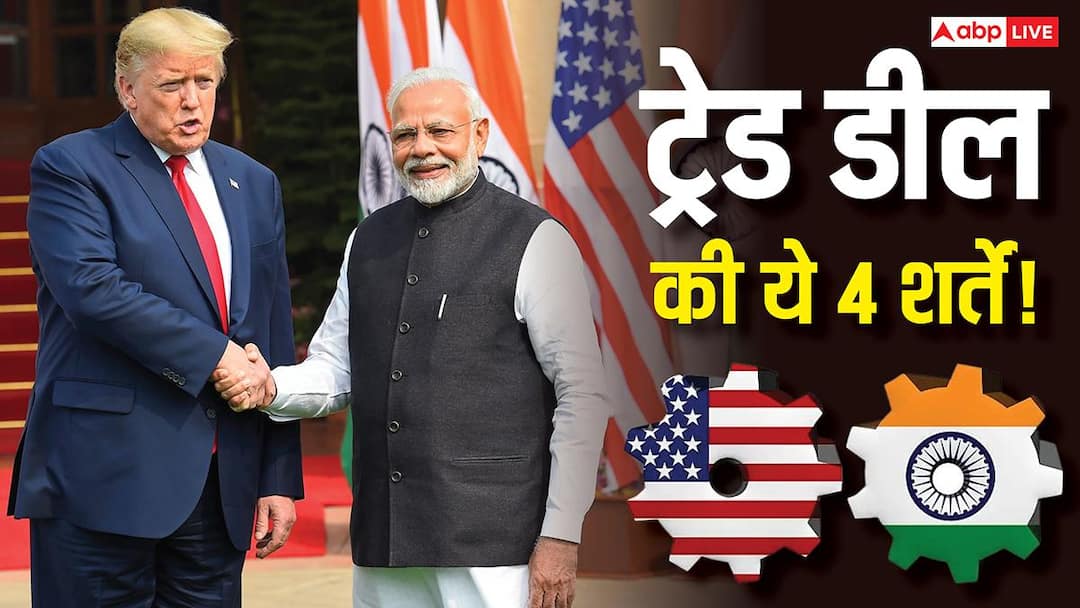
वो 4 बड़ी शर्तें! जिसके बाद भारत के साथ ट्रेड डील पर राष्ट्रपति ट्रंप ने लगाई मुहर

वो 4 बड़ी शर्तें! जिसके बाद भारत के साथ ट्रेड डील पर राष्ट्रपति ट्रंप ने लगाई मुहर


India US Trade Deal: अमेरिकी राष्ट्रपति डोनाल्ड ट्रंप ने सोमवार देर रात भारत-अमेरिका ट्रेड डील का ऐलान करते हुए भारत पर लगाए गए भारी टैरिफ में बड़ी कटौती की घोषणा की, जिसके तहत अब शुल्क घटाकर 18 प्रतिशत कर दिया गया है. कई हफ्तों की अनिश्चितता के बाद हुई इस डील को दोनों देशों के रिश्तों में अहम कदम माना जा रहा है. प्रधानमंत्री नरेंद्र मोदी ने इस फैसले का जोरदार स्वागत करते हुए कहा कि दुनिया के दो बड़े लोकतंत्रों के बीच इससे आपसी सहयोग और मजबूत होगा.

इससे पहले अमेरिका ने रूस से सस्ता कच्चा तेल खरीदने को लेकर भारत पर कुल 50 प्रतिशत तक का टैरिफ लगाया था, जिसे अब हटा दिया गया है. ट्रंप ने ट्रूथ सोशल पर दावा किया कि भारत रुस से तेल की खरीद रोकने पर सहमत हो गया है, हालांकि पीएम मोदी ने अपने बयान में रूस से तेल खरीद को लेकर कोई टिप्पणी नहीं की.

ट्रेड डीर पर क्या हैं चार शर्तें-

1-ट्रेड डील की शर्तों के मुताबिक भारत अमेरिकी उत्पादों पर टैरिफ और नॉन-टैरिफ बैरियर कम करेगा और अमेरिकी कंपनियों के लिए अपने बाजार को और खोलेगा.

2-अमेरिका ने रूस से तेल खरीद को लेकर लगाए गए 25 प्रतिशत अतिरिक्त टैरिफ को हटाने की बात कही है, हालांकि इस पर आधिकारिक पुष्टि नहीं हुई है और अलग-अलग एजेंसियों ने अलग जानकारी दी है.

3-ट्रंप ने इस समझौते को सीधे यूक्रेन युद्ध से जोड़ते हुए कहा कि रूस से तेल न खरीदने का दबाव मॉस्को पर पड़ेगा और इससे युद्ध खत्म करने में मदद मिल सकती है. साथ ही उन्होंने कहा कि भारत अमेरिका और संभवतः वेनेजुएला से ज्यादा तेल खरीदेगा.

4-इसके अलावा डील के तहत भारत अमेरिका से ऊर्जा, तकनीक, कृषि उत्पाद, कोयला समेत पेट्रोलियम, डिफेंस, इलेक्ट्रॉनिक्स, फार्मा, टेलीकॉम और एयरक्राफ्ट जैसे उत्पादों की खरीद बढ़ाएगा, जिससे अमेरिकी निर्यात को बड़ा बढ़ावा मिलने की उम्मीद जताई जा रही है.

उद्योग जगत ने किया स्वागत

भारतीय उद्योग जगत के शीर्ष नेताओं ने मंगलवार को कहा कि भारत-अमेरिका व्यापार समझौता भारत की वृद्धि महत्वाकांक्षाओं को नई गति देगा और देश को वैश्विक स्तर पर प्रतिस्पर्धी विनिर्माण व नवाचार केंद्र बनाने में मदद करेगा. भारती एंटरप्राइजेज के संस्थापक एवं चेयरमैन सुनील मित्तल, आदित्य बिड़ला समूह के कुमार मंगलम बिड़ला और महिंद्रा समूह के अनीश शाह सहित उद्योग जगत के दिग्गजों ने इसे द्विपक्षीय व्यापार और निवेश परिदृश्य को बदलने की क्षमता वाला ऐतिहासिक कदम बताया.

महिंद्रा ग्रुप के सीईओ और प्रबंध निदेशक अनीश शाह ने इसे व्यापार और निवेश संबंधों को मजबूत करने की दिशा में महत्वपूर्ण कदम बताते हुए कहा कि यह सौदा भारत की मजबूत वृद्धि राह के साथ उसकी महत्वाकांक्षाओं को ठोस समर्थन देगा.

वहीं सुनील भारती मित्तल ने कहा कि यह समझौता दोनों देशों के लिए बहुप्रतीक्षित और अहम उपलब्धि है, जो निवेश और विकास के अपार अवसर खोलेगा, और मुक्त व्यापार समझौतों की यह श्रृंखला इस बात का प्रमाण है कि भारत वैश्विक व्यापार ढांचों के केंद्र में सक्रिय भूमिका निभा रहा है.

ये भी पढ़ें: यूएस टैरिफ में कटौती से गदगद एक्सपोर्टर और शेयर बाजार, 48 अरब डॉलर के निर्यात को मिलेगा बूस्ट


Source link

Gold rate today Feb 3 : Gold rates up in Mumbai, Delhi, Chennai, Kolkata, Ahmedabad & Bengaluru

Gold rate today Feb 3 : Gold rates up in Mumbai, Delhi, Chennai, Kolkata, Ahmedabad & Bengaluru


Gold prices up across India
| Photo Credit:
VIJAY SONEJI

Gold prices in India have seen an upward trend today, February 3, with a mild increase across all major cities. The price of both 22-carat and 24-carat gold has risen compared to yesterday’s rates. This report provides a detailed, city-by-city breakdown of today’s gold prices.

Gold Rate in India

The average price for 22-carat gold in India today is ₹13,960 per gram, marking an increase of ₹20. For 8 grams, the price is ₹1,11,6280, up by ₹160. The 24-carat gold price stands at ₹14,658 per gram (up by ₹21) and ₹1,17,264 for 8 grams (up by ₹168).

Gold Rate in Mumbai

In Mumbai, the price for 1 gram of 22-carat gold today is ₹13,960 per gram, marking an increase of ₹20. For 8 grams, the price is ₹1,11,6280, up by ₹160. The 24-carat gold price stands at ₹14,658 per gram (up by ₹21) and ₹1,17,264 for 8 grams (up by ₹168).

Gold Rate in Chennai

Chennai’s gold rates have also seen a jump. A gram of 22-carat gold is priced at ₹14,030, a rise of ₹80. An 8-gram piece costs ₹1,12,240, up by ₹640. For 24-carat gold, the price is ₹14,732 per gram, an increase of ₹84, and ₹1,17,856 for 8 grams, up by ₹672.

Gold Rate in Hyderabad

Hyderabad’s 22-carat gold price is ₹14,030 per gram, an increase of ₹80. The 8-gram price is ₹1,12,240 up by ₹640.

The 24-carat gold rate is ₹14,732 per gram, up by ₹84, and ₹1,17,856 for 8 grams, up by ₹672.

Gold Rate in Delhi

In Delhi, the price of 22-carat gold is ₹14,010 per gram (up by ₹20) and ₹1,12,080 for 8 grams (up by ₹160). The 24-carat gold price is ₹14,711 per gram, a jump of ₹21, while 8 grams costs ₹1,17,688, up by ₹168.

Gold Rate in Ahmedabad

Ahmedabad’s gold prices also reflect the national trend. The price for 1 gram of 22-carat gold is ₹14,014, an increase of ₹20, and ₹1,12,112 for 8 grams, up by ₹160. For 24-carat gold, the price is ₹14,715 per gram (up by ₹21) and ₹1,17,720 for 8 grams (up by ₹168).

Gold Rate in Kolkata

In Kolkata, 1 gram of 22-carat gold is priced at ₹14,060, up by ₹20, and 8 grams at ₹1,12,480, up by ₹160. The price for 24-carat gold is ₹14,763 per gram, an increase of ₹21, while 8 grams is priced at ₹1,18,104, up by ₹168.

Gold Rate in Bengaluru

Bengaluru also witnessed a rise in gold rates. The price of 22-carat gold is ₹14,020 per gram (up by ₹20) and ₹1,12,160 for 8 grams (up by ₹160). The 24-carat gold price is ₹14,721 per gram (up by ₹21) and ₹1,17,768 for 8 grams (up by ₹168).

Gold Rates Courtesy: bankbazaar.com

More Like This

The probability of a Fed rate cut next month inched down to 69 per cent on Monday, after jumping to 74 per cent in the previous session, according to the CME FedWatch Tool

Published on February 3, 2026



Source link

Immediate halt of Russian crude oil imports to India unlikely soon

Immediate halt of Russian crude oil imports to India unlikely soon


Despite the US President Donald Trump’s assertion that India has promised to halt Russian crude oil imports, analysts and refiners say a complete halt is “extremely unlikely” at least for the next two to three months.

Moreover, they caution that if India did completely halt Russian cargoes, the implications for the world’s fastest growing economy could be “disruptive”.

Besides, trade sources, refiners and analysts clarified that thus far, there is no diktat from the government to stop purchases of crude oil from Moscow.

Logistics also supports their claim: typically, cargoes from Russia are booked about 10 weeks in advance. Currently, vessels ferrying the commodity are at various stages of loading and transporting, which means that cargoes booked 10 weeks prior will continue to off-load crude oil at Indian ports, mostly on the west coast, till end-March or April 2026.

Sumit Ritolia, Kpler’s Lead Research Analyst for Refining & Modelling, told businessline “India–US trade deal does not imply a near-term structural shift in India’s crude slate. Russian barrels remain sticky in the next term (around 2 months), while incremental diversification risk skews toward US and Venezuelan crude rather than a sharp displacement of Urals.”

Moody’s Ratings said “Even though India has reduced its purchase of crude oil from Russia in recent months, it is unlikely to cease all purchases immediately, which could be disruptive to India’s economic growth. A complete shift toward non-Russian oil could also tighten supply elsewhere, raise prices and pass through to higher inflation given that India is one of the world’s largest oil importers.”

However, Prashant Vasisht, Senior VP and Co-Group Head, Corporate Ratings, ICRA, said “The discounts on Russian crude oil were marginal prior to the US announcing sanctions on some Russian crude suppliers in October 2025, and ICRA estimates that replacement of Russian crude with market-priced crude would lead to an increase in the import bill of the country by less than 2 per cent.”

The announcement of the US-India trade deal includes removing the 25 per cent penal tariffs on India, with the latter agreeing to stop purchases of crude oil from Russia, he added.

Additionally, India is to step up purchases of US crude oil and potentially start buying oil from Venezuela. For the Indian refining sector, there are ample avenues including the US, to purchase crude as Russian crude accounted for less than 2 per cent of Indian crude imports prior to FY23, he said.

“Additionally Venezuelan crudes are heavy and sour and therefore cheaper and would be of interest to Indian refiners, many of whom can process these types of crudes,” Vasisht said.

Published on February 3, 2026


Source link

Gold, silver rise as investors look for bargain hunting

Gold, silver rise as investors look for bargain hunting


At 1245 hours IST, gold was up by $227 or nearly 5 per cent at $4,887.05 an ounce. Gold April futures on COMEX gained over 5.5 per cent at $4,913.14 an ounce.
| Photo Credit:
matejmo

Bargain hunting put an end to the fall in gold and silver prices, as the precious metals gained handsomely on Tuesday in the global market.

“The sharp correction — around 25 per cent in gold and 45 per cent in silver from recent highs — has attracted strong physical buying from investors who were waiting for meaningful price retracements to accumulate precious metals,” said Renisha Chainani, head of research at Augmont.

Silver, again, outshone gold, gaining over 8 per cent, while gold rose nearly 5 per cent by mid-day. In India, the yellow precious metal gained by 10 per cent, but silver dropped marginally in the Mumbai spot market. But on MCX, gold futures were  5.5 per cent and silver contracts by 11 per cent as investors saw a buying opportunity after the precious metals complex was mauled on Friday and Monday. 

At 1245 hours IST, gold was up by $227 or nearly 5 per cent at $4,887.05 an ounce. Gold April futures on COMEX gained over 5.5 per cent at $4,913.14 an ounce.  In the Mumbai spot market, gold opened at ₹1,50,708 per 10 gm and on MCX, the precious metal’s April futures ruled at ₹1,51,900, a gain of nearly ₹8,000.  

Silver at premium in China

Silver surged to $86.3 an ounce, up by over $7. On COMEX, silver March futures increased to $86.06 an ounce. In the Mumbai spot market, silver opened at ₹2,55,372 against ₹2,59,500 last evening. On MCX, silver March futures increased by over ₹27,800 a kg to ₹2,64,100. 

On the Shanghai Futures Exchange, silver March futures ruled at 21,750 yuan a kg ($97.39 an ounce). The white precious metal is at a premium in China as it is in demand for a slew of industries, such as electric vehicles, electronics and data centres. 

Platinum was up over 5% at $2,219.40 an ounce.  Palladium gained nearly 7 per cent at $1,822 an ounce.

Hareesh V, Head of Commodity Research, Geojit Investments Limited, said, “A dramatic unwind hit gold and silver markets over the past two days, erasing a chunk of their record‑breaking January gains. The plunge began after CME Group hiked margin requirements on both metals, forcing leveraged traders to liquidate positions and accelerating a wave of selling.” 

Lack of key data

The correction was amplified by extreme overbought conditions after gold and silver touched unprecedented highs just days earlier, with silver having surged more than 60 per cent in a month and gold over 20 per cent. Profit‑taking cascaded into panic selling as liquidity thinned and volatility spiked, he said.

“The violent drop is more like a technical correction than a deterioration in core fundamentals, noting that longer‑term drivers—geopolitical tensions, central‑bank buying and macro uncertainty—remain intact,” said Hareesh.

Chainani said gold and silver rebounded nearly 10 per cent from recent lows as markets factor in the absence of key US economic data due to a partial government shutdown and renewed bargain hunting.  

 Gold prices may extend the ongoing rebound toward $5,000 (₹155,000), with strong support seen near $4,600 (₹139,000).

Silver is attempting to build a base and is expected to consolidate in the $72–$87 range (~₹225,000–₹270,000). A buy-on-dips and sell-on-rallies strategy is advisable within this range amid elevated volatility, she said.

The precious metals complex has had a dazzling run up to a record high of $5,608 on geopolitical crises, US trade disputes with other nations, and investors switching over to precious metals, fearing slack economic growth. In addition, silver is facing physical deficit for over seven years in a row. 

Published on February 3, 2026


Source link

GAIL shares swing after Q3 profit slump

GAIL shares swing after Q3 profit slump


Shares of GAIL (India) rose sharply in early trade on Tuesday despite a steep year-on-year decline in December-quarter profit, before paring gains later in the session.

The stock climbed nearly 4 per cent to ₹166.49 on the NSE from its previous close of ₹160.39, but at 11.39 am was trading almost flat at ₹161.80.

The state-run gas utility reported a 58.5 per cent fall in standalone net profit for the quarter ended December 2025 to ₹1,602.57 crore, compared with ₹3,867.38 crore in the same period last year.

Revenue from operations slipped about 2.5 per cent to ₹34,075.81 crore in Q3FY26 from ₹34,957.76 crore a year earlier.

Brokerages attributed the weaker earnings primarily to softness in gas trading margins and continued pressure in the petrochemicals segment, partly offset by better performance in gas transmission.

JM Financial said GAIL’s standalone EBITDA at ₹26.6 billion came in below its estimate and consensus due to sharply lower profitability in gas trading and a steep fall in petchem earnings.

This was partially cushioned by stronger gas transmission EBITDA, helped by lower operating costs and slightly higher volumes, as well as better-than-expected performance in the LPG pipeline business.

The brokerage maintained its buy call while revising its target price to ₹205, citing expectations of steady growth in transmission volumes and sustained trading profitability over the medium term.

HDFC Securities, retained a buy rating at ₹196, even though the reported EBITDA and adjusted profit after tax were below its estimates. It said GAIL’s ability to defend gas marketing margins amid rising gas costs and a recovery in transmission volumes underpins its positive stance, while noting that petrochemical profitability remained a drag during the quarter.

Motilal Oswal reiterated its buy at target price of ₹190, projecting a 19 per cent compound annual growth in profit over FY26–28. The brokerage expects this to be driven by higher gas transmission volumes, improved performance in the petrochemical business as new capacity comes on stream and spreads recover, and healthy profitability in the trading segment. It also forecast return on equity stabilising above 12.5 per cent and strong free cash flow generation over the period.

Nuvama Institutional Equities, however, struck a cautious note, highlighting delays in tariff hikes and a prolonged downcycle in petrochemicals. The brokerage said GAIL’s Q3 EBITDA missed consensus expectations mainly because of weaker petchem earnings, while transmission volumes were flat year on year. It cut its FY27 and FY28 estimates and maintained a reduce rating with a target price of ₹151.

Published on February 3, 2026


Source link

Indian refiners seek wind-down period to exit Russian crude oil imports

Indian refiners seek wind-down period to exit Russian crude oil imports


Indian refiners will need a wind-down period ​to complete Russian oil deals before imports from that country can be ‌halted, and they have so far not been ordered by the government ​to stop such imports, two refining sources said.

U.S. President Donald Trump announced a trade agreement with Prime Minister Narendra Modi on Monday that included a halt to Indian oil purchases from Russia.

Indian companies have already booked cargoes loading in February and arriving in March, so a wind-down period would be needed to fulfil existing commitments, the sources said. They spoke on condition of anonymity because they were not authorised to speak ​with the media.

The trade deal with India would slash U.S. tariffs on ⁠Indian goods to 18% from 50% in exchange for India lowering trade barriers and stopping its purchases of Russian oil. It would buy oil instead from the U.S. and potentially Venezuela.

India became the top buyer of ​discounted Russian seaborne crude after the ⁠2022 outbreak of war in Ukraine, generating a backlash among Western nations that targeted Russia’s energy sector with sanctions.

The United States wants to curb Russia’s oil revenues to make it harder for Moscow to fund the war.

“We spoke about many things, ‌including Trade, and ending the War with Russia and Ukraine,” Trump said of ‌his discussion with Modi. “He agreed to stop buying Russian Oil, and to buy much more from the United States and, potentially, Venezuela.”

Modi followed with ‍a post on social media that he was delighted with the reduced tariff, but made no mention of a halt to purchases of Russian oil.

India will gradually cut its Russian ‍oil imports, a third source said, adding that a complete halt would hit operations at Russia-backed Indian refiner Nayara Energy’s 400,000-barrel-per-day refinery.

Nayara relies solely on Russian crude after Iraq’s SOMO and Saudi Aramco pulled back amid payment difficulties following European Union sanctions imposed on the refiner in July last year.

This source said Nayara’s Russian oil imports in April would be negligible as it shuts its refinery for over a month from April 10 for maintenance.

Reuters last week reported that the United States had told Delhi it could soon resume purchases of ⁠Venezuelan oil to help replace imports of Russian oil. Trump said on Saturday that India would buy Venezuelan oil.

Oil Minister Hardeep Singh Puri ​said last month India was diversifying its crude sources as its Russian oil imports fall.

Data from trade ⁠sources showed India’s Russian oil imports fell to their lowest level in two years in December, while OPEC’s share of Indian imports rose to an 11-month high.

Indian refiners have been buying more oil from Middle Eastern, African and South American countries as they began scaling back Russian oil purchases, following discussions at ⁠a government meeting about accelerating a U.S.-India trade deal, refining sources said last month.

Published on February 3, 2026


Source link

YouTube
Instagram
WhatsApp



