Plasma on moon sparse, radio communication won’t be hard, finds Chandrayaan-3 instrument

Plasma on moon sparse, radio communication won’t be hard, finds Chandrayaan-3 instrument


Even as one more instrument onboard the Pragyan rover confirmed the presence of sulfur on the moon, another instrument—a Langmuir probe—on the Vikram lander has revealed that the density of plasma near the lunar surface is rather thin. 

A Langmuir probe—named after its inventor, the American physicist Irving Langmuir—is an instrument that measures properties of plasmas. (Plasma—not to be confused with blood plasma—is a state of matter, when it is super-hot. It is a soup of positively charged ions and negatively charged electrons.) 

The Langmuir probe on the Vikram lander, which ISRO has christened ‘Radio Anatomy of Moon Bound Hypersensitive Ionosphere and Atmosphere—Langmuir Probe (RAMBHA-LP) has checked out the plasma in the region near the moon’s surface and has assessed that “the plasma near the lunar surface is relatively sparse.” 

This means that there are not many electrons in this region of space, ISRO said in a tweet. The thinness of lunar plasma is important because it affects the way radio waves propagate through space. Radio waves are affected by the presence of plasma—the denser the plasma, the more the radio waves are scattered. 

The sparseness of lunar plasma means that radio waves can propagate through space with less attenuation, which is important for communication between lunar missions, ISRO said. 

The Langmuir probe

A Langmuir probe, which is essentially an electrode which, when dipped into plasma, can pick up electrons and ions, and measure the electron temperature, electron density and ion density of the plasma by obtaining its current-voltage characteristics. The RAMBHA-LP, developed by the Space Physics Laboratory (SPL), Vikram Sarabhai Space Centre (VSSC), Thiruvananthapuram, is a 5-cm metallic spherical probe mounted on a 1-meter boom and attached to the Lander’s upper deck. The boom, which opens like a switch-knife, holds the spherical probe away from the Lander, so that the probe is dipped into the undisturbed lunar plasma environment well away from the Lander’s body.  

In a press release issued today, ISRO noted that the system “can detect minute return currents, as low as pico-emperes with a dwell time of 1 millisecond.” 

The system can accurately determine ion and electron densities as well as their energies based on the measured return current. 

“The initial assessment indicates that the plasma encompassing the lunar surface is relatively sparse, characterized by a number density ranging from approximately 5 to 30 million electrons per cubic meter. This evaluation specifically pertains to the early stages of the lunar daytime. The probe operates without interruption, aiming to explore the changes occurring in the near-surface plasma environment throughout the lunar day. These ongoing observations hold significant implications for comprehending the process of charging within the lunar near-surface region, particularly in response to the fluctuations in solar space weather conditions,” the ISRO release says.  

More good news

Meanwhile, another instrument on the Pragyan rover confirmed the presence of sulfur in the region, using a different technique, called ‘alpha particle X-ray spectroscope’. This finding “compels scientists to develop fresh explanations for the source of sulphur in the area—intrinsic? Volacanic? Meteroritic?” tweeted ISRO. Earlier, the ‘laser-induced breakdown spectroscope’ (LIBS) on the rover had “unambiguously” confirmed the presence of sulphur there.  

Presence of sulphur on the moon has been known for decades, through analysis of soil samples brought by the Apollo missions of NASA, but this is the first time that an in-situ measurement was done. This finding may not be new, but it is a ‘technology demonstrator’. The LIBS has also found aluminium, calcium, iron, chromium, titanium, manganese, silicon and oxygen. “Search for hydrogen is underway,” ISRO said. 

Further, the rover was rotated around, in search of a safe route. ISRO has released pictures of the rotation, captured by a camera on the Lander. “It feels as though a child is playfully frolicking in the yards of Chandamama, while the mother watches affectionately. Isn’t it?” tweeted ISRO. 



Source link

Dropbox ends unlimited cloud storage following Google change

Dropbox ends unlimited cloud storage following Google change


Dropbox Inc., a provider of online data storage, is ending its unlimited option, saying a small handful of customers were using massive amounts of resources that had the potential to degrade the cloud service for the rest of its clients.

The company’s highest-tier “all the space you need” storage plan will be capped at about 5 terabytes per user for new customers, the company said in a blog post shared with Bloomberg to be released Thursday. That’s enough space to save about 33 million documents, Dropbox said.

While the plan was designed for businesses, some clients were instead using it for cryptocurrency mining, pooling storage with strangers, or re-selling the cloud service, Dropbox said. These uses “frequently consume thousands of times more storage than our genuine business customers, which risks creating an unreliable experience for all of our customers,” the company said.

Also Read | Dropbox announces new features including automated folders to help users stay organised

With more than 18 million paying users, Dropbox is one of the best-known companies in the cloud storage industry and reported $2.5 billion in annual recurring revenue during its fiscal-second quarter earnings on August 3. The company has worked to expand beyond storage with document management services and video-specific tools.

The change follows Alphabet Inc.’s Google removing “as much storage as you need” product branding for its highest-tier Workspace plan in May, according to copies of its website hosted on the Wayback Machine. Customers have posted on forums about being told they had exceeded storage limits and needed to pay for additional capacity. Some discussed moving to Dropbox after receiving such warnings.

A Google spokesperson said the company began rolling out “pooled storage” for customers last year, and those using over 80% of their plan’s limit will be notified. While storage policies weren’t changed in May, language was updated to “clarify that customers on these plans receive 5 TB of Drive Secure cloud storage per user with the ability to request more,” the spokesperson said.

Dropbox said it saw a surge of unintended uses the past few months “in the wake of other services making similar policy changes.” The company’s server capacity faced increased pressure in recent weeks, said a person familiar with the issue who asked not to be named discussing internal matters.

Under Dropbox’s new plan, each additional terabyte will cost $8 per month compared with the previous “as much space as needed” plan at $24 per month. Current users with less than 35 terabytes — more than 99% of top-tier plan customers — will be able to keep their current storage at the same price for five years, the company said. Those exceeding will be contacted “to discuss a range of options.”

Across the economy, more people and businesses rely on internet-based services to store and manage their files. Industry analyst IDC said that spending on cloud storage is expected to jump 25% this year to $59.9 billion, and hit $127.8 billion in 2027. For its infrastructure customers, Google increased the cost of cloud storage last year. Apple Inc. also recently raised cloud storage prices for customers in the UK. Amazon.com Inc. once offered an unlimited storage plan, before ending it in 2017. Microsoft Corp. made a similar move in 2015. Box Inc., another provider, still advertises “unlimited storage” for its enterprise plans.

“We recognize that changing an ‘all the space you need’ policy will be disappointing for some customers,” Dropbox said. “While we‘re unable to offer this option going forward, our goal is to ensure that the vast majority of teams on our Advanced plan experience no disruption.”

More stories like this are available on bloomberg.com


Source link

Chandrayaan-3: ISRO releases images of Lunar far side area captured by Lander camera

Chandrayaan-3: ISRO releases images of Lunar far side area captured by Lander camera


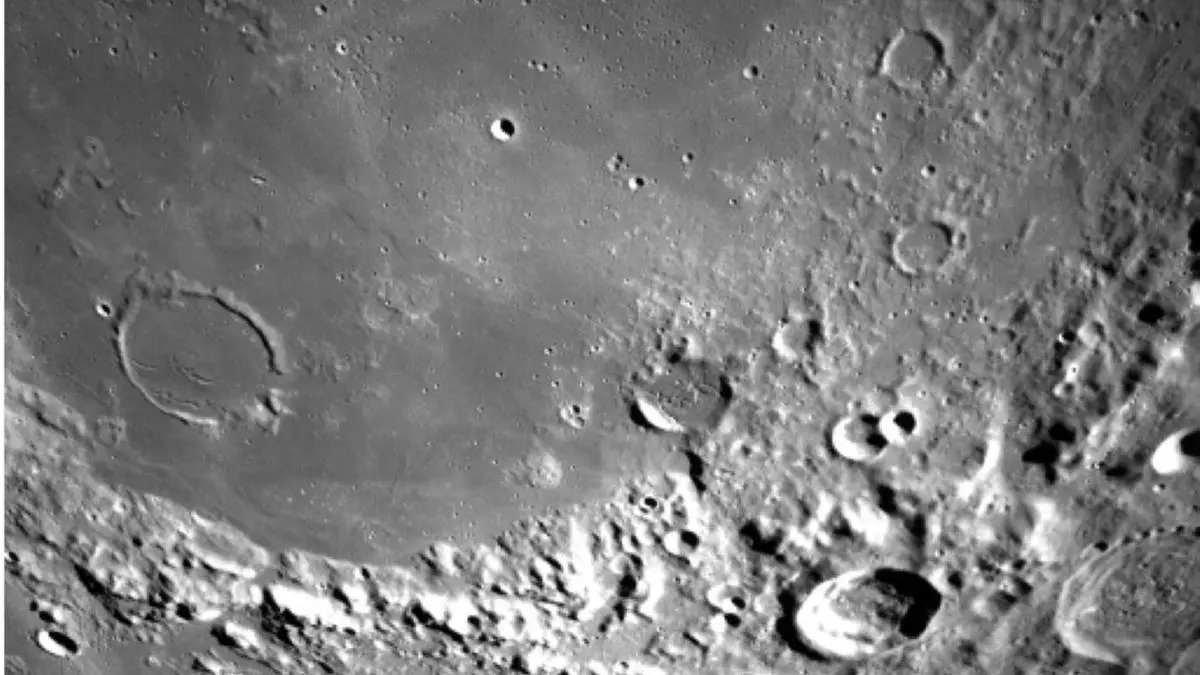
The ISRO on Monday released images of Lunar far side area captured by the Lander Hazard Detection and Avoidance Camera (LHDAC).

This camera that assists in locating a safe landing area — without boulders or deep trenches — during the descent is developed by Ahmedabad-based Space Applications Centre (SAC), a major research and development centre of ISRO.

Also Read | Chandrayaan-3 lunar landing: Lessons from Chandrayaan-2 drive success plans

According to the space agency, to achieve the mission objectives of Chandrayaan-3, several advanced technologies are present in the Lander such as LHDAC.

Chandrayaan-3, launched on July 14, is a follow-on mission to Chandrayaan-2 to demonstrate end-to-end capability in safe landing and roving on the lunar surface.

Also Read | Chandrayaan-3: Lander Module successfully separates; ready to be moved closer to Moon’s surface

The ISRO said on Sunday that the Lander Module with rover in its belly is expected to touch down on the surface of the Moon around 6.04 p.m. on August 23.


Source link

Digging ice-capped Arctic depths to understand climate change

Digging ice-capped Arctic depths to understand climate change


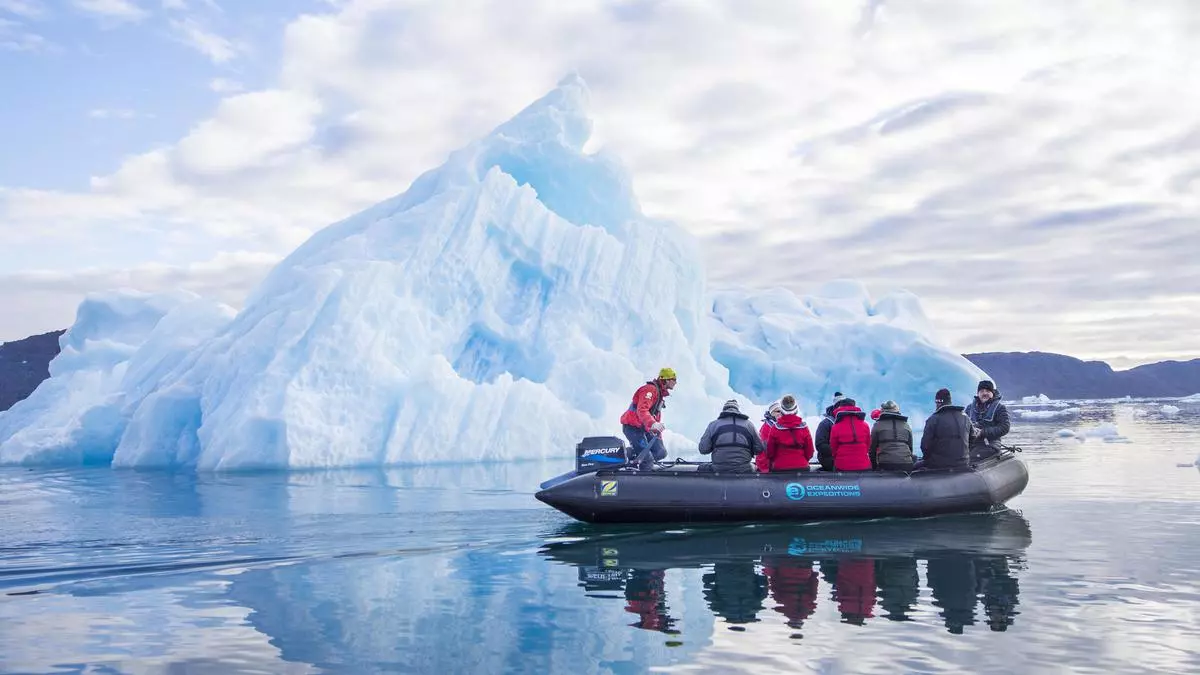
The heat content of the Arctic Ocean is crucial globally, affecting climate, weather, sea levels, and ecosystems. It serves as an indicator of broader climate change effects worldwide, connecting ecosystems, economies, and societies globally.

Highlighting the importance of such studies, Palanisamy Shanmugam, professor at the Department of Ocean Engineering, Indian Institute of Technology, Madras, said, “The Arctic OHC (ocean heat content) is a vital measure to represent the global climate system. This research and the OHC estimates produced from it will lead to better understanding of global climate change such as sea level rise and temporal trends of polar sea ice extent decline.”

Researchers from IIT Madras have created an artificial neural network (ANN) model to estimate OHC in ice-covered Arctic regions. They have linked satellite-based sea ice data to in-situ CTD (conductivity, temperature, depth) profiles to estimate OHC up to 700 metres deep. This model accurately predicts OHC changes and tracks spatio-temporal variations, offering insights into historical trends and regional patterns. Led by professor Palanisamy Shanmugam and his student Kondeti Vijay Prakash, the team published its work in the peer-reviewed journal IEEE Access .

Scarce data

The challenge for reliable OHC estimates is the scarcity of data. Estimating OHC in the inaccessible top ocean layer involves approximations, leading to uncertainties. Improving accuracy involves creating in-situ databases for different layers and refining modelling studies.

This is where the availability of satellite-derived sea-ice parameters becomes crucial for model development. Enhancing these parameters, especially snow concentration, can improve the efficiency and accuracy of the OHC model for the Arctic region in the future. Prakash said that the research team overcame the challenge of scarce in-situ data by building an optimum ANN architecture to model the spatial, temporal, and depth variabilities of Arctic OHC with greater accuracy than previously possible. He added, “As a result, the research provides an elaborate and comprehensive framework of ice-covered Arctic heat content estimation in a near real-time and wide coverage of satellite observation data.”

The study uses satellite data products like sea ice concentration, sea ice thickness, surface temperature, ambient air temperatures, and snow depth. Daily sea ice thickness and surface temperature products from the APP-x product suite were used in the study. Surface and 2m air temperatures from satellite observations over the Arctic region were utilised. Snow depth data were collected from the TOPAZ4 reanalysis products.

In combination with the satellite data products, the researchers used data from instruments like the WHOI-ITP, which measures temperature and other properties of the ocean under the ice.

A promising model

The researchers developed an ANN model to estimate changes in OHC based on various sea ice thermodynamic parameters. The model is based on theoretical considerations about various factors affecting heat transfer in the region, including heat advection by Atlantic and Pacific waters, heat exchange at different boundaries (ocean-atmosphere, ocean-continent, ocean-seabed) and sea ice state (thickness, extent, properties).

ANN is a machine learning technique that learns patterns from data and establishes relationships between inputs and outputs. They experimented with different configurations of the ANN architecture, including the number of hidden layers, number of neurons, activation functions, and scaling techniques. The researchers divided their data into different sets to develop and test their model. They wanted their data to cover different regions and times to account for the various factors that influence the ocean’s heat content. They used about 13,932 samples for model development and 5,995 samples for independent validation.

The ANN model takes these inputs, processes them through multiple layers, and produces an estimate of OHC change. The performance of the model is assessed using various statistical metrics. Finally, a comparison is made between the model-derived OHC values and the OHC values obtained from the Multi Observation Global Ocean ARMOR3D L4 analysis system. The model accurately estimates OHC changes at different depths across a 0.25° spatial scale, considering various sources of uncertainty and minimizing data noise. The model also provides a promising tool for estimating spatial and temporal OHC changes in the ice-covered Arctic and has the potential to be further refined for deeper layers.


Source link

Inferences from an inferno

Inferences from an inferno


While the raging fires that laid waste the city of Lahaina, including a centuries-old banyan tree, in the Maui island of Hawaii is a pinching reminder of what a careless fire can do to a climate-change-dried earth, human-caused infernos are nothing new.

A recent study by scientists at Marshall University, US, has revealed that human-lit fires roared through southern California and caused the extinction of several large mammals – 13,000 years ago.

La Brea in Los Angeles is known for its tar pits. These pits have trapped thousands of animals in the last 50,000 years, preserving their bones. These bones reveal much.

Scientists from Marshall University analysed radiocarbon dates of 172 specimens from seven extinct and one extant species. They found that there had been a “complete extirpation of mega-fauna and unprecedented fire activity.” From sediment cores of Lake Elsinore, they found out that, about 13,200 years ago, “charcoal accumulation rates” increased over 30 times. A radical shift in vegetation was also inferred, which “appears to have been triggered by human-ignited fires in an ecosystem stressed by rapid warming, a mega-drought and a millennial-scale trend toward the loss of large herbivores from the landscape.”


Source link

Checking out the Sun: Why ISRO’s Aditya L-1 mission is unique in many ways

Checking out the Sun: Why ISRO’s Aditya L-1 mission is unique in many ways


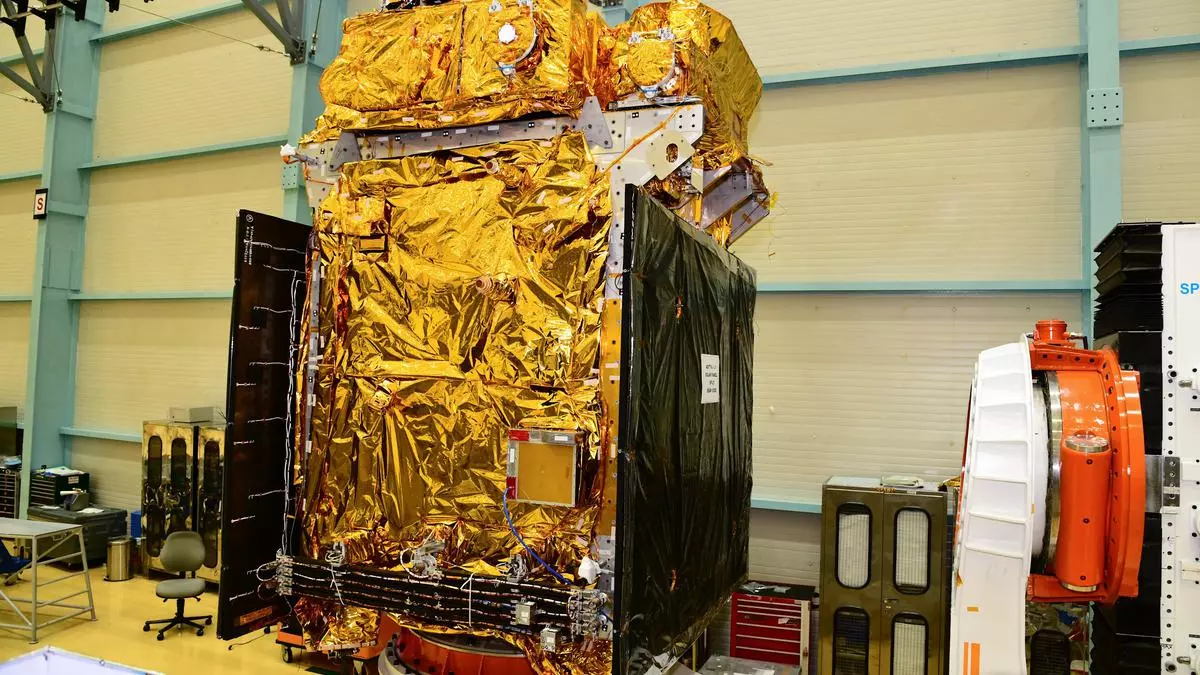
Aditya-L1, the first space-based Indian observatory to study the Sun, is getting ready for the launch. The satellite realised at the U R Rao Satellite Centre (URSC), Bengaluru has arrived at SDSC-SHAR in Sriharikota.
| Photo Credit:
ANI

ISRO’s Aditya L-1 mission, the Indian space agency’s most complex mission ever, which is scheduled to launch by the end of August or early September, is unique in many ways.  

For the first time, India is building a ‘space observatory’ — the spacecraft that will be peering at the Sun all the time, checking out the ball of fire 24×7. 

India has never put a spacecraft at a Lagrange point, which is a point between two or more massive objects (like the Sun and the Earth) where the massive objects exert equal pull over the spacecraft so that it “stays” right there. Placing a spacecraft precisely at a point in space 1.5 million km away from Earth (between Earth and Sun), calls for extreme deftness in ‘steering’ the spacecraft to its slot. Keeping it there is even tougher.  

Also Read | India’s space dreams to lift off?

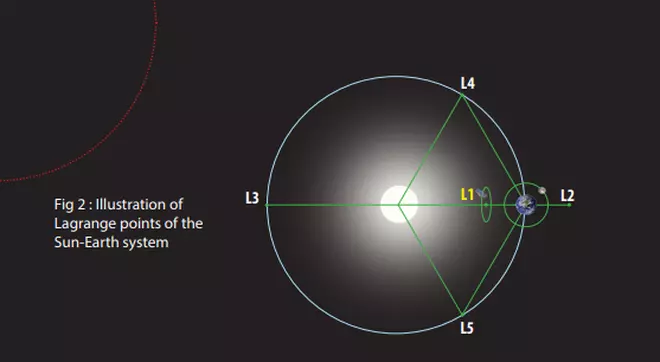
There are five Lagrange points in the Sun-Earth system; Aditya is going to be positioned at Lagrange-1. 

And the two principal instruments onboard Aditya L-1 — SUIT and VELC — are completely home-made — designed and built by Indian scientists. Furthermore, the VELC will do ‘spectropolarimetric measurements’ to study the magnetic field of the Sun — for the first time by any country from space. As such, the data it generates will contribute a lot to science. 

But first, why the interest in the Sun? 

The Aditya L-1 spacecraft is essentially a space telescope. Broadly, the Aditya L-1 mission has two purposes — long term (scientific quest) and short term (protecting our satellites).  

The mission had its genesis in 2006, when a group of scientists from the Indian Institute of Astrophysics and the Astronomical Society of India made a presentation to ISRO, underscoring the need to protect satellites from ‘things’ coming out of the Sun. Back then, the idea was to put up a small satellite in the Low Earth Orbit, which would monitor the Sun, imaging it. But Prof U. R. Rao, a former Chairman of ISRO, suggested that the scope of the mission be expanded, and the spacecraft placed at Lagrange-1 point.  

Also Read | How ISRO is working on next generation rockets 

The idea was to monitor the Sun constantly so as to provide an early warning against solar storms that can damage our satellites and electrical grids. Solar storms can take many forms, such as coronal mass ejections (or billions of tons of matter flung out of the Sun, which can shoot off anywhere including towards the Earth) and solar flares, which are sudden bursts of energy, often in the form of tongues of fire thousands of kilometres long that can spew X-rays, electromagnetic waves, or high-energy particles all across space and can disrupt radio communications and harm astronauts in space). Imagine GPS going out of whack! Aditya L-1 is a sort of an early warning system. 

As for the long term, it is understood that ultraviolet rays from the Sun can impact climate on the Earth and the ozone layer in the atmosphere. UV radiation of wavelengths between 200 and 310 nanometres is absorbed by the oxygen and ozone in the Earth’s atmosphere. UV radiation above 310 nm pierces through the atmosphere. We need to know what kind of UV the Sun is likely to emit. Changes in UV radiation can influence cloud formation, water vapor content and temperature patterns in the Earth’s lower atmosphere. It is important, therefore, to study the behaviour of the Sun to see its impact on the Earth’s climate. 

Why Lagrange-1 point? 
Illustration of Lagrange points of the Sun-Earth system.

Illustration of Lagrange points of the Sun-Earth system.

As shown in the picture, the L-1 point lies between the Sun and the Earth, affording a spacecraft placed there an excellent view of the Sun. L-1 (along with L-2 and L-3) are ‘halo orbits’, where a spacecraft placed there keeps going round an invisible centre. An object kept there is very unstable, because the spacecraft is subject to constant pulls and pushes in space. Imagine keeping a pin stable between two magnets — that is how difficult it is. While taking the spacecraft to that ‘parking slot’ is tough, keeping it there is tougher, because all celestial objects cause ‘gravitational perturbations’ on the spacecraft and ground controllers on the Earth would have to make small orbital adjustments to counteract the perturbations. Still, L-1 is preferred because it is the best vantage point to observe the Sun. If you want to build a ‘watchtower’ in space to observe the Sun 24×7, L-1 is where you should build it.  

How does Aditya L-1 study the Sun? 

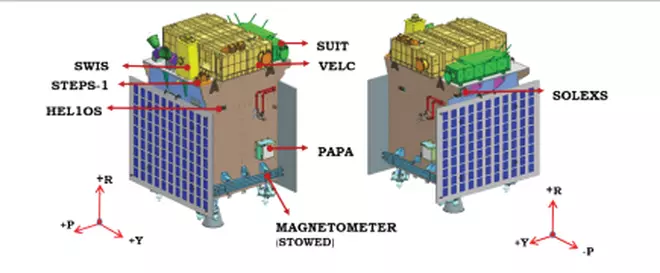
Aditya L-1 houses seven instruments; some study the Sun from afar while the others analyse the particles from the Sun that stream into the spacecraft. But mainly there are two instruments — the Solar Ultraviolet Imaging Telescope (SUIT) and the Visible Emission Line Coronagraph (VELC) — both designed and built in India. 

Locations of Aditya-L1 payloads on the spacecraft. R, P and Y indicate the Raw, Pitch and Roll axis of the spacecraft. ASPEX Payload Consists of SWIS & STEPS.

Locations of Aditya-L1 payloads on the spacecraft. R, P and Y indicate the Raw, Pitch and Roll axis of the spacecraft. ASPEX Payload Consists of SWIS & STEPS.

The SUIT will be looking at the disc of the Sun, which comprises the inner photosphere and the outer chromosphere, while the VELC will peer into the rim (corona). The SUIT will capture the near-ultraviolet rays (200-400 nm wavelength) coming from the Sun; VELC will pick up the near-Infra red radiation from the Sun. Both the instruments were built at the Inter-University Centre for Astronomy and Astrophysics (IUCAA), Pune. 

“These are very unique instruments, completely built in India,” says Dr Somak Raychaudhary, who was involved in the development of SUIT. Raychaudhary, who is now the Vice Chancellor of the Ashoka University, Delhi, explained to businessline that since both SUIT and VELC look at the Sun at the same time, it would be possible to see the effect of any changes in the Sun’s photosphere and chromosphere on the corona—giving a better picture of how the star behaves.  

The Sun is not solid like the Earth is, but a huge ball of gas with different layers, all surrounded by the corona. Each layer spins at a different speed. SUIT will simultaneously map different parts of the Sun — photosphere and chromosphere of the Sun using 11 filters sensitive to different wavelengths and covering different heights in the solar atmosphere. “This will help in the understanding of the processes involved in the transfer from mass and energy from one layer to the other,” according to a 2017 paper published by IUCAA scientists. 

The VELC will study the corona. It will do both photograph (optical imaging) and spectrograph, which is splitting of light into its constituent wavelengths — a study of the spectrographic lines can tell a lot about the light emitter, which, in this case, is the Sun. Dr. Dipankar Banerjee, who was involved with the development of the VELC in IUCAA, explains that the instrument can spectropolarimetric observation. Polarimetric measurements refers to the orientation of electromagnetic waves — sort of slanting this way or that way — which “carries information about the magnetic field of the Sun,” says Banerjee. “This is a unique experiment, because this has never been done by anybody from space,” Banerjee told businessline. The magnetic field is the “main culprit” responsible for all the dynamics of the Sun, so understanding the magnetic field is useful. 

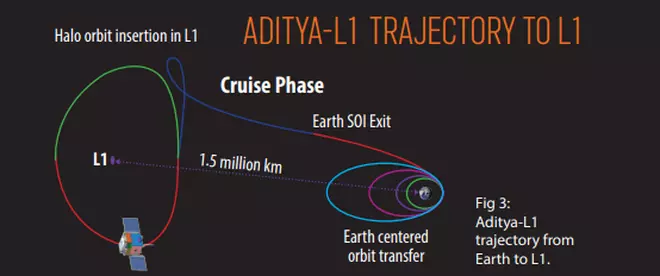
Aditya-L1 trajectory from Earth to L1.

Aditya-L1 trajectory from Earth to L1.

Then the VELC can investigate the red and green spectroscopic lines, which give a peek into the temperature of the region of the Sun from where the light has come. 

The other five instruments pick up and analyse X-rays and particles from the Sun. So, the seven instruments on Aditya L-1 cover the entire gamut of electromagnetic radiation — near infra-red, visible light, near ultraviolet and X-rays as well as particles bursting out of the Sun — all from a vantage point at L-1. If the mission is successful, ISRO can claim to have the Sun in its pocket. 


Source link

YouTube
Instagram
WhatsApp