Ceigall India arm bags NHAI road project of Rs 603 cr

Ceigall India arm bags NHAI road project of Rs 603 cr


In state of Punjab

Ceigall Infra projects (CIPPL), a wholly owned subsidiary of Ceigall India (CIL) has received Letter of Award (LOA) dated 27 March 2026 from National Highways Authority of India for the Construction of 6-lane access-controlled Spur connectivity starting from Ch. 15+100 of Ambala – Chandigarh section of NH-205A and terminating at Ch. 2+500 of Zirakpur Bypass (Total length 10.300 Km) under NH(O) in the State of Punjab on Hybrid Annuity Mode. The project bid cost is Rs 603 crore.

Powered by Capital Market – Live News


Disclaimer: No Business Standard Journalist was involved in creation of this content

First Published: Mar 27 2026 | 8:16 PM IST


Source link

Ceigall India arm bags NHAI road project of Rs 603 cr

JNK India secures order from JNK Global


JNK India announced that the company has received a major order from JNK Global Co., Korea (JNK Global) on 27 March 2026 for providing support services and supplies to JNK Global for Cracker Furnace Package
of a refinery project in India. As per the company’s project classification, the value of the order ranges between Rs 300 crore to Rs 600 crore.

Powered by Capital Market – Live News


Disclaimer: No Business Standard Journalist was involved in creation of this content

First Published: Mar 27 2026 | 8:16 PM IST


Source link

Ceigall India arm bags NHAI road project of Rs 603 cr

Jupiter Life Line Hospitals acquires land for proposed hospital at BKC, Mumbai


Jupiter Life Line Hospitals has received a letter from Mumbai Metropolitan Region Development Authority (MMRDA) conveying the acceptance of its tender for allotment of land on lease basis, for a period of 80 years.

The said allotment pertains to land admeasuring an area of ~10,026.44 sqm on lease basis, for an amount of ~ Rs. 354 crore. The Land is situated at plot no. SF5 in GTxT-Block of Bandra Kurla Complex, Maharashtra.

The aforesaid land is leased for setting up ~ 400 beds hospital subjected to various statutory and regulatory approvals.

Powered by Capital Market – Live News


Disclaimer: No Business Standard Journalist was involved in creation of this content

First Published: Mar 27 2026 | 8:04 PM IST


Source link

Markets slide as West Asia tensions persist; oil tops 0 per barrel

Markets slide as West Asia tensions persist; oil tops $100 per barrel


Indian equities declined on Friday, with the benchmark indices logging their longest weekly losing streak in over seven months amid escalating tensions involving Iran, keeping crude oil prices elevated and unsettling investor sentiment.


The Sensex fell 1,690 points, or 2.3 per cent, to close at 73,583, while the Nifty 50 dropped 487 points, or 2.09 per cent, to settle at 22,820. For the week, both indices lost 1.3 per cent, marking their fifth consecutive weekly decline — the longest since August 2025.


The selloff eroded ₹8.9 trillion in investor wealth, with the market capitalisation of BSE-listed firms falling to ₹422.2 trillion. Brent crude rose 3.1 per cent to $103.05 per barrel, extending gains for a third straight session as hostilities between Iran and Israel showed little sign of abating.


Iran’s continued targeting of Gulf states has heightened concerns over supply disruptions.


US President Donald Trump on Thursday said the US would defer plans to strike Iran’s energy infrastructure for another 10 days, adding that negotiations were progressing. Earlier, he had urged Iran to reopen the Strait of Hormuz — a vital artery for global energy trade that handles roughly a fifth of global oil and LNG flows. The waterway remains effectively blocked, triggering supply concerns and pushing up crude prices. Some estimates suggest oil could surge to $200 per barrel if disruptions persist through June.


The prolonged conflict has stoked fears of slower economic growth, weaker corporate earnings, and rising inflation globally. Reflecting these concerns, the rupee slid to a record low of 94.81 against the dollar. 


Adding to global uncertainty, China launched a series of probes into US trade practices, in response to similar actions by the Trump administration.


India remains particularly vulnerable to rising crude prices due to its heavy reliance on energy imports. Goldman Sachs, in a recent note, cut its CY26 earnings growth forecast for India to 8 per cent from 16 per cent earlier, and warned of further downgrades over the coming quarters.


Among stocks, Reliance Industries declined 4.5 per cent — its steepest since June 2024 — and was the biggest drag on the Sensex, pulling it down by 368 points. The decline followed the government’s decision to reimpose windfall taxes on diesel and aviation turbine fuel exports. HDFC Bank also weighed on the index, falling 3.3 per cent and dragging it by 328 points.


Market breadth remained weak, with 3,615 stocks declining against 761 advancing.


Foreign portfolio investors (FPIs) were net sellers of ₹4,367 crore, while domestic institutional investors (DIIs) provided partial support with net purchases of ₹3,566 crore.


Despite the near-term uncertainty, some market participants see opportunities emerging.


“A lot of critical energy infrastructure has been damaged, and recovery could take years. For long-term investors, sticking to asset allocation and fundamentals is key. Valuation excesses are correcting, which may create opportunities,” said Pramod Gubbi, co-founder of Marcellus Investment Managers.


Technically, analysts see near-term resistance levels ahead.


“For traders, 23,000 on the Nifty and 74,500 on the Sensex will act as immediate resistance. As long as the indices remain below these levels, sentiment is likely to stay weak,” said Amol Athawale, VP (technical research) at Kotak Securities.


Source link

Rupee down over 4% since West Asia war began; bond yield near 2-year high

Rupee down over 4% since West Asia war began; bond yield near 2-year high


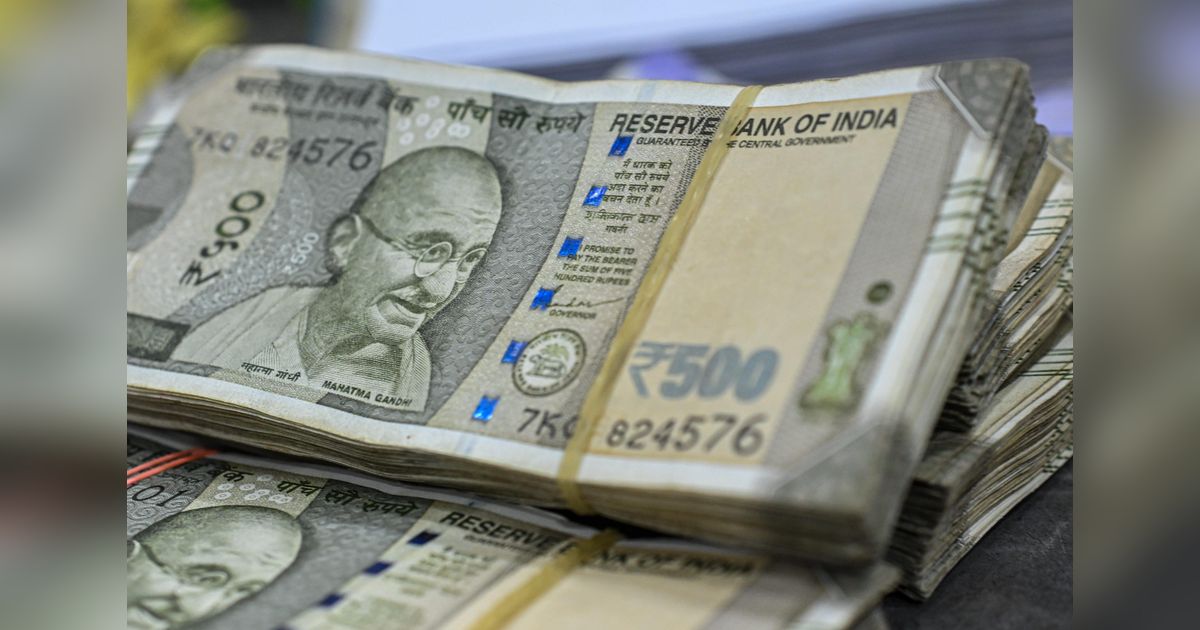
The rupee slumped to a fresh intraday low of 94.85 per dollar on Friday, while government bond yields surged to a near two-year high, as foreign investors pulled out of domestic markets amid escalating tensions in West Asia and elevated crude oil prices.


The local currency settled at a new closing low of 94.81, depreciating nearly 0.9 per cent from the previous close to become the worst-performing currency in Asia. It has fallen over 4 per cent since the West Asia crisis began in late February, and 5.2 per cent this quarter.


The rupee is inching closer to the psychologically crucial 95 mark, with the Reserve Bank of India (RBI) intervening intermittently in the foreign exchange market through dollar sales.


Currency dealers said the RBI was seen intervening mainly in the forward segment rather than in the spot market. They said the central bank’s increasing reliance on the forward market to manage rupee volatility was beginning to influence the currency’s medium-term trajectory. 


By building a sizeable net short dollar position, estimated by market participants to be approaching $100 billion, the RBI appears to be deferring, rather than eliminating, underlying depreciation pressures. 


“While such interventions help stabilise the rupee in the near term by easing immediate dollar demand and preserving headline foreign exchange reserves, they create a future overhang, as these contracts mature and require delivery or rollover,” said Kunal Sodhani, head of treasury, global trading centre, FX & rates treasury, Shinhan Bank India.


Data released on Monday showed that foreign exchange reserves fell $11.4 billion to $698.3 billion for the week ended March 20. The entire decline was due to a $13.5 billion drop in gold reserves, while foreign currency assets rose $2.1 billion. The rupee fell 1.23 per cent during that week.


“This has already manifested in elevated forward premiums and tighter liquidity conditions in swap markets, signalling underlying dollar demand,” he added.


The rupee has depreciated more than it did during the taper-tantrum years of 2013-14, falling 9.85 per cent in FY26. This financial year could be the Indian currency’s worst since FY12, when it had fallen 12.37 per cent.


Market participants said the rupee was expected to weaken in a calibrated manner, with levels around 95 per dollar appearing increasingly likely, especially if external pressures such as elevated crude prices, sustained dollar strength, and portfolio outflows persisted.


Foreign investors sold around ₹850 crore worth of government securities under the fully accessible route (FAR) on Friday, according to data from the Clearing Corporation of India Ltd (CCIL). Overseas investors have pulled $11.5 billion from local stocks this month, according to data compiled by Bloomberg.


On the other hand, the yield on the benchmark 10-year bond climbed past 6.95 per cent, as sentiment weakened after the excise duty cut on fuel raised concerns over the fiscal outlook, compounding pressures already stemming from elevated oil prices amid the West Asia conflict and a heavy supply of government debt.


Total state development loan (SDL) issuances for the week stood at ₹94,800 crore, which further weighed on central government bond yields. States raised about ₹54,834 crore at Tuesday’s auction, against the indicated ₹47,985 crore. Additionally, 13 states together raised about ₹39,991 crore against an indicative ₹12,000 crore on Friday.


The yield on the benchmark 10-year government bond settled at 6.94 per cent, the highest since July 26, 2024, against its previous close of 6.88 per cent.


“The rupee’s sharp depreciation reflects a broader riskoff sentiment due to foreign outflows and high crude prices, and the RBI’s intervention is somewhat smoothing near-term volatility,” said the treasury head at a private bank who did not wish to be named. “Government bond yields rose because of fiscal concerns after the announcement of excise duty cuts, adding to existing pressures from higher oil prices and the large supply.”


Brent crude oil rose to $109.75 per barrel, up from $99.31 the previous day. The dollar index also rose to 100, against the previous day’s 99.31.


Economists estimate that the excise duty cut on petrol and diesel could result in a net revenue loss of over ₹1 trillion for the Centre over 12 months, after accounting for gains from higher taxes on fuel exports.



Source link

Ceigall India arm bags NHAI road project of Rs 603 cr

Meesho allots 3.63 lakh equity shares under ESOP


Meesho has allotted 3,63,12,662 equity shares of face value of Re.
1/- each to the eligible employees, upon exercise of vested options under Company’s ESOP 2024 Plan. Pursuant to the above allotment, the issued, subscribed and paid-up equity share capital of the Company stands
increased from Rs. 4,52,77,42,534 (comprising 4,52,77,42,534 equity shares of Re. 1/- each) to Rs. 4,56,40,55,196 (comprising 4,56,40,55,196 equity shares of Re. 1/- each).

Powered by Capital Market – Live News


Source link

YouTube
Instagram
WhatsApp



