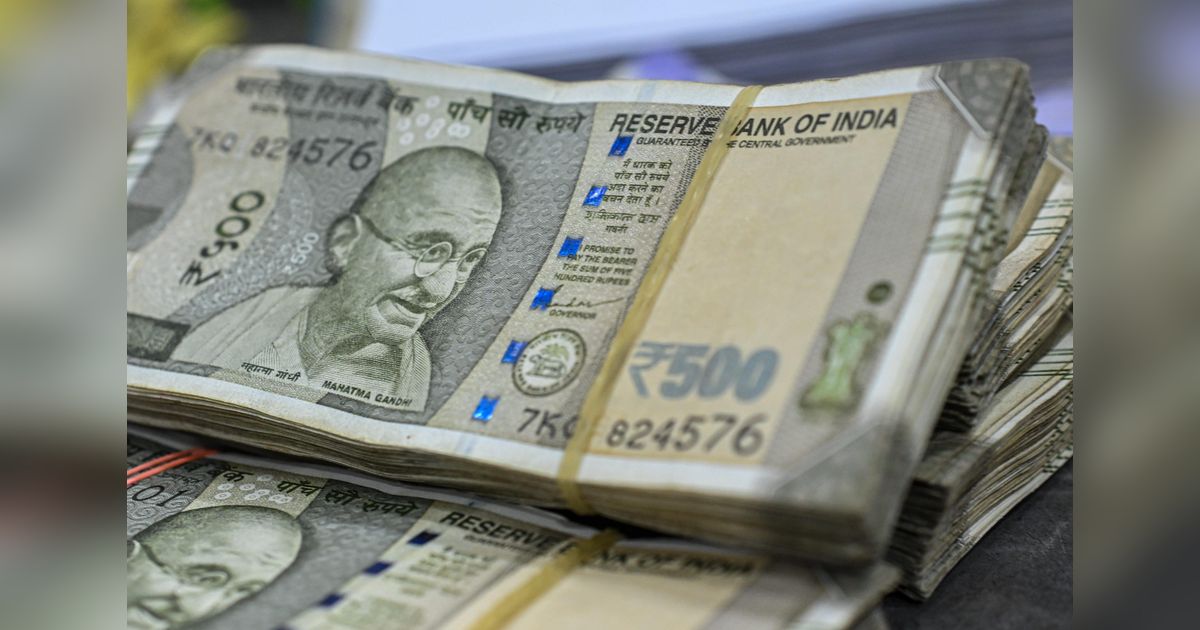
Rupee down over 4% since West Asia war began; bond yield near 2-year high

Rupee down over 4% since West Asia war began; bond yield near 2-year high


The rupee slumped to a fresh intraday low of 94.85 per dollar on Friday, while government bond yields surged to a near two-year high, as foreign investors pulled out of domestic markets amid escalating tensions in West Asia and elevated crude oil prices.


The local currency settled at a new closing low of 94.81, depreciating nearly 0.9 per cent from the previous close to become the worst-performing currency in Asia. It has fallen over 4 per cent since the West Asia crisis began in late February, and 5.2 per cent this quarter.


The rupee is inching closer to the psychologically crucial 95 mark, with the Reserve Bank of India (RBI) intervening intermittently in the foreign exchange market through dollar sales.


Currency dealers said the RBI was seen intervening mainly in the forward segment rather than in the spot market. They said the central bank’s increasing reliance on the forward market to manage rupee volatility was beginning to influence the currency’s medium-term trajectory. 


By building a sizeable net short dollar position, estimated by market participants to be approaching $100 billion, the RBI appears to be deferring, rather than eliminating, underlying depreciation pressures. 


“While such interventions help stabilise the rupee in the near term by easing immediate dollar demand and preserving headline foreign exchange reserves, they create a future overhang, as these contracts mature and require delivery or rollover,” said Kunal Sodhani, head of treasury, global trading centre, FX & rates treasury, Shinhan Bank India.


Data released on Monday showed that foreign exchange reserves fell $11.4 billion to $698.3 billion for the week ended March 20. The entire decline was due to a $13.5 billion drop in gold reserves, while foreign currency assets rose $2.1 billion. The rupee fell 1.23 per cent during that week.


“This has already manifested in elevated forward premiums and tighter liquidity conditions in swap markets, signalling underlying dollar demand,” he added.


The rupee has depreciated more than it did during the taper-tantrum years of 2013-14, falling 9.85 per cent in FY26. This financial year could be the Indian currency’s worst since FY12, when it had fallen 12.37 per cent.


Market participants said the rupee was expected to weaken in a calibrated manner, with levels around 95 per dollar appearing increasingly likely, especially if external pressures such as elevated crude prices, sustained dollar strength, and portfolio outflows persisted.


Foreign investors sold around ₹850 crore worth of government securities under the fully accessible route (FAR) on Friday, according to data from the Clearing Corporation of India Ltd (CCIL). Overseas investors have pulled $11.5 billion from local stocks this month, according to data compiled by Bloomberg.


On the other hand, the yield on the benchmark 10-year bond climbed past 6.95 per cent, as sentiment weakened after the excise duty cut on fuel raised concerns over the fiscal outlook, compounding pressures already stemming from elevated oil prices amid the West Asia conflict and a heavy supply of government debt.


Total state development loan (SDL) issuances for the week stood at ₹94,800 crore, which further weighed on central government bond yields. States raised about ₹54,834 crore at Tuesday’s auction, against the indicated ₹47,985 crore. Additionally, 13 states together raised about ₹39,991 crore against an indicative ₹12,000 crore on Friday.


The yield on the benchmark 10-year government bond settled at 6.94 per cent, the highest since July 26, 2024, against its previous close of 6.88 per cent.


“The rupee’s sharp depreciation reflects a broader riskoff sentiment due to foreign outflows and high crude prices, and the RBI’s intervention is somewhat smoothing near-term volatility,” said the treasury head at a private bank who did not wish to be named. “Government bond yields rose because of fiscal concerns after the announcement of excise duty cuts, adding to existing pressures from higher oil prices and the large supply.”


Brent crude oil rose to $109.75 per barrel, up from $99.31 the previous day. The dollar index also rose to 100, against the previous day’s 99.31.


Economists estimate that the excise duty cut on petrol and diesel could result in a net revenue loss of over ₹1 trillion for the Centre over 12 months, after accounting for gains from higher taxes on fuel exports.



Source link

Meesho allots 3.63 lakh equity shares under ESOP

Meesho allots 3.63 lakh equity shares under ESOP


Meesho has allotted 3,63,12,662 equity shares of face value of Re.
1/- each to the eligible employees, upon exercise of vested options under Company’s ESOP 2024 Plan. Pursuant to the above allotment, the issued, subscribed and paid-up equity share capital of the Company stands
increased from Rs. 4,52,77,42,534 (comprising 4,52,77,42,534 equity shares of Re. 1/- each) to Rs. 4,56,40,55,196 (comprising 4,56,40,55,196 equity shares of Re. 1/- each).

Powered by Capital Market – Live News


Source link

Sebi bars four from markets for 2 years in front-running case linked to FPI

Sebi bars four from markets for 2 years in front-running case linked to FPI


In its investigation covering January 2022 to December 2023, Sebi found evidence of front-running in 350 trades executed by the FPI

The Securities and Exchange Board of India (Sebi) on Friday barred four individuals from the securities market for two years for allegedly front-running trades of foreign portfolio investor Societe Generale.


The regulator also imposed a penalty of ₹5 lakh each on Vishvanath Goswami, Umang Chaturvedi, Shyam Chaturvedi, and Vinod Kumar Chaturvedi.


In its investigation covering January 2022 to December 2023, Sebi found evidence of front-running in 350 trades executed by the FPI.


According to Sebi, the individuals were linked to Atul Chaturvedi, a sales trader at Antique Stock Broking, which acted as the broker for the FPI. Atul Chaturvedi was allegedly privy to material non-public information regarding the FPI’s impending trades.


He settled the case with Sebi in November 2025 after paying a disgorgement amount of ₹1.48 crore. Several other individuals had earlier settled related proceedings in October 2025 by paying a total of ₹19.5 lakh.


First Published: Mar 27 2026 | 6:47 PM IST


Source link

Meesho allots 3.63 lakh equity shares under ESOP

Powerica IPO subscribed 1.45 times


The offer received bids for 2.98 crore shares as against 2.05 crore shares on offer.

Powerica received bids for 2,98,57,779 shares as against 2,05,55,171 shares on offer, according to stock exchange data at 17:30 IST on Friday (27March 2026). The issue was subscribed 1.45 times.

The issue opened for bidding on 24 March 2026 and it will close on 27 March 2026. The price band of the IPO is fixed between Rs 375 and 395 per share. An investor can bid for a minimum of 37 equity shares and in multiples thereof.

The issue comprises both offer for sale and fresh issue of equity shares (of Rs 5 face value) worth aggregating to Rs 400 crore and Rs 700 crore respectively. The entire portion of offer for sale is by promoters i.e. Naresh Oberoi Family Trust (Rs 280 crore) and Kabir & Kimaya Family Trust (Rs 120 crore).


Of the net proceeds the company proposed to utilize Rs 525 crore towards repayment and / or pre-payment, in full or in part, of certain outstanding borrowings availed by the company and balance towards general corporate purposes.

Outstanding borrowings as end of Feb 28, 2026 stood at Rs 1214.25 crore.

Powerica is an integrated power solutions provider specializing in diesel generator (DG) sets for primary and standby applications, with a diversified presence across generator sets and wind power businesses. Its generator segment includes DG sets powered by Cummins engines and medium-speed large generators (MSLG) in collaboration with Hyundai, offering capacities ranging from 7.5 kVA to 10,000 kVA, along with allied products and services.

The company also operates as an independent power producer (IPP) in the wind energy segment, with a growing portfolio of operational and under-construction projects, supported by long-term power purchase agreements. Additionally, it provides engineering, procurement and construction (EPC) and operation and maintenance (O&M) services for balance of plant (BoP) in wind projects. With a strong presence across industrial and infrastructure sectors, Powerica continues to benefit from sustained demand for reliable power solutions in India.

Ahead of the IPO of Powerica on 23 March 2026, the company raised Rs 329.39 crore from anchor investors by allotting 83.39 lakh shares at Rs 395 each to 17 anchor investors.

For the six months ended 30 September 2025, the firm recorded a consolidated net profit of Rs 127.87 crore and sales of Rs 1,447.44 crore.

Powered by Capital Market – Live News


Source link

Meesho allots 3.63 lakh equity shares under ESOP

Amir Chand Jagdish Kumar (Exports) IPO subscribed 3.23 times


The offer received bids for 6.10 crore shares as against 1.89 crore shares on offer.

Amir Chand Jagdish Kumar (Exports) received bids for 6,10,40,490 shares as against 1,89,05,270 shares on offer, according to stock exchange data at 17:30 IST on Friday (27 March 2026). The issue was subscribed 3.23 times.

The issue opened for bidding on 24 March 2026 and it will close on 27 March 2026. The price band of the IPO is fixed between Rs 201 and 212 per share. An investor can bid for a minimum of 70 equity shares and in multiples thereof.

The IPO consists entirely of a fresh issue of equity shares worth up to Rs 440 crore. The objectives for the fresh issue includes Rs 400 crore for funding working capital requirement and remaining amount for general corporate purpose.


The promoters are Jagdish Kumar Suri, Rahul Suri, and Ramnika Suri. The promoters and promoter group hold an aggregate of 8,15,80,500 equity shares, aggregating to 98.53% of the pre-offer issued and paid-up equity share capital. Their post IPO shareholding is expected to be around 78.78%.

Amir Chand Jagdish Kumar (Exports) is a processor and exporter of basmati rice and other FMCG products, with fully integrated operations across the rice value chain, including procurement, processing, and distribution. The companys portfolio is led by basmati rice, complemented by other rice varieties and staple FMCG products such as aata, maida, sooji, besan, salt and sugar, marketed under its flagship Aeroplane brand and over 40 sub-brands. It has a strong domestic and international presence, exporting to over 38 countries, supported by a wide distribution network of more than 400 distributors in India and overseas. The rice segment contributes the majority of revenue, with a dominant share in overall sales, while the company continues to focus on expanding its distribution reach, strengthening brand presence, and scaling operations

Ahead of the IPO of Amir Chand Jagdish Kumar (Exports) on 23 March 2026, the company raised Rs 60 crore from anchor investors by allotting 28.30 lakh shares at Rs 212 each to 3 anchor investors.

For the six months ended 30 September 2025, the firm recorded a consolidated net profit of Rs 48.65 crore and sales of Rs 1,021.25 crore.

Powered by Capital Market – Live News


Source link

Meesho allots 3.63 lakh equity shares under ESOP

Labour Force Participation Rate remained stable in 2025


Ministry of Statistics & Programme Implementation stated that India’s Labour Force Participation Rate (LFPR) in usual status for persons of age 15 years and above observed as 59.3% during 2025 and remained stable compared to 2024. The same for male and female stood at 79.1% and 40.0%, respectively, in 2025. Worker Population Ratio (WPR) in usual status for persons of age 15 years and above estimated as 57.4% during 2025, remaining almost at the same level as in 2024. In 2025, the WPR for male and female was 76.6% and 38.8%, respectively. Earnings of workers have shown a notable improvement in recent years, the ministry noted.


Among male, 69.8% reported want to continue studies as the main reason for not being in the labour force, whereas among female, 44.4% cited child care/personal commitments in home-making as the main reason. Among male aged 15 years and above, about 82.7% of those with a diploma/certificate, 79.1% of those with graduation and 83.1% of those with post-graduation and above as their highest level of education were in the workforce. The share of self-employed persons has shown a gradual decline from 2023 to 2025, decreasing from 58.2% in 2023 to 57.5% in 2024 and further to 56.2% in 2025.

The rural male labour force participation remained strong at 80.5% while rural female participation held steady at 45.9%, sustaining the gains achieved in previous years. Both male and female labour force participation rates based on usual status in 2025 remained broadly consistent with the levels observed in 2024 in urban areas.

The WPR shows a broad stability in 2025 compared with 2024. In 2025, WPR for rural male remained robust at 78.4%, while WPR for rural female held steady at 44.9%, sustaining the significant gains made since 2022. The overall urban WPR maintained nearly at 50.0%.

The Unemployment Rates or UR estimates indicate sustained progress in reducing unemployment across sectors and genders. Overall rural unemployment rates in 2025 stood at 2.4%, showing strong rural labour absorption. The female unemployment rate remained low at 2.1% lower than the male UR in rural areas which stood at 2.6%. The male and female unemployment eased to 4.2% and 6.4%, respectively in urban areas contributed marginal decrease in overall urban UR to 4.8%.

The percentage distribution of workers (in usual status) by industry of work reflects a broadly stable sectoral composition in 2025 with some notable shifts. Agriculture continues to account for the largest share of employment, though it has decreased from 44.8% in 2024 to 43.0% in 2025. The share of employment in construction has decreased marginally (12.3% to 12.0%), while manufacturing has seen improvement from 11.6% to 12.1%. Other services have also recorded an increase (12.2% to 13.1%).

Earnings of workers have shown a notable improvement in recent years across categories, with gains observed for both male and female in nominal terms. In regular wage/salaried employment, average earnings for male increased from Rs 22,891 in 2024 to Rs 24,217 in 2025 (about 5.8% growth), while for female, earnings rose from Rs 17,126 to Rs 18,353 (about 7.2% growth).

Powered by Capital Market – Live News


Source link

YouTube
Instagram
WhatsApp


