


Gold imports rise nearly 29% to  billion in April-February FY26

Gold imports rise nearly 29% to $69 billion in April-February FY26


The country’s gold imports rose 28.73 per cent to $69 billion during April-February 2025-26 on account of high prices of the precious metal, according to the Commerce Ministry data.


Gold imports stood at $53.52 billion in April-February 2024-25.


The rise in gold imports pushed the country’s trade deficit (difference between imports and exports) to $310.60 billion during the 11-months of the last fiscal as compared to $261.80 billion during April-February 2024-25, the data showed.


Prices of the yellow metal are hovering at around Rs 1,51,500 per 10 grams (inclusive of all taxes) in the national capital.


Switzerland is the largest source of gold imports, with about 40 per cent share, followed by the UAE (over 16 per cent) and South Africa (about 10 per cent).


The precious metal accounts for over 5 per cent of the country’s total imports.


The country’s total imports from Switzerland were up 11.57 per cent to $23.5 billion during April-February 2025-26. In February, gold imports from that country surged 719.30 per cent year-on-year to $2.71 billion.


India is the world’s second-biggest gold consumer after China. The imports mainly take care of the demand by the jewellery industry. The imports have implications for India’s current account deficit (CAD).


CAD inched up to $13.2 billion, or 1.3 per cent of GDP, in the December quarter from $11.3 billion (1.1 per cent of GDP) in the year-ago period, mainly due to a higher trade deficit, according to RBI data.


However, the current account deficit moderated to $30.1 billion (1 per cent of GDP) in April-December 2025, from $36.6 billion (1.3 per cent of GDP) in the same period a year ago.


A CAD occurs when the value of goods and services imported and other payments exceeds the value of export of goods and services and other receipts by a country in a particular period.


Silver imports during the 11-month period jumped 142.87 per cent to $11.43 billion. Silver has industrial applications. It is used in sectors like electronics, auto and pharma.


To discourage imports, the government last week imposed import curbs on all forms of articles of gold, silver and platinum.


Source link

Stocks brace for volatility amid RBI policy, West Asia conflict: Analysts

Stocks brace for volatility amid RBI policy, West Asia conflict: Analysts


The domestic stock market is expected to remain volatile this week as investors track the Reserve Bank’s monetary policy decision, key global macroeconomic data and the impact of the West Asia conflict, analysts said.


Movements in crude oil prices and foreign fund flows will also influence domestic equities, they added.


Vinod Nair, Head of Research, Geojit Investments Ltd, said the RBI’s Monetary Policy Committee (MPC) meeting will command centre stage domestically, with investors closely watching the central bank’s stance on inflation and growth.


“A rate pause is near-certain consensus, the central bank walks a tightrope between crude-driven inflation risks and a four-year low Manufacturing PMI signalling a softening growth impulse. The governor’s commentary on the rate cycle trajectory and FY27 projections will be closely monitored.


“Globally, the US March CPI reading will carry significant importance, as it buries residual Fed rate-cut hopes, strengthens the dollar and tightens financial conditions for emerging markets, including India,” Nair said.


He noted that geopolitical developments in West Asia will remain the overarching factor influencing market sentiment.


“Indian markets return after a three-day gap and remain acutely vulnerable to weekend war developments, with crude trajectory and any credible ceasefire signal being the decisive variable that could either trigger a sharp relief rally or extend the current sell-on-rise mode,” Nair added.


In a holiday-shortened last week, the BSE benchmark Sensex declined 263.67 points, or 0.35 per cent, and the NSE Nifty fell 106.5 points, or 0.46 per cent.


Siddhartha Khemka – Head of Research, Wealth Management, Motilal Oswal Financial Services Ltd, said Indian equities are likely to remain volatile this week, with investor sentiment closely tied to evolving developments in the ongoing West Asia conflict.


Brent crude prices have remained elevated near USD 107 per barrel, sustaining concerns around imported inflation. Currency pressures have also intensified, with the rupee weakening sharply before recovering towards Rs 93 against the US dollar, aided by RBI intervention, he added.


Foreign institutional investor (FII) selling remains another key overhang, with March witnessing intense outflows of Rs 1.2 lakh crore, among the highest monthly outflows in the last several years.


“Investors will monitor the US Federal Open Market Committee (FOMC) meeting minutes, GDP data, and initial jobless claims for further cues on growth and the policy trajectory.


“Overall, markets are expected to remain volatile as geopolitical developments, crude price movements, FII flows and global macro data continue to drive sentiment,” Khemka said.


According to analysts, any signs of de-escalation in the West Asia conflict may provide relief through softer crude prices and currency stability, while further escalation could prolong risk aversion and sustain pressure on foreign flows.


Source link

Mcap of 6 most valued firms drops nearly by ₹65k cr, Airtel biggest laggard

Mcap of 6 most valued firms drops nearly by ₹65k cr, Airtel biggest laggard


The combined market valuation of six of the top-10 most valued firms declined by ₹64,734.46 crore in a holiday-shortened last week, with Bharti Airtel taking the biggest hit, reflecting the broader weakness in the equities market.


Last week, the BSE benchmark Sensex declined 263.67 points, or 0.35 per cent, and the NSE Nifty fell 106.5 points, or 0.46 per cent.


“Markets ended lower for the sixth consecutive week, declining by nearly half a per cent, reflecting heightened volatility driven by a mix of global and domestic uncertainties.


“The holiday-shortened week began on a weak note as escalating US-Iran tensions and a sharp rise in crude oil prices weighed on sentiment, triggering broad-based selling pressure,” Ajit Mishra, SVP, Research, Religare Broking Ltd, said.


However, markets staged a mid-week recovery supported by easing geopolitical concerns and softer oil prices, he added.


“Despite this rebound, volatility remained elevated due to fluctuating global cues, continued foreign institutional outflows, rupee weakness, and inflation concerns, Mishra said.


The market valuation of Bharti Airtel eroded by ₹29,993.07 crore to ₹10,20,420.26 crore.


ICICI Bank’s valuation tanked by ₹12,845.81 crore to ₹8,70,705.49 crore.


Bajaj Finance lost ₹11,169.36 crore from its market valuation, which stood at ₹5,14,226.12 crore.


The market capitalisation (mcap) of HDFC Bank dropped by ₹7,822.79 crore to ₹11,56,195.90 crore, and that of Hindustan Unilever’s mcap declined by ₹2,349.59 crore to ₹4,85,190.60 crore.


State Bank of India’s market capitalisation diminished by ₹553.84 crore to ₹9,41,015.31 crore.


In sharp contrast, the market valuation of Tata Consultancy Services (TCS) surged by ₹22,359.78 crore to ₹8,87,028.43 crore.


The mcap of Infosys soared by ₹12,374.76 crore to Rs 5,27,409.43 crore, and that of Larsen & Toubro added ₹6,575.43 crore to Rs 4,97,111.62 crore.


The market valuation of Reliance Industries gained ₹3,518.45 crore to ₹18,28,034.07 crore.


Reliance Industries retained the title of the most valued firm, followed by HDFC Bank, Bharti Airtel, State Bank of India, Tata Consultancy Services Ltd, ICICI Bank, Infosys, Bajaj Finance, Larsen & Toubro, and Hindustan Unilever.


Source link

IPO pipeline strengthens as 38 companies file draft papers in March

IPO pipeline strengthens as 38 companies file draft papers in March


As many as 38 companies, including SBI Funds Management and Manipal Health Enterprises, filed preliminary IPO papers with Sebi in March 2026, signalling improving issuer sentiment even as regulatory timelines contributed to the surge.


This marks a sharp jump from 22 filings in March 2025 and 16 in March 2024, data from the Securities and Exchange Board of India (Sebi) showed, indicating a stronger pipeline of public issues.


The momentum is expected to continue, with several high-profile companies, including the National Stock Exchange (NSE) and Reliance Industries’ telecom arm Jio, preparing to submit their draft papers in the coming weeks, according to merchant banking sources.


In addition, Singapore-based Sembcorp Industries’ Indian renewable energy arm, Sweden-based Modern Times Group’s subsidiary PlaySimple, TPG-backed online lending platform Fibe and Tiger Global-backed BatterySmart are also likely to file DRHPs soon, they added.


Of the 38 companies that filed their draft papers with Sebi, a total of 9 firms, including Zetwerk, SNVA Traveltech, Rediff.com India, Torrent Gas, Synergy Advanced Metals, Garuda Aerospace, and Sohan Lal Commodity Management, opted for the confidential filing route.


According to an Axis Capital report, as many as 64 companies have filed Draft Red Herring Prospectuses (DRHPs) wth Sebi and are awaiting clearance, while 124 companies have already received regulatory approval but are yet to hit the market. Another 20 firms have filed confidential DRHPs since March 2025.


The report further noted that FY2025-26 (up to March-end) saw 109 mainboard IPOs, of which 69 listed above their issue price, while three companies were yet to debut on the exchanges as of March 31, 2026.


The IPO market is expected to gain further momentum in the first quarter of FY2026-27, supported by a robust pipeline, with a large number of companies both awaiting Sebi approval and holding valid approvals for launch, it added.


So far in 2026, 18 companies have launched IPOs, with 8 issues hitting the market in March alone despite volatile market conditions and geopolitical tensions.


On the other hand, digital payments company PhonePe temporarily deferred its public market listing process due to the current geopolitical conflicts and market volatility. However, Sameer Nigam, PhonePe’s CEO, stated the company remains committed to a public listing in India.


Market participants said the spike reflects a combination of improved issuer confidence and regulatory considerations.


Feroze Azeez, Joint CEO at Anand Rathi Wealth, said the surge cannot be attributed to timelines alone.


“It is a mix of both issuer confidence and regulatory compliance pushing filings before March-end, but it would be too simplistic to attribute it only to timelines,” he said.


Echoing a nuanced view, Pratik Loonker, MD & Head- ECM and Co-Head- Financial Sponsor Group at Axis Capital, said the trend is driven more by preparedness than outright confidence.


“Given regulatory approval timelines and the difficulty of timing markets, companies are filing early to stay ready for favourable windows as they emerge. Regulatory approvals are valid for up to 12 months,” he said.


Typically, companies tend to file towards the end of the financial year to keep their approval window open. However, the scale of filings this time is notable, with more than a dozen firms submitting DRHPs in the last two days of March alone, Azeez added.


Importantly, the quality of companies entering the IPO pipeline also points to improving sentiment.


According to sources, new-age insurance distribution platform Turtlemint is on track with its IPO plans and has received encouraging investor feedback in recent weeks. Institutional investors have already begun preparatory processes, with the company eyeing a launch in the next available market window.


Similarly, Kerala-based Learnfluence Education, which operates under the brand Lakshya, is expected to file an updated offer document with Sebi soon.


Experts note that companies moving ahead with IPO plans in the current environment largely fall into two categories– those with strong institutional backing and demand visibility, and those with pressing capital requirements. Others may wait for better price discovery and improved market stability.


“This reflects a broader shift from a liquidity-driven cycle to a fundamentals-led market,” Loonker said.


Azeez added that the supportive macroeconomic backdrop and healthy earnings outlook are giving companies the confidence to plan listings. At the same time, private equity investors seeking exits are further contributing to the robust pipeline.


“While timelines may have influenced the timing, the intent to tap the markets is clearly backed by confidence,” he said.


Source link

FPIs extend sell-off in April, pull out ₹19,837 crore in two sessions

FPIs extend sell-off in April, pull out ₹19,837 crore in two sessions


Foreign investors continued to exit Indian equities, withdrawing Rs 19,837 crore ( $2.1 billion) in the first two trading sessions of April, weighed down by the West Asia conflict, rising crude oil prices, and persistent rupee depreciation.


This came following a record withdrawal of Rs 1.17 trillion (about $12.7 billion) from domestic equities in March, making it the worst monthly outflow. Before this, FPIs pumped in Rs 22,615 crore in February, the highest monthly inflow in 17 months.


With the latest withdrawals, total Foreign Portfolio Investors (FPIs) outflow has reached Rs 1.5 trillion so far in 2026, according to NSDL data.


As per the data, FPIs continued to take out money in April, offloading equities worth Rs 19,837 crore in the cash market till April 2.


Market participants attributed the sustained selling pressure to global macroeconomic headwinds and heightened geopolitical uncertainty.


“Continuation of the war, crude again spiking to above $ 100 level, the steady decline in the rupee and appreciation of the dollar triggered this record selling by FPIs,” said VK Vijayakumar, Chief Investment Strategist at Geojit Investments.


Moreover, the rupee has depreciated by about 4 per cent since the war began, and fears of further depreciation have added to the weakness of the rupee, which, in turn, is triggering further selling by FPI, he added.


Additionally, elevated US bond yields have improved the relative attractiveness of fixed-income assets, prompting global investors to rebalance away from equities, said Himanshu Srivastava, Principal-Manager Research at Morningstar Investment Research India.


Vijayakumar said that sustained selling by the FPIs has made Indian market valuations fair and in some segments attractive, although FPI inflows can happen only when there is de-escalation on the war front, leading to a decline in crude oil prices.


Source link

An Almost Four-Decade-Old Large-Cap Fund To Sell

An Almost Four-Decade-Old Large-Cap Fund To Sell


Even as investors eagerly seek an end to the ongoing conflict in West Asia, there are no signs of a thaw as yet, with the US President’s recent address to his nation adding to the anxiety of the already beleaguered Indian equity markets.

Furthermore, there is no clarity on when the Strait of Hormuz would be opened for regular goods traffic shipments without disruptions. The sharp rise in crude prices has brought fiscal calculations of the government under the scanner.

LPG cylinder prices have already seen price hikes. Any disruption or shortage due to the war may lead to higher inflation and possibility of higher interest rates as well, later in the year.

From a market perspective, along with mid and small-caps, large-cap stocks (perceived as resilient in volatile phases) too continue to face the heat.

Given their importance to most investor portfolios, underperforming large-cap funds can hamper financial goals and would thus need careful decision-making while making investment choices.

Many large-cap funds have struggled to get past the Nifty 100 TRI or BSE 100 TRI on a consistent basis.

UTI Large Cap (UTI Master Share), which is in its 40th year, has seen returns turn lukewarm for years now, going below many peers and standard benchmarks.

Investors can exit the fund and also stop any SIPs in the scheme and move to better-performing schemes.
Slackening returns

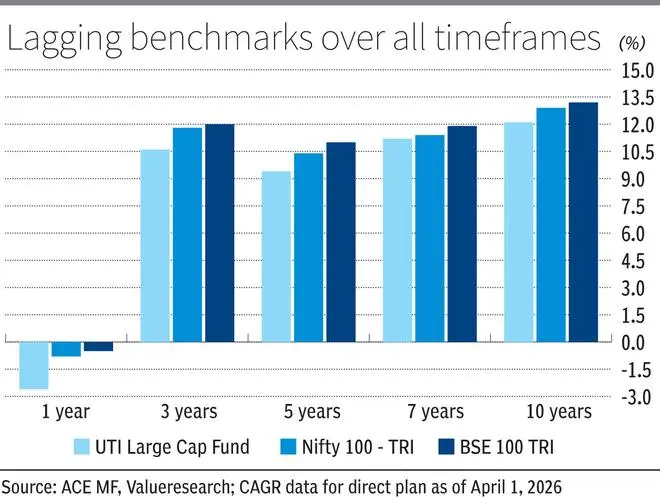
UTI Large Cap’s track record over the past several years has been underwhelming, with the fund’s performance falling below those of standard benchmarks and peers.

Over one, three, five and 10-year timeframes, the fund has underperformed the Nifty 100 TRI by 1-2.5 percentage points. The fund’s underperformance with respect to the BSE 100 TRI is also similar.

UTI Large Cap’s five-year point-to-point returns are moderate, at 9.4 per cent. In this timeframe, the Nifty 100 TRI gave 10.1 per cent and the BSE 100 TRI delivered 11 per cent. Even on a 10-year basis the fund lags these benchmarks.

When five-year rolling returns are considered from January 2013 to March 2026, the fund has outperformed the Nifty 100 TRI a mere 36.2 per cent of the times. The mean return for the fund in this rolling period is 13.7 per cent, while for the Nifty 100 TRI it is 13.9 per cent.

When returns on monthly SIPs (XIRR) over the past 10 years are considered, UTI Large Cap fund has given 10.3 per cent. A similar SIP in the Nifty 100 TRI would have delivered 11 per cent.

UTI Large Cap has an upside capture ratio of 96, indicating that its NAV rises less than the benchmark during market rallies. The fund has a downside capture ratio of 93.8, indicating that the scheme’s NAV falls less than the benchmark during periods of corrections. A score of 100 indicates that a fund performs exactly in line with its benchmark. Overall, these ratios point to prolonged underperformance.

This inference is based on data from March 2021-March 2026. All return figures and ratios pertain to the direct plan of the fund.

Churning moderately

UTI Large cap sticks to being bluechip in character and principle with such stocks accounting for more than 87 per cent of the portfolio at most times.

Mid and small-caps find utmost 8-10 per cent weightage in the fund’s holdings. Cash and debt positions are restricted to 2-4 per cent most of the time.

As with most funds, more so from the large-cap stable, banks figure among the top holdings of the scheme.

Exposure to HDFC Bank, a major underperformer in the past few years, in recent months, and holding on to the likes of Kotak Mahindra Bank and Bajaj Finance which have had a weak run, have hurt returns.

IT software has consistently been the second largest holding for UTI Large Cap fund, despite the underperformance due to AI disruptions. Stocks such as Infosys, which corrected heavily, still find a place among the top holdings.

Not giving higher weightage to segments that have done well such as pharma/healthcare, automobiles, and so forth, has been another cause for the fund’s underperformance.

Instead, retailing and consumer durables figure among key holdings. The likes of Dmart, ITC and lackadaisical insurance picks such as HDFC Life have all added to erosion in returns.

Though there is a certain value orientation to the fund’s picks, it has not paid off well enough even over longer timeframes.

Published on April 4, 2026



Source link

YouTube
Instagram
WhatsApp



