Benchmark equity indices ended sharply lower on Friday, snapping a two-day winning streak, as global uncertainties dampened investor sentiment.
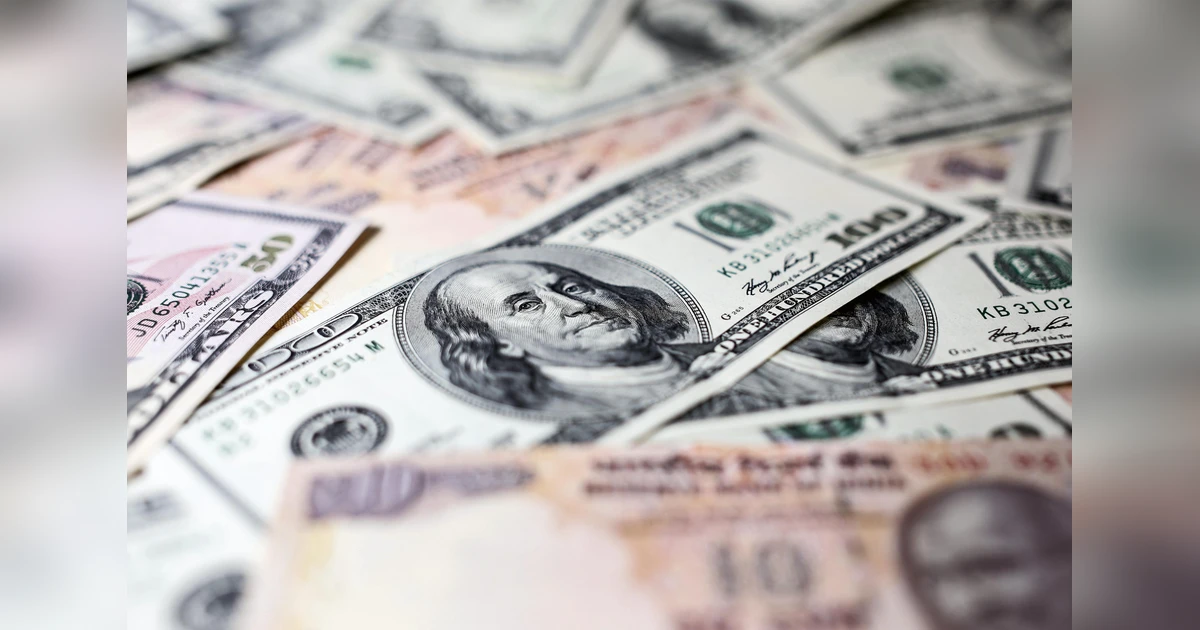
The Nifty slipped below the 22,850 mark, while the rupee hit a record low against the US dollar, breaching the 94 level amid sustained pressure. Sectoral indices on the NSE ended in the red, with PSU banks, realty and auto stocks declining the most.
The decline was driven by multiple factors, including persistent geopolitical tensions in the Middle East, elevated crude oil prices, weakness in global markets, continued foreign institutional investor (FII) selling, and a rise in US bond yields.
Amid the volatility, the government moved to cushion the impact of high oil prices by cutting additional excise duty on fuels. The duty on petrol was reduced to Rs 3 per litre from Rs 13 earlier, while diesel saw a complete removal of the levy from Rs 10 per litre. The measure is aimed at stabilising domestic fuel prices as crude remains elevated.
The S&P BSE Sensex tumbled 1,690.23 points or 2.25% to 73,583.22. The Nifty 50 index fell 488.85 points or 2.09% to 22,819.60. In the past two sessions, the Sensex and Nifty climbed 3.54% and 3.53%, respectively.
Reliance Industries (down 4.55%), HDFC Bank (down 3.26%) and ICICI Bank (down 2.03%) were major index drags today.
In the broader market, the BSE 150 MidCap Index slipped 2.18% and the BSE 250 SmallCap Index declined 1.82%.
The market breadth was weak. On the BSE, 822 shares rose and 3,544 shares fell. A total of 145 shares were unchanged.
The NSE’s India VIX, a gauge of the market’s expectation of volatility over the near term rallied 8.77% to 26.80.
US-Iran Warfare:
As the conflict in the Middle East continues without a clear resolution, uncertainty remains a material risk factor for investors. Public statements by U.S. President Donald Trump and media reports indicate that the United States has extended a pause on potential strikes against parts of Irans energy infrastructure into early April, with Trump describing the latest extension as made at the request of the Iranian government. Iranian officials, however, have publicly denied formally requesting such a pause, and no formal Iranian request has been independently verified in the public domain.
Media reports also suggest that Iran has rejected a 15-point proposal attributed to the United States and, instead, has outlined its own conditions, including alleged demands for non-resumption of military operations by the United States and Israel, broader regional de-escalation, compensation for damage, and stronger recognition of its authority over shipping routes near the Strait of Hormuz. These reported conditions rely on secondary sourcing and have not been fully confirmed by the parties.
Numbers to Track:
In the foreign exchange market, the rupee edged lower against the dollar. The partially convertible rupee was hovering at 94.75 compared with its close of 93.9600 during the previous trading session. It fell to a record low of 94.85 against the U.S. dollar today.
The yield on India’s 10-year benchmark federal paper rose 0.87% to 6.934, compared with the previous session’s close of 6.874.
MCX Gold futures for the April 2, 2026 settlement jumped 1.64% to Rs 141,813.
The US Dollar Index (DXY), which tracks the greenback’s value against a basket of currencies, was up 0.07% to 100.01.
The United States 10-year bond yield rose 0.97% to 4.461.
In the commodities market, Brent crude for May 2026 settlement jumped $2.15 or 1.99% to $110.16 a barrel.
Global Markets:
Dow Jones futures are down by 144 points, signaling a weak start for US stocks today.
European shares declined on Friday as investors struggled to decipher mixed messages on the status of Middle East peace talks.
Asian indices ended mixed despite President Donald Trumps postponing of strikes on Iran brought some relief, although concerns over a prolonged conflict kept some regional markets under pressure.
President Donald Trump extended his Friday deadline to attack Irans energy infrastructure by 10 days to April 6 to allow more time for negotiations.
The extension was at the request of the government of the Islamic Republic, Trump said, and it was granted in exchange for 10 oil tankers that passed through the Strait of Hormuz as a present from Tehran. Washington has in recent days signaled it wants a negotiated end to the conflict and insisted that peace talks with the Islamic Republic have been ongoing. Tehran has denied that it is in direct talks with the U.S.
Meanwhile, Chinas industrial profits jumped 15.2% from a year earlier in the January-February period, the National Bureau of Statistics data showed Friday, extending a sharp rebound from a 5.3% jump in December.
Overnight on Wall Street, the S&P 500 fell on Thursday, weighed by higher oil prices, as traders followed the latest developments out of the Middle East.
The broad market index declined 1.74% to end at 6,477.16, while the Nasdaq Composite shed 2.38% and closed at 21,408.08. The tech-heavy index closed in correction territory, down more than 10% from its high. The Dow Jones Industrial Average dipped 469.38 points, or 1.01%, and settled at 45,960.11.
Stocks in Spotlight:
Tata Motors Passenger Vehicles tumbled 4.68% after reports said its luxury arm, Jaguar Land Rover (JLR), has temporarily halted production at its Solihull plant in the United Kingdom due to a parts supply disruption.
Larsen & Toubro declined 2.27%. The company said its buildings & factories (B&F) vertical has secured multiple orders across several states in India, with the total value classified as significant (Rs 1,000 crore Rs 2,500 crore).
Wealth First Portfolio Managers fell 6.09%. Its subsidiary, Lakshya Asset Management, received final approval from the Securities and Exchange Board of India to launch its mutual fund business.
Royal Orchid Hotels (ROHL) fell 4.54%. The company announced the signing of a new upscale hotel project in Mundra, further strengthening its presence in key industrial and port cities across the country.
ACME Solar Holdings jumped 6.09% after the company announced commissioning of an additional 4 MW capacity at its wind power project in Gujarat. The capacity addition has been executed through its subsidiary, ACME Eco Clean Energy, at Surendranagar district. With this, the total commissioned capacity at the project has reached 92 MW out of the planned 100 MW.
Hilton Metal Forging hit upper circuit of 20% after the company secured an order worth approximately Rs 720 crore for the supply of 3,60,000 standard 155mm M107 empty bomb artillery shells.
Azad Engineering advanced 1.12% after the company signed an 8-year long-term contract and price agreement with Mitsubishi Heavy Industries (MHI), Japan, to supply complex hot-section nozzle vane segments for gas turbine engines.
Sula Vineyards fell 2.56%. The company has signed a definitive agreement with Mo Hennessy India to acquire the wine production facility and estate of Chandon in Dindori, Nashik, as part of its expansion strategy. Spread across 19 acres, the estate houses a state-of-the-art winery with an annual production capacity of 4.5 lakh litres, which can be scaled up to 13 lakh litres.
IPO Update:
Sai Parenteral’s received bids for 78,74,474 shares as against 75,22,486 shares on offer, according to stock exchange data at 16:45 IST on Friday (27 March 2026). The issue was subscribed 1.05 times.
The issue opened for bidding on 24 March 2026 and it will close on 27 March 2026. The price band of the IPO is fixed between Rs 372 and 392 per share.
Amir Chand Jagdish Kumar (Exports) received bids for 6,08,30,140 shares as against 1,89,05,270 shares on offer, according to stock exchange data at 16:45 IST on Friday (27 March 2026). The issue was subscribed 3.22 times.
The issue opened for bidding on 24 March 2026 and it will close on 27 March 2026. The price band of the IPO is fixed between Rs 201 and 212 per share.
Powerica received bids for 2,97,61,949 shares as against 2,05,55,171 shares on offer, according to stock exchange data at 16:45 IST on Friday (27 March 2026). The issue was subscribed 1.45 times.
The issue opened for bidding on 24 March 2026 and it will close on 27 March 2026. The price band of the IPO is fixed between Rs 375 and 395 per share.
Powered by Capital Market – Live News