Titan, Kalyan: Jewellery stocks tumble up to 16% amid West Asia jitters

Titan, Kalyan: Jewellery stocks tumble up to 16% amid West Asia jitters


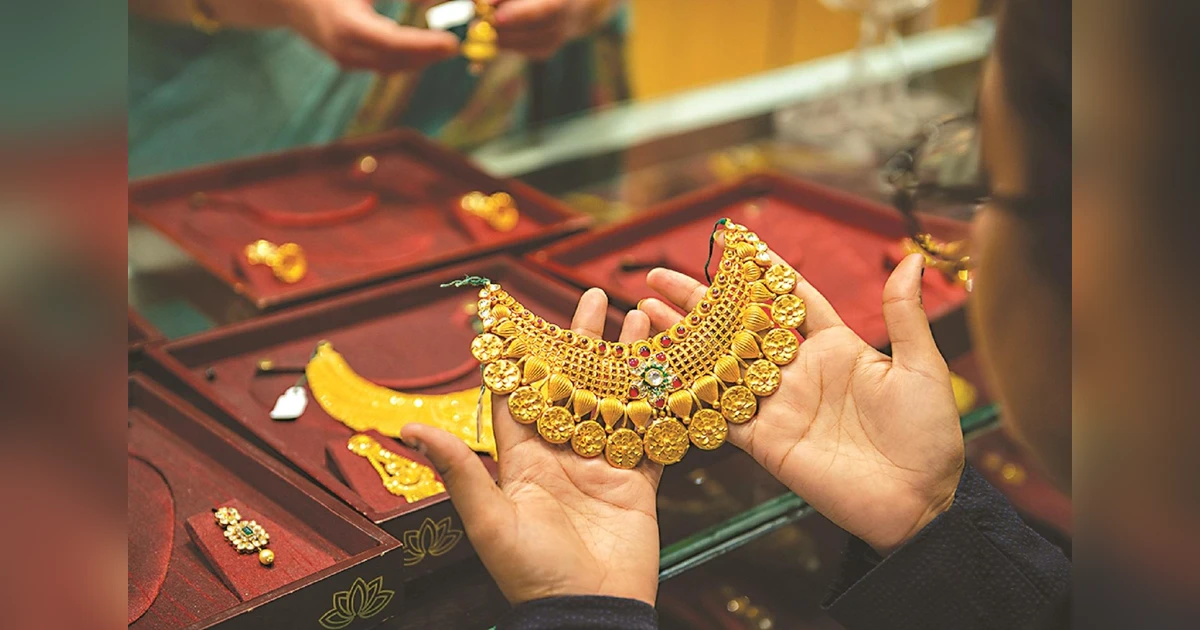
Jewellery-related stocks tanked as much as 16 per cent in Monday’s trade, as gold and silver prices jumped amid the West Asia conflict. Mostly, a rise in precious metals poses headwinds for jewellery stocks, as an increase in prices could lead to a decrease in jewellery demand and weak margins.


Precious prices jumped as investors sought shelter in safe havens after the US and Israel attacked Iran over the weekend, adding to worries for equity investors. 


On the Multi-Commodity Exchange (MCX), around 11:25 AM, gold April futures were trading 3.2 per cent higher at ₹1,67,299 per 10 grams. Silver May futures were also up 3 per cent at ₹2,91,143 per 1 kg.  

The US and Israel fired missiles across Iran on Saturday, with the Supreme Leader Ayatollah Ali Khamenei being killed. Iran responded with strikes against Israel, as well as US bases and other targets in states including Saudi Arabia, Qatar, the United Arab Emirates (UAE), Kuwait and Bahrain.  READ | Gold surges over 1%, climbs above $5,300 as strikes on Iran rattle markets 


US President Donald Trump said the forces sank nine Iranian naval ships and that combat operations would continue until all objectives were completed, according to Bloomberg. 


Analysts’ view


In the current scenario, the sentiment towards jewellery stocks is a mix of high-performance optimism coupled with caution due to volatile gold prices, said Kruttika Prabhudesai, research analyst, Mirae Asset ShareKhan.  
“In the jewellery space we prefer Titan Company due to its leadership position and multiple growth drivers. The company continues to outperform other branded players driven by its brand recall, exchange program, focus on international expansion and other initiatives,” said Prabhudesai. 
She added: With natural diamond prices fluctuating and younger consumers seeking affordability, its recently launched lab-grown-diamond brand – beYon – will help Titan to capture the everyday luxury market without diluting Tanishq’s premium heritage status. The non-jewellery business is also scaling up well and will contribute to growth in the medium term. Further, market share gains, shift from unbranded to branded and network expansion will be additional drivers. 


According to Ponmudi R, CEO of Enrich Money, MCX Gold futures are trading in the ₹1,65,000–₹1,70,000 range after consolidating post the sharp correction from all-time highs.


“While the price is currently in short-term consolidation with a positive tilt, holding firm above critical support zones. Robust buying interest persists in the ₹1,58,000–1,62,000 demand band following the recent surge driven by Middle East tensions. A sustained hold above this base, followed by a breakout above ₹1,65,000, may revive momentum toward ₹1,70,000–1,75,000, preserving a bullish medium-term perspective,” he said.   READ | Gold, Silver ETFs soar as safe haven assets gain on West Asia concerns 


For silver futures, he said, “The long-term bullish framework remains firmly intact, key support is placed at ₹2,50,000–2,70,000. A sustained hold above this region could trigger recovery toward ₹3,20,000–3,30,000. Dips toward strong support zones may offer accumulation opportunities for positional traders, though a decisive breakdown below these levels could accelerate downside pressure.”


Disclaimer: The views and investment tips expressed by the brokerage in this article are their own and not those of the website or its management. Business Standard advises users to check with certified experts before taking any investment decisions.


On the Multi-Commodity Exchange (MCX), around 11:25 AM, gold April futures were trading 3.2 per cent higher at ₹1,67,299 per 10 grams. Silver May futures were also up 3 per cent at ₹2,91,143 per 1 kg. 


Source link

Hyundai Motor clocks total sales of 66,134 units in Feb'26

Hyundai Motor clocks total sales of 66,134 units in Feb'26


Hyundai Motor India has recorded total sales of 66,134 units in February 2026, thereby registering a year-on-year growth of 12.6%.

The companys total sales for February 2025 were 58,727 units.

While domestic sales rose by 9.8% YoY to 52,407 units, exports increased by 24.8% to 13,727 units in February 2026.

Hyundai Motor India manufactures and sells passenger cars, along with vehicle parts and accessories.

The company had reported a 6.34% rise in consolidated net profit to Rs 1,234.40 crore on a 7.96% increase in total revenue from operations to Rs 17,973.49 crore in Q3 FY26 as compared with Q3 FY25.


The scrip fell 1.77% to currently trade at Rs 2125.35 on the BSE.

Powered by Capital Market – Live News

Disclaimer: No Business Standard Journalist was involved in creation of this content

First Published: Mar 02 2026 | 11:50 AM IST


Source link

Hyundai Motor clocks total sales of 66,134 units in Feb'26

Sensex slumps 1,007 pts; Nifty slides below 24,900 level; oil & gas shares decline for 2nd day


The domestic equity benchmarks traded with significant losses in the morning trade, pressured by a sharp rise in crude oil prices amid escalating Middle East tensions.

The Nifty traded below the 25,550 mark. Oil & Gas shares extended losses for the second consecutive trading session.

At 10:30 ST, the barometer index, the S&P BSE Sensex, slumped 1,007.33 points or 1.24% to 80,279.86. The Nifty 50 index tanked 314.15 points or 1.25% to 24,864.50.

The broader market, the BSE 150 MidCap Index declined 1.02% and the BSE 250 SmallCap Index fell 1.47%.

The market breadth was weak. On the BSE, 735 shares rose and 3,193 shares fell. A total of 214 shares were unchanged.


The NSE’s India VIX, a gauge of the market’s expectation of volatility over the near term, zoomed 17.71% to 16.13.

Brent crude, the global oil benchmark, jumped 6.44% to USD 77.56 per barrel.

Middle East Tension:

Middle East tensions escalated sharply following unconfirmed reports that Irans Supreme Leader Ali Khamenei may have been killed in joint U.S.Israeli strikes on Tehran, although Iranian authorities have not issued any official confirmation. Media outlets also cited remarks attributed to Donald Trump claiming that several Iranian leaders were killed in ongoing operations, but these assertions remain independently unverified. Social media speculation pointed to Ayatollah Arafi as a possible interim successor, without credible confirmation. Meanwhile, reports indicated that Iran launched missiles toward Israel and other regional locations, heightening concerns of a broader regional conflict.

New Listing:

Shares of Shree Ram Twistex were currently trading at Rs 69 at 10:06 IST on the BSE, representing a discount of 33.65% as compared with the issue price of Rs 104.

The stock debuted at Rs 70, marking a discount of 32.69% to the issue price.

So far, the stock has hit a high of 72.90 and a low of 67. On the BSE, over 0.85 lakh shares of the company were traded in the counter so far.

Shares of Clean Max Enviro Energy Solutions were currently trading at Rs 877.35 at 10:15 IST on the BSE, representing a discount of 16.68% as compared with the issue price of Rs 1,053.

The stock debuted at Rs 952.20, marking a discount of 9.57% to the issue price.

So far, the stock has hit a high of 958.40 and a low of 857.05. On the BSE, over 1.49 lakh shares of the company were traded in the counter so far.

Buzzing Index:

The Nifty Oil & Gas index fell 1.90% to 12,032.10. The index declined 2.13% in three consecutive trading session.

Indian Oil Corporation (down 4.05%), Adani Total Gas (down 3.62%), Bharat Petroleum Corporation (down 3.31%), Petronet LNG (down 3.22%), Gujarat Gas (down 2.1%), Reliance Industries (down 2.03%), GAIL (India) (down 2%), Gujarat State Petronet (down 1.97%), Indraprastha Gas (down 1.89%) and Aegis Logistics (down 1.76%) fell.

Stocks in Spotlight:

Ashok Leyland rose 0.95%. The company reported a 24% jump in total sales (domestic & exports) to 22,157 units in February 2026, compared with 17,903 units sold in February 2025.

Bajaj Auto fell 2.11%. The company reported 27% increase in total auto sales for February 2026, selling 4.48 lakh units as against 3.52 lakh units sold in February 2025.

Hero MotoCorp fell 1.31%. The company has recorded a 44% year-on-year (YoY) rise in total two-wheeler dispatches in February 2026, selling 558,216 units during the month as compared with 388,068 units in February 2025.

Powered by Capital Market – Live News


Source link

Hyundai Motor clocks total sales of 66,134 units in Feb'26

Accord Transformer & Switchgear IPO lists in MT group


The equity shares of Accord Transformer & Switchgear (Scrip Code: 544710) are listed effective 02 March 2026 and admitted to dealings on the exchange in the list of ”MT” group securities. At 09:57 IST, the stock price was quoting at Rs 50, a premium of 8.70% compared to offer price of Rs 46.

Powered by Capital Market – Live News


Disclaimer: No Business Standard Journalist was involved in creation of this content

First Published: Mar 02 2026 | 10:16 AM IST


Source link

Gold price climbs ₹10 to ₹1,73,090; silver falls ₹100, trades at ₹2,94,900

Gold price climbs ₹10 to ₹1,73,090; silver falls ₹100, trades at ₹2,94,900


Gold Price Today: The price of 24-carat gold rose ₹10 in early trade on Monday, with ten grams of the precious metal trading at ₹1,73,090, according to the GoodReturns website. The price of silver fell by ₹100, with one kilogram of the precious metal selling at ₹2,94,900.


The price of 22-carat gold increased by ₹10, with ten grams of the yellow metal selling at ₹1,58,660. 


The price of ten grams of 24-carat gold stood at ₹1,73,090 in Mumbai and Kolkata, and ₹1,72,100 in Chennai.


In Delhi, the price of ten grams of 24-carat gold stood at ₹1,73,240.


In Mumbai, the price of ten grams of 22-carat gold was ₹1,58,660, the same as in Kolkata, Bengaluru, Hyderabad, and ₹1,57,760 in Chennai.


In Delhi, the price of ten grams of 22-carat gold stood at ₹1,58,810.


The price of one kilogram of silver in Delhi, Kolkata, and Mumbai stood at ₹2,94,900. 


The price of one kilogram of silver in Chennai stood at ₹3,25,100.


US gold prices rose more than 1 per cent on Monday after the US and Israel launched major strikes on Iran, ​killing Supreme Leader Ayatollah Ali Khamenei, escalating geopolitical tensions ​and deepening global economic uncertainty.


Spot gold was up 1.35 per cent at $5,348.49 an ‌ounce by 2316 GMT.


US gold futures rose 2.2 per cent to $5,362.30.


Spot ​silver rose 1.21 per cent ​to $94.95 an ounce after registering a monthly gain in February.


Spot platinum climbed 0.31 per cent to $2,372 an ounce while palladium was down 0.35 per cent at $1,779.80 ‌an ounce.


(with inputs from Reuters)


Source link

Equities remain core for long-term wealth creation: Harsha Upadhyaya

Equities remain core for long-term wealth creation: Harsha Upadhyaya


It has been a topsy-turvy 2026 for the markets thus far. Harsha Upadhyaya, president and chief investment officer at Kotak Mahindra Asset Management, tells Puneet Wadhwa in an email interview that if the markets are to move up meaningfully from here, leadership is more likely to come from sectors with earnings visibility rather than pure re-rating. Edited excerpts:


Have the recent geopolitical events altered your investment preference?


On geopolitics or any events, we generally avoid trading headlines. We ask – does it alter earnings trajectory and fundamentals? If yes, we adjust exposures gradually. So, our positioning tends to be evolutionary rather than abrupt. We trim where valuations go ahead of fundamentals and add where earnings visibility improves without paying an excessive premium. 


What’s the road ahead for the markets? When can we expect the worst to be over?


We avoid calling a “worst is over” too confidently as markets rarely give that clarity. That said, a good part of the near-term negatives is better understood and partially reflected in prices. At current levels, the market appears to be factoring in moderation in near-term earnings growth for parts of the economy, lower margin tailwinds versus the post-Covid period, higher dispersion—meaning not all sectors participate equally, and liquidity sensitivity, especially in the frothier segments. If the markets move up meaningfully from here, leadership is more likely to come from sectors with earnings visibility rather than pure re-rating.


Which sectors are likely to lead the earnings recovery?


Likely leadership areas (selectively) would be financials where growth has started pick up and asset quality stays stable; interest rates to remain stable implying no impact on interest margins; Industrials / capital goods / engineering as overall capex continues, and execution stays strong; select consumption plays where rural/urban demand normalises, and input cost volatility is lower, and the auto and ancillaries pack where volume growth and product mix remain supportive.


View on small-and mid-caps (SMID)?


The SMID segment has some excellent businesses, but also greater valuation and liquidity risk. After strong periods, the burden of proof shifts to earnings. If earnings recovery broadens and is sustained, quality SMIDs can participate—possibly outperform—but it will be more selective than what investors have seen in broad SMID rallies.


Did the December 2025 (Q3-FY26) quarter earnings give confidence for next fiscal?


The Q3-FY26 broadly reinforced two things. Firstly, the dispersion is high; and second, the next leg (of earnings growth) depends on whether volumes and capex momentum sustain. One quarter is not enough to declare a new earnings cycle, but it does give more data points on which pockets are stabilising and where margins/volumes are turning. 


To what extent will the recent trade deals help their earnings recover?


For SMIDs, benefits can be indirect and uneven due to trade deals. A supportive trade environment can help via better export demand for niche manufacturing, supply chain diversification opportunities and lower input volatility in some cases. But for many SMIDs, execution, balance-sheet strength, and governance matter more than macro headlines. So yes, trade-related tailwinds can help select pockets, but the primary filter remains fundamentals and valuation.


Gold exchange traded funds (ETF) inflows beat equity-oriented schemes in January. Do you foresee a trend reversal ahead?


Short-term flows can be noisy—one month doesn’t make a trend. Gold tends to attract flows when investors are seeking portfolio insurance, when real rates and currency expectations shift, or when risk perception rises. Do we see a sustained reversal away from equities? Not necessarily. 


In India, equities are often a long-term wealth creation product and flows typically normalise once volatility stabilises. What is expected is a more balanced allocation mindset, where investors use gold as a diversifier rather than a return-chasing asset. 


So, gold flows may remain healthy if uncertainty persists, but for long-term wealth creation, equities remain core—provided investors align allocations to risk capacity and time horizon. 


For a mutual fund investor, is it the right time to invest in flexicaps, or commodity ETFs for wealth creation in 2026?


Over multi-year horizons, equities—especially via diversified funds like flexicaps—have a stronger structural case because earnings growth compounds. Commodity ETFs, including metals, are typically better viewed as tactical allocations or diversifiers, not primary compounding engines.


Flexicaps offer two advantages in uncertain markets. First, the manager can move across market caps based on valuation and earnings quality; and second, they can manage risk through portfolio construction when dispersion is high.


Commodity ETFs, on the other hand, can complement a portfolio if the investment goal is diversification or inflation/uncertainty hedging, but relying on them for long-term wealth creation is more cycle dependent.


So, for 2026, core investments should be in diversified equities (flexicap) and satellite in commodities if it fits the investor’s risk profile, rather than an either/or.


Source link

YouTube
Instagram
WhatsApp




