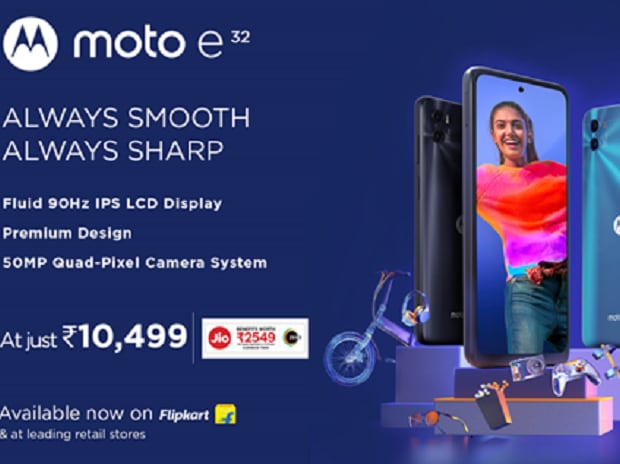
Motorola Moto e32 with 6.5-inch HD IPS screen of 90Hz refresh rate launched

Motorola Moto e32 with 6.5-inch HD IPS screen of 90Hz refresh rate launched


on Friday launched in India the Moto e32 at Rs 10,499. The is available with launch offers on . The e-commerce platform is offering a discount of 10 per cent on HDFC Bank credit and debit cards. Besides, Reliance Jio is offering benefits worth Rs 2,549, which includes Rs 2,000 cashback on recharge and Rs 549 discount on annual Zee5 membership.


Moto e32: Specifications


Powered by the MediaTek Helio G37 processor, the Moto e32 sports a 6.5-inch IPS LCD screen of 90Hz refresh rate. It has a 50-megapixel primary camera sensor on the back, paired with a 2MP depth sensor. On the front, the phone has an 8MP camera sensor for face unlock, selfies and video calls. Camera features include night vision, pro mode, and dual capture. The phone is IP52 rated for splash and dust protection. It comes in 4GB RAM and 64GB internal storage configuration. There is a microSD card slot for storage expandable (up to 1TB). The boots 12 operating system. It is powered by a 5,000mAh battery, supported by 10W wired charging.


Other features include Wi-Fi, Bluetooth 5.0, 3.5mm audio jack, and USB-C port. The smartphone boots 12 operating system. It would get security updates for two years, according to . The phone is 2G, 3G, and 4G compatible. It supports gestures like three-finger screenshot or fast flashlight by chopping down twice. Besides, there is a side-mounted fingerprint scanner, dual-SIM support, and proximity sensor.


Source link

New space tech can charge electric cars in just five minutes: NASA

New space tech can charge electric cars in just five minutes: NASA


A new NASA-funded technology for future space missions may charge an electric car in just five minutes on Earth, paving the way for increased adoption of such vehicles, the US space agency said.


Researchers at Purdue University, US developed the Flow Boiling and Condensation Experiment (FBCE) to enable two-phase fluid flow and heat transfer experiments to be conducted in the long-duration microgravity environment on the International Space Station (ISS).


The new “subcooled flow boiling” technique results in greatly improved heat transfer effectiveness compared to other approaches and could be used to control the temperatures of future systems in space.


This technology can also have applications on Earth: It could make owning an electric car more appealing, the researchers said.


Currently, charging times vary widely, from 20 minutes at a station alongside a roadway to hours using an at-home charging station.


Lengthy charging times and charger location are both cited as major concerns of people who are considering electric vehicle ownership.


Reducing the charging time for to five minutes — an industry goal — will require charging systems to provide current at 1,400 amperes.


Currently, advanced chargers only deliver currents up to 520 amperes, and most chargers available to consumers support currents of less than 150 amperes.


However, charging systems providing 1,400 amperes will generate significantly more heat than current systems, and will require improved methods to control temperature.


Recently, the team applied the technique learned from the FBCE experiments to the electric vehicle charging process.


Using this new technology, dielectric — non-electrically conducting — liquid coolant is pumped through the charging cable, where it captures the heat generated by the current-carrying conductor.


Subcooled flow boiling allows the team to deliver 4.6 times the current of the fastest available electric vehicle chargers on the market today by removing up to 24.22 kilowatts of heat, the researchers said.


The charging cable can provide 2,400 amperes, which is far beyond the 1,400 amperes required to reduce time required to charge an electric car to five minutes, they said.


“Application of this new technology resulted in unprecedented reduction of the time required to charge a vehicle and may remove one of the key barriers to worldwide adoption of electric vehicles,” the researchers added.

(Only the headline and picture of this report may have been reworked by the Business Standard staff; the rest of the content is auto-generated from a syndicated feed.)


Source link

Western Digital launches new SSD for hardcore Indian gamers on Oct 7

Western Digital launches new SSD for hardcore Indian gamers on Oct 7


Data storage solution company Western Digital on Friday launched a new SSD (solid-state drive) to provide a seamless experience for hardcore gamers in the country.


The SSD, titled ‘SN850X NVMe’, comes in three capacities — 1TB, 2TB and 4TB — and can be purchased at a starting price of Rs 13,119, the company said in a statement.


Powered by an internal PCIe Gen4 SSD, the new drive delivers speeds of up to 7,300 MB per second for better gaming experience.


Gamers can get an amazing gaming experience with quick load times, rich visuals, and uncompromised thermal performance thanks to decreased latency, predictive loading, and adaptive thermal management, the company said.


New Game Mode 2.0 offers extra capabilities to increase PC performance that is included with downloadable WD BLACK Dashboard.


To help maintain top performance, an optional heatsink (1TB and 2TB models) is also available. It incorporates RGB lights to match any gaming computer.


–IANS


aj/na

(Only the headline and picture of this report may have been reworked by the Business Standard staff; the rest of the content is auto-generated from a syndicated feed.)


Source link

TikTok rolls out range of creation enhancing, editing tools in US

TikTok rolls out range of creation enhancing, editing tools in US


With an aim to give users more creative freedom with their content, Chinese short-form video app has rolled outAa range of enhanced new creation and editing tools in the .


The platform said that the new editing tools will empower users to enjoy more creative freedom, share richer stories, and bring their content ideas to life across formats.


“To expand what’s possible with content on TikTok, we’ve introduced a range of enhanced creation and editing tools,” the company wrote in a blogpost.


“We are excited to see how an enhanced editing experience powers storytelling and makes video creation intuitive and more accessible, making it easier than ever to create great content,” it added.


The platform said its enhanced editing tools allow users to easily adjust clips, sounds, images, and text in a new editing environment, all within TikTok’s creation flow.


has also released Photo Mode, a new carousel format available on mobile for photo content that’s ideal for sharing high-quality images on .


Photo Mode allows users to share carousel posts of still images that automatically display one after another. Users can add music to soundtrack the images, which viewers can swipe through at their own pace.


Users can now pair your videos and content made in Photo Mode with longer descriptions, up to 2,200 characters for each post.


“With the extra space, we are hopeful creators will have some extra room to build on the stories they have shared in videos or Photo Mode, giving them another space to express themselves and more deeply connect with others,” the company said.


In June 2020, the Indian government banned the popular short-form video app amid border tensions with China.


–IANS


vc/ksk/

(Only the headline and picture of this report may have been reworked by the Business Standard staff; the rest of the content is auto-generated from a syndicated feed.)


Source link

Over 7 in 10 Indians now prefer to chat with businesses: Meta report

Over 7 in 10 Indians now prefer to chat with businesses: Meta report


In the ever-evolving communication landscape, more than 70 per cent of Indians prefer to message businesses rather than sending an email, calling or visiting their website, a new report said on Friday.


Nearly 75 per cent Indians surveyed said they are more likely to do business with/purchase from a company that they can contact via messaging.


People in India increasingly prefer messaging over other forms of communication, the same way they chat with their friends and family, according to the research by Kantar commissioned by Meta (formerly Facebook).


“Today, customers not only want a quick and easy way to connect with brands, but they also want to engage with a brand to learn more about their product while considering a purchase,” said Ravi Garg, Director Business Messaging at Meta.


The findings of the report showed that 86 per cent of adults message a business at least once a week, considerably higher than the global average of 66 per cent.


Majority (83 per cent) of the people surveyed expect businesses to deploy quick and easy modes of communication, such as messaging.


About 72 per cent of the people surveyed in India said they message with a business more often since the start of the pandemic.


Interestingly, 75 per cent are more likely to do business with/purchase from a company that they can contact via messaging.


“Conversational messaging is not only helping brands connect with consumers but also build brand experiences that grow their business,” said Ravi Sundararajan, Chief Operating Officer, Gupshup.


–IANS


na/ksk/


(Only the headline and picture of this report may have been reworked by the Business Standard staff; the rest of the content is auto-generated from a syndicated feed.)


Source link

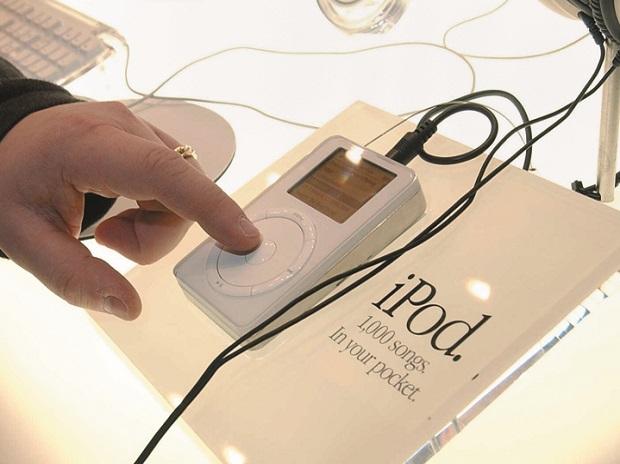
iPod inventor Tony Fadell says Apple should move iPhone to USB-C

iPod inventor Tony Fadell says Apple should move iPhone to USB-C


Tony Fadell, inventor of the iPod, has said that Apple should include USB-C port in iPhones, as the European Union passed a resolution on Type-C as standard charging port.


The debate started when a Twitter user questioned if the iPod would succeed if Apple was forced to utilise 1.0 rather than the fast FireWire technology.


“I can’t see a problem. The world has converged on USB-C. The physical and user limits have been hit. Next up is wireless per, not a diff physical connection. So I’m not too worried about this regulation. They’re simply forcing Apple to do the right thing… it’s overdue frankly”, Fadell posted on Twitter.


“Not in this case. This is only happening because Apple hasn’t been doing the right thing. Period. This is about a monopolist like position not about technology. I hope after Apple is forced to change the regulations will be removed to allow innovation to continue”, he added.


Earlier, the European Parliament passed a resolution mandating that by the end of 2024, all consumer electronics, including iPhones and AirPods, will use Type-C as their standard charging port.


The Parliament said that the new law is part of a broader EU effort to reduce e-waste and empower consumers to make more sustainable choices.


“Following Parliament’s approval, EU consumers will soon be able to use a single charging solution for their electronic devices,” the European Parliament said in a statement.


“By the end of 2024, all mobile phones, tablets and cameras sold in the EU will have to be equipped with a USB Type-C charging port. From spring 2026, the obligation will extend to laptops,” it added.


–IANS


aj/na

(Only the headline and picture of this report may have been reworked by the Business Standard staff; the rest of the content is auto-generated from a syndicated feed.)


Source link

YouTube
Instagram
WhatsApp