Top Putin aide to lead Russian delegation for AI Impact Summit in New Delhi

Top Putin aide to lead Russian delegation for AI Impact Summit in New Delhi


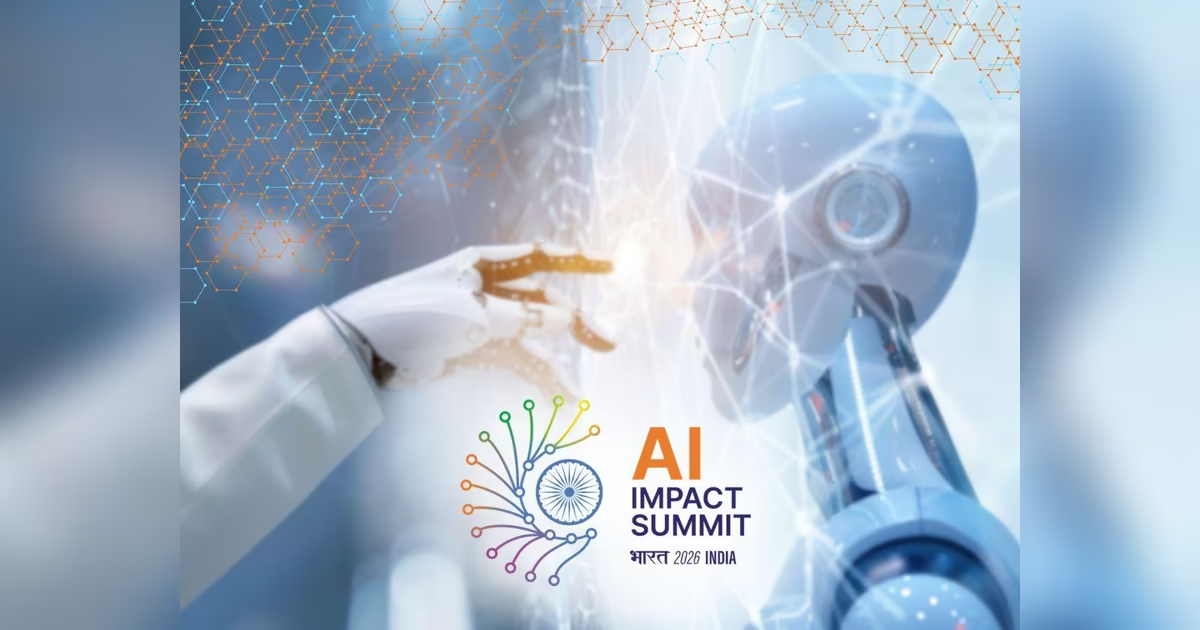
Russian President Vladimir Putin’s senior aide Maxim Oreshkin will lead a large delegation for the AI Impact Summit being held in New Delhi from Monday.


India is set to host the AI Impact Summit 2026, a high-profile gathering of global leaders and industry heavyweights in Artificial Intelligence from February 16-20 at New Delhi’s ‘Bharat Mandapam,’ bringing together policymakers, industry leaders and technology innovators.


Oreshkin, who is deputy chief of the Kremlin staff and economic aide to President Putin, is set to lead the Russian delegation to the India AI Impact Summit 2026.


This (choice of sending Oreshkin) highlights a strategic push for AI collaboration between the two nations, a Kremlin source told PTI, adding, the delegation will focus on secure, trusted, and sovereign AI, with active engagement in discussions on AI governance, technology, and partnerships within BRICS and other platforms.


In an interview to BRICS TV Network on February 9, Russian Foreign Minister Segei Lavrov noted: “India also emphasises ICT security, which we actively support, contributing to the agenda. This is significant, as norms regulating AI use between states, and AI applications by individual states, are only now being established.” 
Lavrov said these norms will regulate behaviours that affect security. “Some countries are actively introducing AI into military applications. While each state has the right to determine its own approach, certain countries are already attempting to centralise control, subordinating what states can and may do with AI in the military sphere,” he said.


BRICS members will not accept infringements on their sovereignty, yet transparency remains crucial, the minister added.


In an article published by state-run news agency TASS on Friday, India’s Ambassador to Russia Vinay Kumar outlined the promising prospects for IndiaRussia cooperation in the field of Artificial Intelligence, highlighting the growing strategic and technological partnership between the two nations.


The synergy between Moscow and New Delhi in AI would act as a catalyst for shared growth and technological advancement of the two strategic partners, Ambassador Kumar said.


Source link

AI buzzwords decoded: What terms like LLMs, generative AI, guardrails mean

AI buzzwords decoded: What terms like LLMs, generative AI, guardrails mean


Artificial intelligence is rapidly reshaping industries, workplaces and the daily digital life, emerging as one of the most transformative technologies – and a focal point of global conversations.


As chatter around AI intensifies ahead of the mega summit that New Delhi is set to host, here is a straightforward guide to some frequently used terms making headlines, and what they mean.


From LLMs to guardrails, decoding AI vocabulary: 
— AI: First things, first. Artificial Intelligence, or AI, refers to the simulation of human intelligence by machines. Think of it as systems designed to perform tasks that typically require human intelligence – understanding language, recognising images, making decisions, solving problems, and increasingly, creating content such as text, music or videos.


At its core, AI is about enabling machines to learn from data. Instead of being programmed step-by-step for every scenario – as is the case with conventional software – AI systems are trained on large volumes of information to detect patterns, make predictions and improvise over time.


— Large Language Model (LLM): An LLM is a type of AI model trained on vast amounts of data (books, websites, articles) to understand and generate human-like language. LLMs power chatbots, writing assistants, coding tools and search summaries.


They work by predicting the next word in a sequence based on patterns learned from massive data sets. An LLM specialises in language.


Prominent examples include Grok, GPT-4o, Claude 4, Gemini 2.5, Llama 4 and DeepSeek-R1.


— Generative AI: AI that can create new content – text, images, music, code or video in response to prompts.


It includes text generators (often powered by LLMs), as well as image models, video models, voice synthesis tools and music generators.


These systems respond to prompts and generate outputs that resemble human-created work, from summarising reports and writing code to composing music, designing logos, creating marketing copy, generating product descriptions, producing social media posts, building presentations, creating synthetic voices, generating realistic images and videos, and even simulating customer service conversations.


— Use Cases: A ‘use case’ means how AI is applied in real-world scenarios, or simply, its practical impact. Common use cases could include fraud detection in banking, personalised recommendations on OTT platforms, AI tools in agriculture, analysing soil and weather data, healthcare diagnostics, and drug discovery.


— Algorithm: A set of defined rules or instructions that tells a computer how to process data and make decisions. Think of algorithms as the building blocks of AI systems.


— AI guardrails: Safeguards woven into AI systems to ensure they operate safely, ethically and within defined boundaries. They are designed to prevent harmful, biased, illegal or inappropriate outputs, and to align the system’s behaviour with laws, policies and human values.


Guardrails could be around content filters, safety policies, bias mitigation, among others.


— Bias (AI Bias): Systematic errors in AI outputs caused by skewed training data, flawed assumptions or design limitations.


— AI hallucination: When an AI system generates information that appears plausible and convincing but is factually incorrect or fabricated.


— Prompt: The input or instruction given to a generative AI system to produce a response.


— Token: A unit of text (word, sub-word, or character) that an AI model processes during training and inference.


Source link

AI buzzwords decoded: What terms like LLMs, generative AI, guardrails mean

'India pivotal for AI-driven change', say tech CEOs ahead of key summit


The India AI Impact Summit being held at the Bharat Mandapam from February 16-20 showcases India front and centre as a key player in Artificial Intelligence.


The Summit is envisioned as a pivotal global platform to shape a future-oriented agenda for inclusive, responsible, and impactful AI and aims to move beyond high-level discussions and deliver tangible outcomes that can support economic growth, social development, and sustainable use of AI.


Adobe CEO Shantanu Narayen says India has led the way to show what is possible with the confluence of ambition and imagination.


“India has always shown what’s possible when imagination meets ambition. I commend Honourable Prime Minister Modi and the Ministry of Electronics and IT for their visionary leadership in organizing the AI Impact Summit, the first global AI summit in the Global South. It reflects our shared commitment to harnessing the transformative power of AI to drive inclusive growth, unlock human potential, and create a sustainable future. At Adobe, we’re proud to lead the way in developing commercially safe creative AI, supporting the vision of a Viksit Bharat and empowering everyone to create,” he said in a video posted by the Indian Embassy in the US.


This year’s Summit will serve as an impact-focused global platform, shaping AI into measurable outcomes across economies, aligning with the national vision of Welfare for All, Happiness of All and global principle of AI for Humanity.


Raj Koneru, Founder & CEO Kore.AI says AI is more than transformation and India will play a pivotal role in this.


“I’ve been a tech entrepreneur all my life, and I’ve never seen technology like AI before. We’ve seen the internet, we’ve seen the cloud, we’ve seen mobile, but AI is more than just transformation. It is going to change the way humans live. India has a pivotal role in this process. With its digital infrastructure, the enormous human talent, and a supportive government, it’s going to provide AI to the entire world as time develops. We saw this early. About a dozen years ago, we built Kore.ai from India and brought a world-class AI platform to the world. I’m excited to be here at the India AI Summit, along with other business leaders and technology leaders, to learn and exchange ideas,” he said in a video posted by the Indian Embassy in the US.


India’s rapid adoption of AI is opening new pathways for innovation and inclusive growth across sectors. As technology evolves, India is advancing workforce readiness for an AI-driven economy while ensuring broad participation across regions and socio-economic groups.


Vinod Khosla, Founder, Khosla Ventures says he looks forward to discussion on what AI service can do for Indian citizens.


“The AI summit in India is going to be a really exciting opportunity to talk about the benefits of AI. AI is such a transformational opportunity, especially for the bottom half of the population that has very little access to the knowledge economy. It’ll be most helpful to them and provide them services like healthcare services, education, and other things at their level, in their language. So it’s such a large opportunity and I look forward to the discussion there about AI services and what it can do for the Indian population, especially those with the least resources today,” he said in a video posted by the Indian Embassy in the US.


The India-AI Impact Summit 2026 strengthens India’s role as a key platform for shaping the global AI agenda.


By linking policy with implementation and innovation with public purpose, the Summit establishes a structured approach to responsible AI deployment. It aligns technological advancement with inclusive growth and sustainable development.


Source link

India must pursue 'sovereign by design' AI approach to benefit all: BCGX

India must pursue 'sovereign by design' AI approach to benefit all: BCGX


AI in India will drive productivity, quality, and role redesign in the near term rather than mass unemployment, but the country must pursue a “sovereign by design” approach, maintaining control over its data and capabilities while staying globally integrated to ensure AI benefits everyone, according to BCGX.


India’s talent base is a real advantage, with 13 per cent of the global AI talent pool as new centres of influence emerge beyond AI superpowers US and China, top officials of BCGX, the AI, digital and innovation division of global consulting firm BCG, told PTI in an emailed interview.


“The Asia-Pacific region is often described as being ahead of the curve in AI adoption, for example, a recent BCG report found that 92 per cent of employees in India use AI at least several times a week,” Sylvain Duranto, Global Leader BCGX, said, referring to how AI has gained traction in India.


On India’s AI talent pool, Duranto said, “Beyond the AI superpowers of the US and China, new centres of influence are emerging. With a population of 1.4 billion, and (India has) 13 per cent of the global AI talent pool”.


Elaborating, BCGX India Leader Nipun Kalra said, “BCG-sized estimates put India’s AI talent pool at 6,00,000 today, projected to exceed 1.25 million by 2027, with an AI skill penetration factor of 3.09 (highest among G20/OECD)”.


However, he said, “With over 2,000 AI startups, India is only second to the US, but lags in AI patents with less than 1 per cent patents from India”.


India needs to solve for AI adoption formally by the workforce with scaled pilots that are enforced organisationally to drive success, Kalra added.


When asked about the impact of jobs in India, he said, “The near-term story in India is productivity and quality uplift-paired with role redesign more than mass displacement”.


Citing BCG’s executive survey, he said 64 per cent expect ‘AI and humans working side by side’, and fewer than 10 per cent expect a net headcount decrease due to AI automation.


Yet, Kalra said, toil tasks — repetitive, rule-based activities will increasingly be automated, while ‘reasoning tasks’ such as analysis, synthesis, decision support will be augmented through AI copilots.


On the other hand, expertise-driven roles such as healthcare, advisory, engineering, and financial services will see the strongest augmentation, where AI enhances judgment rather than replaces it, Kalra noted.


When asked what policy safeguards are needed so that AI remains a boon, not a bane, he said, “India’s approach should be AI for all, sovereign by design”.


“Sovereign AI is not about isolation. It is about ensuring that India controls its data, context, and critical AI capabilities, while remaining globally connected.” 
Kalra stressed the need to “scale skilling and transition pathways” so that “AI adoption creates productivity, not displacement, especially across MSMEs and Tier-2/3 cities”.


Noting that sovereign AI infrastructure is critical, he said it will play a key role in reducing dependence on external platforms while ensuring affordability.


“Governance must move beyond compliance to proactive enablement,” he said, adding that already the IndiaAI Safe & Trusted AI Mission and the DPDP Act provide guardrails for privacy, accountability, and responsible deployment at scale.


Commenting on sectors which will see economy-wide AI impact in the next two to three years, Kalra said, “Over the next few years, AI impact in India will be significant in IT services, financial institutions, agriculture, and healthcare”.


Citing a report by BCGX and FICCI, he also said AI adoption in Indian MSMEs can generate over USD 500 billion in economic value.


Source link

'India key to global AI growth', say tech leaders ahead of mega summit

'India key to global AI growth', say tech leaders ahead of mega summit


With just a day to go for the mega AI-India Impact summit 2026, there is a huge buzz in the tech corridors as the who’s-who of the tech world gear up for this big event.


The summit puts India front and centre as a key player in Artificial Intelligence. It showcases India’s role in global AI governance and demonstrates how India is prioritizing on deployment of AI and its measurable impact on citizens. The summit brings together global leaders, policymakers, technology companies, innovators, and experts to showcase and deliberate on the transformative potential of AI for inclusive growth, governance, and sustainable development.


Jay Chaudhry, CEO, Chairman & Founder, Zscaler, says that to let AI make an impact, a foundation of zero trust security is needed, and India has the vision to lead this.


“Excited to join global industry and government leaders at the India AI Impact Summit in Delhi. India is where both my personal story and the Zscaler story began. Our engineering teams here built the Zscaler cloud security platform that processes over 500 billion transactions per day. That data is the fuel that makes AI meaningful and powerful. But you cannot capitalize on AI using legacy firewall-based security. It just doesn’t work. To let AI truly impact the world, you need a foundation of zero trust security. India has the talent and the vision to lead this shift, not just follow it. India’s future growth depends upon secure AI adoption. And we are committed to helping turn ideas into impact at this one-of-a-kind global summit,” Chaudhary said in a video posted by the Indian Embassy in the United States.


Prith Banerjee, SVP of Innovation at Synopsys, says that India is not just an AI market but has emerged as a force multiplier.


“The AI Impact Summit is extremely important as India is the world’s most populous country. India is not just a market for AI but a force multiplier for global AI growth and has the capability to solve some of the world’s most pressing problems, from healthcare to mobility. In my talk on AI machine learning for electronic design automation and engineering simulation for chips to systems, I’ll discuss how automotive, aerospace, energy, healthcare, and high-tech are fundamentally transforming the intelligent systems that are silicon-designed, software-enabled, and AI-driven. And how Synopsys is helping India build these intelligent systems from chips to systems,” he said.


Artificial Intelligence (AI) has become a central pillar of India’s development journey. It is strengthening governance, improving public service delivery, and enabling solutions that can reach citizens at scale. Mati Staniszewski, Co-Founder, ElevenLabs says that for India, AI is a tool to ensure seamless interaction with technology.


“As the world moves toward using AI as a tool for inclusive growth and empowerment, we are entering an era where voice becomes the primary interface for technology, freeing us from keyboards and screens. For a diverse nation like India, this means a future of seamless interaction with technology across all regions, languages and demographics. In areas such as education and healthcare, human-sounding voice allows us to communicate, learn and receive guidance without losing trust or nuance. At ElevenLabs, by giving voice to technology, we narrow the gap between ideation and production, ensuring opportunity is accessible and affordable to all,” he said


Pari Natarajan, CEO and Co-Founder, Zinnov says that India is today shaping AI that is practical, scalable and human-centric.


“AI is not just a technology shift–it is a once-in-a-generation opportunity to reimagine inclusive growth at a planetary scale, and India is already playing a defining role. Our Global Capability Centres and IT services firms have evolved into innovation engines, startups are building AI-native businesses grounded in deep domain expertise, and academia is strengthening the research and talent pipeline. Powered by millions who understand real-world enterprise and government workflows, India is shaping AI that is practical, scalable, and human-centric. If India leads AI, it will be open, affordable, and inclusive–ensuring progress reaches not just a few, but all 8 billion people,” he said.


India’s approach focuses on practical deployment across sectors so that AI improves everyday life and public services. By prioritising applications that are easy to use and widely accessible, India is ensuring that AI delivers inclusive and measurable public impact.


Source link

India must pursue 'sovereign by design' AI approach to benefit all: BCGX

Why Sigmund Freud is making a comeback in the age of authoritarianism, AI


Psychoanalysis is having a moment. Instagram accounts dedicated to Freudian theory have amassed nearly 1.5 million followers. Television shows like Orna Guralnik’s Couples Therapy have become compulsive viewing. Think pieces in The New York Times, The London Review of Books, Harper’s, New Statesman, the Guardian and Vulture are declaring psychoanalysis’s resurrection. As Joseph Bernstein of the New York Times put it: “Sigmund Freud is enjoying something of a comeback.”


For many, this revival comes as a surprise. Over the past half century, psychoanalysis – the intellectual movement and therapeutic practice founded by Sigmund Freud in 1900 Vienna – has been shunned and belittled in many scientific circles. Particularly in the English-speaking world, the rise of behavioural psychology and a ballooning pharmaceutical industry pushed long-form talking therapies like psychoanalysis to the margins.


But there’s a more complex global story to tell. In Freud’s own lifetime (1856-1939), 15 psychoanalytic institutes were established worldwide, including in Norway, Palestine, South Africa and Japan. And around the world – from Paris to Buenos Aires, from São Paulo to Tel Aviv – psychoanalysis often flourished throughout the 20th century.


Across South America, psychoanalysis continues to wield huge clinical and cultural influence. It remains so popular in Argentina that people joke you can’t board a flight to Buenos Aires without having at least one analyst on board.


There are several reasons why psychoanalysis became popular in some countries but not others. One relates to the 20th-century history of Jewish diaspora. As the Third Reich expanded, many Jewish psychoanalysts and intellectuals fled central Europe before the Holocaust. Cities like London, which received Freud and his entire family, were culturally reshaped by this refugee crisis.


But another, perhaps less obvious reason concerns the rise of authoritarianism. Psychoanalysis may have been created and spread in the crucibles of wartime Europe, but its popularity has often surged alongside political crisis.


Take Argentina. As left-wing authoritarian Peronism gave way to a US-sponsored “dirty war”, paramilitary death squads abducted, killed or otherwise “disappeared” roughly 30,000 activists, journalists, union organisers and political dissidents. Loss, silence and fear enveloped the emotional worlds of many.


Yet at the same time, psychoanalysis – with its interest in trauma, repression, mourning and unconscious truth – became a meaningful way of grappling with this oppression. Therapeutic environments for talking about trauma and loss became a technique for responding to, and perhaps even resisting, this political disaster. In a culture of state lies and enforced silence, simply speaking truth was a radical exercise.


Many of Freud’s original followers used psychoanalysis in a similar way. Surrounded by the inexplicable horrors of European fascism, figures like Wilhelm Reich, Otto Fenichel, Theodor Adorno and Erich Fromm saw psychoanalysis, typically combined with classical Marxism, as an essential tool for understanding how we develop and desire authoritarian personalities.


Half a world away in Algeria, the psychiatrist and anti-colonial activist Frantz Fanon relied heavily on psychoanalysis to protest the oppressive racial regimes of French colonialism. For all these doctors and philosophers, psychoanalysis was essential to political resistance. 


Something similar appears to be happening today. As new forms of multinational autocracy rise, as immigrants are demonised and detained, and genocide is live-streamed, psychoanalysis is thriving once more.


A tool for making sense of the senseless


For some, neuropsychoanalysts like Mark Solms have provided the necessary links to take psychoanalysis up again. In his new book, The Only Cure: Freud and the Neuroscience of Mental Healing, Solms uses neuroscientific expertise – specifically his work on dreaming – to argue that Freud’s theory of the unconscious was right all along.


According to Solms, while drugs may be temporarily effective, they offer only short-term solutions. Only psychoanalytic treatments, he argues, provide any long-term curative effect.


But Solms is just one among many such resurgent figures – a growing cadre of clinician-intellectuals whose work has returned psychoanalysis to cultural esteem. Where Solms veers towards neurology, others including Jamieson Webster, Patricia Gherovici, Avgi Saketopoulou and Lara Sheehi return us to psychoanalysis’s political urgency.


Their work shows how psychoanalysis’s core concepts – the unconscious, the “death drive”, universal bisexuality, narcissism, the ego and repression – help make sense of our contemporary moment where other theories fall short. 
In a world of increasing commodification, psychoanalysis resists commercialised definitions of value. It emphasises deep time in a climate of shortening attention spans and insists on the value of human creativity and connection in a landscape of artificial intelligence overwhelm. It challenges conventional conceptions of gender and sexual identity, and prioritises individual experiences of suffering and desire.


The reasons for psychoanalysis’s contemporary resurgence mirror those that drove its earlier waves of popularity. In times of political upheaval, state-sponsored violence and collective trauma, psychoanalysis offers tools for making sense of the seemingly senseless. It provides a framework for understanding how authoritarian impulses take root in individual psyches and spread through societies.


More still, in an era where quick fixes and pharmaceutical interventions dominate mental health care, psychoanalysis insists on the value of sustained attention to human complexity. It refuses to reduce psychological distress to chemical imbalances in the brain or symptoms to be managed. Instead, it treats each person’s inner world as worthy of deep exploration.


The collective resurgence of interest in psychoanalysis is also challenging the field itself to transform. Old assumptions – like the idea that therapists should be neutral or that heterosexuality is the norm – are being challenged. And psychoanalytic practice is being reimagined alongside many social justice and solidarity movements. This is a moment in which many are coming together to reimagine what psychoanalysis can be.


Whether this renaissance will endure remains to be seen. But for now, as political crises mount and traditional therapeutic approaches seem insufficient, Freud’s insights into the human psyche are finding new audiences eager to understand the darkness of our times.
Source link

YouTube
Instagram
WhatsApp




