Nvidia GeForce Now app launched for Amazon Fire OS users: Eligible devices

Nvidia GeForce Now app launched for Amazon Fire OS users: Eligible devices


Nvidia has rolled out a dedicated GeForce Now app for devices running Amazon’s Fire OS. This means Fire TV Stick users can now access the cloud gaming service and stream supported titles from their existing libraries. Apart from the Fire TV hardware, players only need a compatible controller and a stable internet connection to start gaming. This also puts Nvidia in direct competition with Amazon, which offers its own cloud gaming service called Luna.


Notably, Nvidia GeForce Now is not yet available in India. However, it is set to debut soon, as confirmed on the company’s website. Amazon Luna is also not available in India at the moment. 


Nvidia GeForce Now App: Compatible devices


In a blog post, Nvidia said the GeForce Now app for Fire TV is currently supported on the Fire TV Stick 4K Plus (2nd Gen) and Fire TV Stick 4K Max (2nd Gen) running Fire OS 8.1.6.0 or newer, as well as the Fire TV Stick 4K Max (1st Gen) with Fire OS 7.7.1.1 and above.


The service streams games at up to 1080p at 60fps in SDR using H.264 encoding and stereo audio, giving Fire TV users another way to play on larger screens. 


What is Nvidia GeForce Now


Nvidia GeForce Now is a cloud gaming service that allows users to stream PC games from remote servers to devices such as laptops, desktops, smartphones, smart TVs, and streaming devices. Instead of running games locally, titles are rendered in Nvidia’s data centres and streamed over the internet, enabling users to play high-performance games without requiring powerful hardware.


The service supports games purchased from digital storefronts including Steam, Epic Games Store, and other supported platforms, letting players access their existing libraries. GeForce Now offers multiple membership tiers, with higher tiers providing benefits such as faster servers, extended session lengths, and access to advanced graphics features including ray tracing and higher frame rates.


Source link

Most white-collar jobs will be automated in 12-18 months: Microsoft AI CEO

Most white-collar jobs will be automated in 12-18 months: Microsoft AI CEO


Amid the rapid rise of artificial intelligence (AI) and ongoing layoffs across industries, Microsoft AI chief executive officer (CEO) Mustafa Suleyman has warned that AI will replace a significant share of white-collar jobs within the next 12 to 18 months.


Suleyman cautioned that the impact will extend beyond coders and software engineers to professionals such as lawyers, accountants, project managers, and marketing executives.


In an interview with the Financial Times, Suleyman said: “White-collar work, where you’re sitting down at a computer, either being a lawyer or an accountant or a project manager or a marketing person, most of those tasks will be fully automated by an AI within the next 12 to 18 months.”


He further added that AI agents are expected to coordinate more effectively within the workflows of large institutions over the next two to three years. These AI tools will continue to learn and improve over time, taking increasingly autonomous actions.


Suleyman also noted that as AI advances, creating new models will become easier and more accessible. “Creating a new model is going to be like creating a podcast or writing a blog,” he said. “It is going to be possible to design an AI that suits your requirements for every institutional organisation and person on the planet”, he added, reported Financial Times.


His comments come at a time when companies are accelerating the adoption of AI. Recently, Anthropic’s Claude model shook stock markets after raising concerns about the future of Software-as-a-Service (SaaS) firms such as Infosys and Tata Consultancy Services (TCS). 


Microsoft pursuing “true self-sufficiency” in AI


To keep pace with AI’s rapid evolution, Microsoft is pursuing what Suleyman described as “true self-sufficiency” in AI by developing its own powerful foundation models and reducing reliance on OpenAI.


“We have to develop our own foundation models, which are at the absolute frontier, with gigawatt-scale compute and some of the very best AI training teams in the world,” Suleyman told the Financial Times. Microsoft is investing heavily in assembling and organising the vast datasets required to train advanced AI systems.


This shift follows a restructuring of Microsoft’s relationship with OpenAI last year. Microsoft holds nearly a 27 per cent stake in the ChatGPT maker, valued at $135 billion. The agreement secures Microsoft’s long-term access to OpenAI models until at least 2032, while also giving OpenAI greater freedom to seek new investors and infrastructure partners.


In a bid to sharpen its competitive edge, Microsoft is also investing in other model developers such as Anthropic and Mistral. According to Suleyman, the company has accelerated development of its own in-house models, with a launch expected sometime this year.


Microsoft has forecast capital expenditure of $140 billion in its fiscal year ending in June, as it ramps up spending on the infrastructure required to build advanced AI systems.


Microsoft plans AI expansion in healthcare


According to Suleyman, healthcare is another key focus area for Microsoft. The company aims to build what he described as “medical superintelligence”, AI systems capable of helping address staffing shortages and long waiting times in overstretched healthcare systems.  Last year, Microsoft unveiled an AI diagnostic tool that it claims can outperform doctors on certain tasks.


He added that Microsoft’s broader goal is to develop “humanist superintelligence,” ensuring that AI technologies remain under human control. This stance comes amid growing concerns that rival AI labs are racing to build increasingly powerful systems that may resist oversight by their creators.


Suleyman said: “These tools, like any other past technology, are designed to enhance human wellbeing and serve humanity, not exceed humanity”, reported Financial Times


Source link

NITI Aayog calls for AI-led overhaul of India's tech services industry

NITI Aayog calls for AI-led overhaul of India's tech services industry


Ahead of the India AI Impact Summit 2026, government think tank NITI Aayog has urged a fundamental restructuring of India’s technology services industry around artificial intelligence (AI), warning that the current labour-intensive model will not sustain global competitiveness.


In its 10-year roadmap titled ‘Technology Services – Reimagination Ahead’, the think tank says the sector must transition to outcome-based, intellectual property (IP)-led and platform-driven delivery models to achieve a revenue target of $750-850 billion by 2035.


According to NITI, India’s technology services industry, currently valued at around $265 billion and contributing 7 per cent to gross domestic product (GDP), is already facing a growth slowdown of 4-5 per cent due to AI-driven automation and broader macroeconomic shifts.


Why AI is critical for the tech sector?


The roadmap makes it clear that simply expanding the traditional labour-driven IT services model will no longer be enough. AI, automation and platform-based delivery are transforming how businesses purchase and use technology services. As a result, Indian companies can no longer depend solely on large workforces and cost advantages to drive growth.


According to the report, AI represents a fundamental shift in value creation. Instead of relying primarily on headcount-based revenues, firms will need to focus on building intellectual property, delivering measurable outcomes and developing platform-led solutions. This transition presents India with an opportunity not just to remain a global services hub, but to emerge as a leader in creating AI-native systems and high-value digital solutions.


Companies that fail to adapt risk being confined to low-margin service segments, the report warns. NITI Aayog places the technology services sector at the centre of India’s broader economic ambitions. Its evolution, the report notes, will be critical to meeting long-term growth and employment objectives.


The roadmap also highlights mounting external pressures, including geopolitical fragmentation, data localisation mandates and changing client expectations. These dynamics strengthen the case for diversification, resilience and innovation-led growth. 


Five strategic growth levers for India’s AI transition


To enable structural transformation, NITI Aayog identifies five strategic growth pillars:


  • Agentic AI

  • Software & Products

  • Digital Infrastructure

  • Innovation-led Engineering

  • India-for-India solutions


To unlock these, the roadmap calls for coordinated action across government and industry: accelerated enterprise AI adoption, scaled investment in IP and R&D, workforce reskilling at national scale, and regulatory predictability to enable global market access. 


Policy reforms to enable AI-driven growth


On the policy front, the report recommends streamlined regulatory processes through a national single-window mechanism for technology services companies. It also calls for strengthening India’s innovation and R&D ecosystem and expanding large-scale skilling and reskilling programmes focused on AI-augmented roles.


Further, it stresses the need for clarity around employee stock ownership plans (ESOPs) and talent mobility to support startups and product-led firms.


“The rise of AI is transforming the technology services industry in fundamental ways. For India, this is not just a challenge, it is a generational opportunity to create new value pools, upgrade skills at scale and strengthen our global leadership. The roadmap launched today outlines a forward-looking strategy to build an innovation-driven, AI-enabled technology services ecosystem that supports India’s growth ambitions and creates high-quality employment,” said BVR Subrahmanyam, CEO, NITI Aayog.


Source link

What businesses should track closely at the India AI Impact Summit 2026

What businesses should track closely at the India AI Impact Summit 2026


The India-AI Impact Summit 2026 will be held from February 16 to 20 at Bharat Mandapam, New Delhi, positioning India as host of the first global AI summit in the Global South. Organised under the IndiaAI Mission and anchored by the Ministry of Electronics and Information Technology, the five-day programme aims to bring together governments, companies, startups, researchers and civil society to focus on how artificial intelligence is being deployed on the ground, not just debated at a policy level .


For businesses, the summit is less about headline speeches and more about signals on where AI adoption is moving, which use cases are gaining institutional backing, and how public systems may shape future demand. 


Sectoral AI use cases moving beyond pilots


A core focus of the summit is showcasing AI applications already being deployed across sectors such as agriculture, healthcare, governance, education and financial services. According to the officials, these are not framed as experimental projects but as scalable systems intended for public service delivery and industry adoption.


“For companies building in AI, especially applied AI, this summit is expected to move the narrative from experimentation to execution,” said Apurv Agrawal, CEO and co-founder of SquadStack.ai, a conversational AI company whose voice-based agents became the first in the world to pass a Turing Test. “We are looking for clear signals on infrastructure support, policy stability, compute accessibility, and long term commitment to deep tech.”


Startups and companies working on farming advisory tools, remote diagnostics, language translation, fraud detection, and judicial automation are expected to feature prominently across the summit’s thematic tracks, as per the official release. For businesses, these sessions offer visibility into how AI is being operationalised in real environments, particularly in rural and low-resource settings, and where government-backed demand may emerge.


Agrawal said industry is watching closely for alignment between policy ambition and enterprise realities. “The biggest expectation is that this becomes a platform where real use cases, real deployments, and real outcomes are highlighted rather than just announcements.”


Indian startups to watch on responsible and applied AI


Several Indian startups are part of the summit ecosystem, reflecting its emphasis on applied and responsible AI. These include firms working on privacy-preserving AI systems, cybersecurity platforms, multilingual AI tools for farmers, vertical language models for smallholder agriculture, aquaculture monitoring, fresh-produce quality tracking, AI-enabled governance tools, and judicial transcription systems. 


Others operate in conversational AI, surveillance analytics, satellite-based AI, video generation and drone-based inspections.


“Companies expect three things: regulatory clarity that balances innovation with governance, expanded access to sovereign compute infrastructure — India’s 1.2 million H100-equivalent capacity is a fraction of the US’s 39.7 million — and concrete global collaboration frameworks, especially around AI chip access and cross-border R&D,” said Sudiptaa Paul Choudhury, CMO of QNu Labs, a full-stack hybrid quantum cybersecurity company, which delivers hardware and software solutions that protect critical infrastructure worldwide.


She added that the presence of a large international business delegation raises the stakes. “With 100+ US firms attending through USISPF’s largest-ever delegation, the stakes are real. What must not get lost in the AI euphoria is the security conversation. Every AI system is only as trustworthy as the cryptographic infrastructure protecting it, and quantum computing is about to upend that entire foundation.”


Global tech leaders and policy signals


The summit is also expected to see participation from senior leadership at major global technology firms, alongside Indian business leaders and policymakers. The summit is also being framed as a platform to position India differently in the global AI economy not just as a talent supplier, but as a deployment and product ecosystem.


“This summit can position India not just as a talent hub, but as a product nation in AI,” Agrawal said. He pointed to opportunities around indigenous model development, public-private partnerships in sectors such as BFSI, healthcare and governance, access to datasets and computes for startups, and exporting AI products built for Indian conditions to other emerging markets.


The presence of global CEOs and founders alongside regulators and multilateral bodies signals that outcomes from the summit may feed into future standards, partnerships and procurement decisions, particularly in emerging markets. 


Flagship challenges and funding pathways


A major business-relevant component of the summit is its set of flagship challenges. The AI for ALL Global Impact Challenge, AI by HER Global Impact Challenge, and YUVAI Global Youth Challenge are designed to surface deployable AI solutions in areas such as agriculture, healthcare, education, climate and governance.


Winning teams are eligible for financial awards, mentorship, cloud credits, pilot opportunities with institutions, and visibility through the summit’s official platforms. For investors and enterprises, these challenges function as a pipeline for early-stage technologies that have already been screened for real-world relevance.


What companies should track closely


“India is strong in AI talent, data scale, and applied AI use cases,” Agrawal said, while flagging lagging compute access and long-term capital. Choudhury described the gap more starkly, “India’s AI talent advantage writes cheques its infrastructure can’t yet cash.”


Hence, for businesses tracking the summit, the key signals will lie in commitments on compute access, security standards, data governance, procurement pathways and the scale of public investment announced or avoided. The outcomes may shape not just India’s AI roadmap, but how companies plan deployment, partnerships and risk over the next decade.


Source link

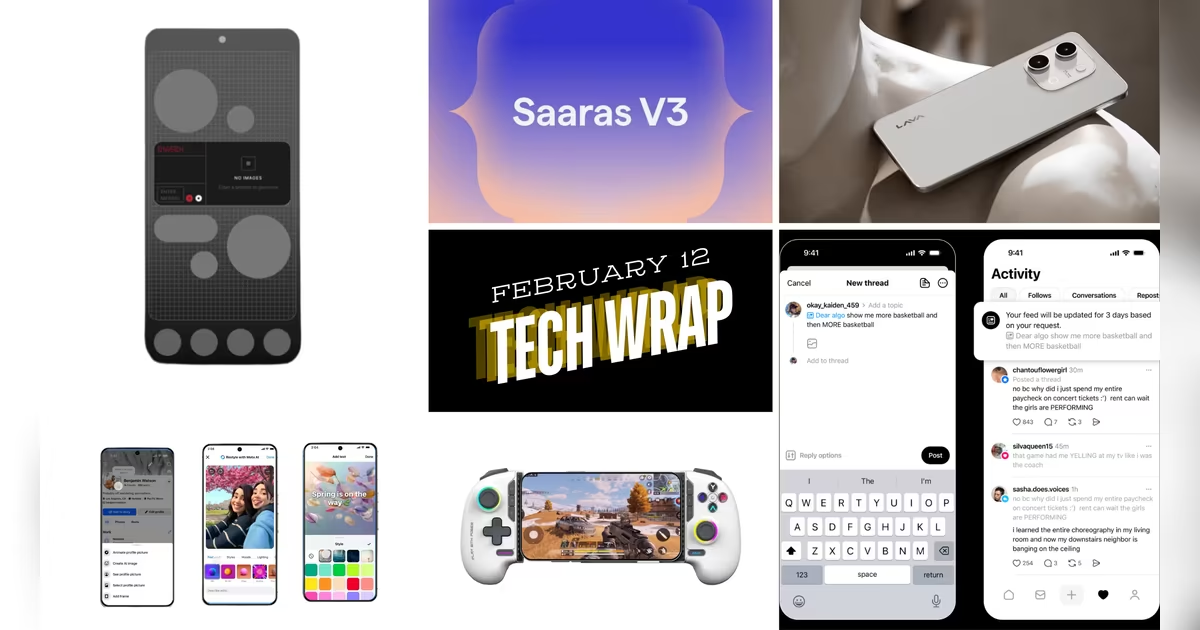
Tech Wrap Feb 12: Lava Yuva Star 3, Apple releases iOS 26.3, EvoFox Deck 2

Tech Wrap Feb 12: Lava Yuva Star 3, Apple releases iOS 26.3, EvoFox Deck 2


Lava has introduced a new entry-level smartphone, the Yuva Star 3. The device is backed by a 5,000mAh battery and is available in two colour variants — Indus Black and Siachen White. It features a 6.75-inch display, a 13MP rear camera, and a 5MP front-facing camera. The company describes the handset as a suitable first smartphone for new users. The Lava Yuva Star 3 follows the Lava Yuva Star 2, which debuted in May last year.


Apple has released the iOS 26.3 update for compatible iPhone models, bringing several new features, system refinements, and security patches. The update includes changes to the wallpaper gallery, a tool to help users switch from an iPhone to an Android device and notification forwarding support for third-party accessories, among other additions.


Amkette has unveiled the EvoFox Deck 2 game controller in India, highlighting its compatibility across Android, iOS, Windows, macOS, and Nintendo Switch platforms. The company said the controller is mainly aimed at smartphone gamers but can also connect to PCs and consoles through Bluetooth. It features Hall Effect joysticks and triggers, macro buttons, and RGB lighting. The EvoFox Deck 2 replaces the original EvoFox Deck introduced in July 2024.


Nothing has started rolling out the beta version of its Playground platform, widening access to a tool that allows users to create simple, custom apps using natural language rather than code. Known as the Essential Apps Builder, the feature is available through a waitlist and is currently limited to the Nothing Phone 3 during this initial phase, the company said on its community blog.


Facebook is rolling out new Meta AI-powered tools designed to make profiles, Stories, and Feed posts more dynamic. Users can animate profile pictures, restyle images in Stories and Memories, and apply animated backgrounds to text posts. According to Meta, these tools are intended to help users express themselves creatively without requiring advanced editing skills.


Threads is launching a new feature called “Dear Algo” that gives users greater control over their feed. As stated in Meta’s latest blog, the AI-driven tool enables users to temporarily adjust their feed by specifying what type of content they want to see. Instead of depending only on the “Not Interested” option, users can now post a request that modifies their feed for a limited period. The feature is currently available in the US, New Zealand, Australia, and the UK, with plans to expand to additional regions.


Google has reportedly delayed the Android 17 beta update, which was expected to launch on February 11 for select Pixel devices. As per Android Central, Google had contacted several publications about the release, but the Android Developers blog post and related official documentation did not appear. The company later indicated that the Android 17 beta is coming soon, though not on February 11.


Indian AI startup Sarvam AI has launched Saaras V3, the latest version of its speech recognition model. The company claims the model performs better than several global systems, including Google’s Gemini 3 Pro, OpenAI’s GPT-4o Transcribe, Deepgram Nova-3, and ElevenLabs Scribe v2, on benchmarks focused on Indian languages and Indian-accented English. 


American video game developer Insomniac Games’ superhero action-adventure title Marvel’s Spider-Man 2 is reportedly set to join the PS Plus Game Catalogue this month. According to a report by Gadgets 360, citing Dealabs, the game will be included in the PlayStation Plus Game Catalogue for February. Alongside Marvel’s Spider-Man 2, racing game Test Drive Unlimited Solar Crown and puzzle-platformer Neva are also said to be part of February’s additions to the subscription service.


Microsoft has addressed a security issue in Notepad that may have allowed attackers to trick users into clicking malicious links within Markdown files. The company fixed the flaw in its latest patch update to prevent possible misuse. Microsoft said the vulnerability could have enabled remote loading and execution of harmful files on a user’s system. It added that there is no evidence of the flaw being actively exploited.


Apple has reportedly postponed the launch of its revamped Siri once again. According to Bloomberg, the virtual assistant has encountered testing challenges in recent weeks, which may have delayed certain anticipated features from iOS 26.4 to iOS 26.5 (expected in May) and potentially to iOS 27 (likely in September).


Leading AI players Nvidia, Google, and OpenAI are among 400 exhibitors set to participate in the five-day India AI Impact Expo 2026, a senior government official said. STPI Director General Arvind Kumar told PTI that the event will act as a matchmaking platform for AI ecosystem participants, where Indian innovators will also present their work.


Elon Musk said he reorganised xAI, his artificial intelligence startup, after two co-founders exited earlier this week. The company will now operate across four main areas, he told employees during a Wednesday meeting: Grok’s chatbot and voice product, Coding, the Imagine video product, and Macrohard, an AI software firm run by digital agents. Musk shared the plan during an all-hands meeting, which he later posted on X.


New York-based Chief Executive Officer Matt Shumer said artificial intelligence is something bigger than the Covid-19 pandemic. He stressed that people should not treat AI as a future issue to be discussed later, but recognise that “this is happening right now”.


Experts have advised telecom service providers to take stronger responsibility in improving customer verification procedures and offering proactive assistance to investigative agencies in tackling cybercrime, officials said on Wednesday.


This week, OpenAI began testing ads on ChatGPT. I also resigned from the company after two years as a researcher working on how AI models were developed and priced, and helping shape early safety policies before standards were formalised. I once believed I could help those building AI anticipate and address the problems it might create. This week reinforced my growing view that OpenAI seems to have stopped asking the questions I joined to help answer.


Source link

IIT Bombay, Columbia Univ to set up AI centre for manufacturing innovation

IIT Bombay, Columbia Univ to set up AI centre for manufacturing innovation


The Indian Institute of Technology (IIT), Bombay on Thursday inked an agreement with the US-based Columbia University to establish a centre of artificial intelligence (AI) for manufacturing.


Initiated by the Union Education Ministry, the joint research and translation centre aims at building robust, scalable and human-centric AI systems for real-world manufacturing. “Many industry partners are in the process of joining this centre,” people in the know said.


The new centre aims to address all areas of manufacturing, including semiconductors, robotics, industrial manufacturing, process industries such as pharmaceuticals, food processing, refining and petrochemicals, construction and infrastructure development, as well as transport and logistics.


This will be the fifth AI centre to be initiated by the ministry after the Translational AI for Networked Universal Healthcare (TANUH) Foundation at IISc, the IIT Madras Bodhan AI Foundation (for education), and a centre each for sustainable cities and agriculture with IIT Kanpur and IIT Ropar, respectively.


Commenting on the development, IIT Bombay Director Prof Shireesh Kedare said that the partnership reflects its commitment to nation-building by positioning India as a global leader in AI-driven manufacturing innovation.


“By building open and interoperable industrial AI infrastructure, this initiative will support industry modernisation, empower MSMEs, nurture start-ups and develop future-ready talent,” he added.


Leveraging the complementary strengths of both institutes in various domains such as foundational AI, optimisation, manufacturing and process engineering, this centre will develop end-to-end, interoperable industrial AI infrastructure.


“This will address shop-floor realities such as legacy equipment, noisy data, real-time constraints and multilingual workforces,” IIT Bombay added.


Through close engagement with industry partners, officials said that the centre will deliver applied research, customised solutions, talent development and start-up translation, while releasing foundational datasets, models and interfaces as public goods to strengthen India’s varied manufacturing ecosystem, including MSMEs.


Source link

YouTube
Instagram
WhatsApp