
by Hansraj Agrawal | Jul 3, 2024 | Technology
Meta 3D Gen (Source: Meta)
3 min read Last Updated : Jul 03 2024 | 1:31 PM IST
Meta, the parent company of Facebook, Instagram and Whatsapp, has published a research paper detailing “Meta 3D Gen AI” system, which it said is capable of generating 3D models using text prompt. Meta said that the 3D Gen is a combined AI system that can generate high-quality 3D assets, with both high-resolution textures and material maps, all within one minute.
Meta 3D Gen: What is it
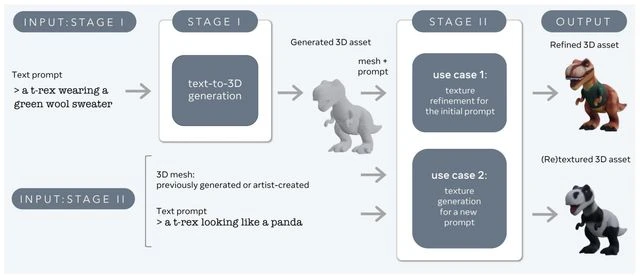
According to the paper published by the Researchers at Meta, Meta 3D Gen is a combined system that uses two AI-powered sub-systems called Meta 3D AssetGen and Meta 3D TextureGen. The system can take text prompts from the user and produce a final output of AI generated 3D content such as characters, props or scenes. Additionally, the user can also provide the system with an already created 3D mesh, which is essentially the structure of a 3D model, and ask it to add texture to it.
Meta 3D Gen: How it works
Meta said that the 3D Gen AI system uses Physically-Based Rendering (PBR) techniques to build up 3D content from scratch. The system first takes an input from the user which contains instructions for creating a 3D structure and its design elements including the texture.
In the first step, the Meta 3D AssetGen system creates an initial “3D asset” based on the user prompt. This step produces a 3D mesh with texture and PBR material maps. Meta said that the inference time for this step is approximately 30 seconds.
In stage two, a higher-quality texture and PBR maps are generated for the 3D asset generated in stage one. This step utilises the Meta 3D TextureGen system that takes approximately 20 seconds, according to the company.
Additionally, the Meta 3D TextureGen system can be used individually by the user as a text-to-texture generator. If the user provides the system with an already generated 3D mesh along with a text prompt detailing the texture they want on the 3D content, the system automatically initiates step two.
In an example shared by the company, a user inputs a prompt asking the AI system to generate a T-rex wearing a green wool sweater, the system first creates a 3D visual for the T-rex and then adds the wool sweater texture and other colour details.
 "Meta 3D Gen")
Meta 3D Gen (Source: Meta)
First Published: Jul 03 2024 | 1:31 PM IST
Source link

by Hansraj Agrawal | Jul 3, 2024 | Technology
2 min read Last Updated : Jul 03 2024 | 12:54 PM IST
Netflix, an over-the-top video streaming platform, is reportedly discontinuing its most affordable ad-free subscription plan in select regions. According to a report by The Verge, Netflix has begun notifying some users in the UK and Canada that they will need to switch to a different plan to continue accessing Netflix content.
The report indicates that a few Netflix users subscribed to the basic plan have received notifications from Netflix. These notifications state that once their current subscription period ends, they will need to choose a new plan to keep watching. Users in these regions will either have to switch to the ad-supported subscription plan or opt for a higher-priced plan if they want an ad-free experience on Netflix.
Netflix has removed the basic plan pricing details, too, from its websites in Canada and the UK. This follows the platform’s announcement last year that it would discontinue the basic plan for new subscribers in the US, UK, and Canada. However, existing subscribers were allowed to continue with their plans until now. It appears Netflix is now phasing out the basic plan for existing users as well.
In India, Netflix still lists the basic plan, priced at Rs 199, which allows users to stream at 720p resolution on one device at a time. If Netflix implements similar changes in India, basic plan subscribers will need to choose the more expensive Premium and Standard plans or switch to a Mobile plan, which only works on smartphones and tablets. Netflix has not yet announced the ad-supported subscription plan in India, but it is expected to launch soon.
First Published: Jul 03 2024 | 12:54 PM IST
Source link

by Hansraj Agrawal | Jul 3, 2024 | Technology
Representative image: iPhone 15 series
2 min read Last Updated : Jul 03 2024 | 11:57 AM IST
Apple will equip all four models of the upcoming iPhone 16 series—iPhone 16, 16 Plus, 16 Pro, and Pro Max—with the same processor, reported MacRumors. This would mark a departure from the iPhone 15 series, where different processors were used for the baseline and Pro models. The model numbers for the forthcoming iPhones have appeared online, indicating that Apple will not differentiate processors between the baseline and Pro variants in the iPhone 16 series.
The report notes that Apple has internally listed the new iPhone models with the same “17” prefix in their model numbers. In the iPhone 15 series, the baseline iPhone 15 and iPhone 15 Plus had a “15” prefix, while the iPhone 15 Pro and Pro Max had a “16” prefix. Apple subsequently announced that the iPhone 15 Pro models would be powered by the A17 Pro chips, while the standard models would utilise A16 Bionic chips. This could change with iPhone 16 series though, as reported by MacRumors.
Potential differentiation through GPU cores
While all four iPhone 16 models are expected to use the new A18 chip, Apple might still differentiate the Pro models by incorporating more Graphic Processing Unit (GPU) cores. This strategy could help distinguish the Pro models from the standard iPhone 16 variants. Additionally, Apple might brand the chip in the Pro models as the A18 Pro.
iPhone SE
The report also mentions that Apple’s internal data includes a fifth iPhone model, likely the anticipated iPhone SE. This model also has the “17” prefix, suggesting it will use the same chipset as the other four iPhone 16 series smartphones. If accurate, Apple could leverage the processing power of the new chips to introduce advanced artificial intelligence features to the iPhone SE.
First Published: Jul 03 2024 | 11:57 AM IST
Source link

by Hansraj Agrawal | Jul 3, 2024 | Technology
1 min read Last Updated : Jul 03 2024 | 9:54 AM IST
Apple will get an observer role on OpenAI’s board as part of a landmark AI agreement announced last month, Bloomberg News reported on Tuesday.
Phil Schiller, the head of Apple’s App Store and its former marketing chief, was chosen for the position, the report said.
The board arrangement will take effect later this year, and Schiller has not yet attended any meetings, according to the report.
An observer can attend board meetings without being able to vote or exercise other powers that directors usually have, according to the report. Observers, however, do gain insights into how decisions are made at the company.
Apple and OpenAI declined to comment when contacted by Reuters.
The move comes on the heels of Apple’s announcement in June, bringing OpenAI’s chatbot ChatGPT to its devices and integrating its new “Apple Intelligence” technology across its suite of apps, including virtual assistant Siri.
OpenAI said in March it was appointing new directors to the board, including company CEO Sam Altman, Sue Desmond-Hellmann, a former CEO of the Bill and Melinda Gates Foundation, Nicole Seligman, a former president of Sony Entertainment, and Fidji Simo, CEO of Instacart.
First Published: Jul 03 2024 | 9:54 AM IST
Source link

by Hansraj Agrawal | Jul 2, 2024 | Technology
2 min read Last Updated : Jul 02 2024 | 11:20 PM IST
Meta Platforms said on Tuesday it would lift its blanket ban on the word “shaheed”, or “martyr” in English, after a year-long review by its oversight board found the social media giant’s approach was “overbroad”.
The company has been criticized for years over its handling of content involving the Middle East, including in a 2021 study Meta itself commissioned that found its approach had an “adverse human rights impact” on Palestinians and other Arabic-speaking users of its services.
Those criticisms have escalated since the onset of hostilities between Israel and Hamas in October.
The oversight board, which is funded by Meta but operates independently, started its review last year because the word accounted for more content removals on the company’s platforms than any other single word or phrase.
Meta is the parent company of Facebook and Instagram.
The review found in March that Meta’s rules on “shaheed” failed to account for the word’s variety of meanings and resulted in the removal of content not aimed at praising violent actions.
Meta acknowledged the findings of the review on Tuesday and said its tests showed that removing content when “shaheed” was “paired with otherwise violating content captures the most potentially harmful content without disproportionally impacting the voice”.
The oversight board welcomed the change, saying Meta’s policy related to the word had led to the censoring of millions of people across its platforms.
First Published: Jul 02 2024 | 11:20 PM IST
Source link

by Hansraj Agrawal | Jul 2, 2024 | Technology
3 min read Last Updated : Jul 02 2024 | 8:03 PM IST
Apple on July 2 announced a range of India-focused features set to be introduced in eligible iPhones with iOS 18. According to Apple, these enhancements will span across various functionalities including communication, language input, and significant updates to the Move to iOS app. The US-based technology giant confirmed additional features and language support tailored for users in India with the upcoming platform update, which is scheduled for release later this year.
Meta has updated the way it labels artificial intelligence manipulated content on its platform such as Instagram and Facebook. The US-based social media giant said that it is updating the “Made with AI” label to “AI info” across its apps. Unlike the static label, the AI info badge will be clickable and offer information about the content for more context.
Taiwanese electronics maker ASUS has commenced pre-bookings for its first laptop based on Microsoft’s Copilot+ PC platform, the ASUS Vivobook S15. Powered by the Qualcomm X Elite chip, the laptop features AI capabilities provided by Microsoft Copilot in conjunction with its proprietary AI functionalities. The official launch date for the ASUS Vivobook S15 is set for July 9.
Apple is planning to introduce a subscription model for its artificial intelligence (AI) tools and features in the future. A report by Bloomberg reveals that the company, which collectively refers to its AI features as Apple Intelligence, will initially offer these tools for free on supported Apple devices later this year. However, Apple has a long-term plan to monetise these features.
Meta is reportedly developing new artificial intelligence features for WhatsApp that will enable users to generate images of themselves in various backgrounds and themes. According to a report by WABetaInfo, these AI-powered image generation capabilities have been identified in the latest beta version of WhatsApp for Android. Although the feature is still under development, it may be included in a future app update.
Samsung is reportedly set to discontinue its compact flagship tablet with the next Galaxy Tab S series. According to a report by 9To5Google, the upcoming Galaxy Tab S series will include only a Plus model and an Ultra model, thereby phasing out the 11-inch standard model. The report indicates that the Samsung Galaxy Tab S10 series, anticipated to launch around the Galaxy Unpacked event on July 10, will consist of a 12.4-inch model and a 14.6-inch model. These models are similar in size to the Galaxy Tab S9 Plus and Tab S9 Ultra, respectively. The discontinuation of the standard 11-inch display model would mark a significant shift in Samsung’s tablet lineup strategy.
First Published: Jul 02 2024 | 8:03 PM IST
Source link







