CPU, DRAM, Samsung, TSMC: Key terms, firms to know in global chip crisis

CPU, DRAM, Samsung, TSMC: Key terms, firms to know in global chip crisis


There’s an unprecedented crisis in the memory-chip sector. Less than a year after companies’ warnings, the $160 billion industry is suffering one of its worst routs. A glut of chips is sitting in warehouses, customers are cutting orders, and product prices have plunged. The crisis is wiping out cash for industry leaders and destabilising their suppliers.


Here’s a look at what are the different kinds of microchips and their major sources.


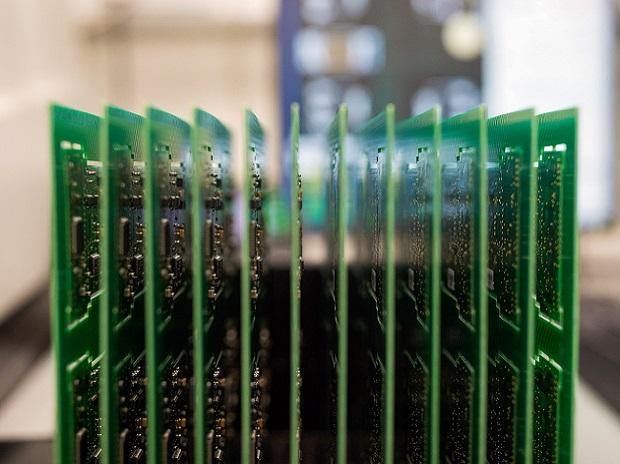
A microchip, also called an integrated circuit or IC, is a set of electronic circuits on a small flat piece of silicon. On the chip, transistors act as miniature electrical switches that can turn a current on or off. Chips are primarily of two categories.


Logic chips are the ‘brains’ of electronic devices: they process information to complete a task. Among logic chips, CPUs (central processing units) are the ‘original’ chips, first designed in the 1960s. But there are also processors with specific functionality in mind, such as GPUs (graphical processing units, which are optimized for visual display) and NPUs (neural processing units, designed for deep and machine learning applications).


Key players in the global logic industry include Fujitsu Inc., Infineon Corporation AG, MediaTek Inc., ARM Holdings Plc, Qualcomm Incorporated, Broadcom Corporation, Marvell Group, Apple Inc., Freescale Inc., Texas Instruments Inc.


The second kind, memory chips, store information. There are two types of memory chips: DRAM (Dynamic Random Access Memory), which are the ‘working memory’ chips that only save data while the device’s power is turned on, and NAND Flash, which saves data even after the device is turned off. For example, DRAM helps to run programmes on your device, whereas NAND stores your photos. Whereas DRAM is fast, NAND is slow to read and write data.


Taiwan Semiconductor Manufacturing Co. (TSMC) is the world’s largest memory chip manufacturer and it has single-handedly placed Taiwan on the list of the most important regions in the world. Besides TSMC, Taiwan is also home to some of the most advanced chipmaking facilities in the world, including the brand new 3-nanometer fabs that entered production in the latter half of 2022.


However, in terms of the producers of semiconductors and microchips, Japan boasts of the strongest semiconductor ecosystems in the world, with 102 chipmaking facilities operating in the country.


South Korea is the other major exporter of logic and memory chips. The country is home to two of the world’s three largest memory manufacturers: SK Hynix and . The pair collectively controlled roughly two-thirds of the global memory market as of September 2022. Samsung’s chipmaking divisions also manufacture semiconductors for other companies. Foundry is only of two companies in the world (the other being TSMC) that make chips for others with leading-edge process technologies such as 5-nanometer and now 3-nanometer.


Among other major producer centres are the United States, Germany and China, which maintain a steady balance of supply between both logic and memory chips.


All eyes are now on Samsung, which has thus far said little about the industry’s near-term prospects in the wake of the memory chip crisis. The world’s largest maker of chips, smartphones, and display panels is set to report fourth-quarter earnings on Tuesday, followed by a call during which analysts are likely to question its capacity management plans.


Source link

Elon Musk plans WeChat-like payments system on Twitter that includes crypto

Elon Musk plans WeChat-like payments system on Twitter that includes crypto


under is now working on a payments system that will support accepted currencies with crypto functionality embedded into it.


According to a report in The Financial Times, citing sources, the payments feature will support fiat currencies to start with.


Neither Musk nor confirmed the development.


“Mr Tweet” has apparently instructed developers to build the platform’s payments system.


has been teasing about bringing payments to its platform as Musk wants it to become “an everything app” like China’s WeChat.


“Buying Twitter is an accelerant to creating X, the everything app,” Musk said in October last year, as he took over the company after acquiring it for $44 billion.


“Twitter probably accelerates X by 3 to 5 years, but I could be wrong,” he added.


Later, images surfaced about “Twitter Coins” on .


Unconfirmed rumours also emerged that Twitter was working on a wallet prototype that would support crypto deposits and withdrawals.


Musk’s “Twitter 2.0 The Everything App” will have features like encrypted direct messages (DMs), long-form tweets and payments.


During a podcast, he had said that the US needs a super app.


“It’s either convert Twitter to that, or start something new. It does need to happen somehow,” he said.


“If you’re in China, you kind of live on WeChat. It does everything. It’s sort of like Twitter, plus PayPal, plus a whole bunch of things all rolled into one, with a great interface. It’s really an excellent app, and we don’t have anything like that outside of China,” Musk told the listeners during the podcast last year.


In 1999, Musk co-founded an online bank called X.com, which was later merged to form PayPal.


–IANS


na/dpb


(Only the headline and picture of this report may have been reworked by the Business Standard staff; the rest of the content is auto-generated from a syndicated feed.)


Source link

Instagram expands short-post feature ‘Notes’ for users in Europe, Japan

Instagram expands short-post feature ‘Notes’ for users in Europe, Japan


platform has expanded its ‘Notes’ feature, a way for users to share their thoughts, to and .


The head of Instagram, Adam Mosseri, made the announcement on the micro-blogging platform Twitter, stating that “Notes are now available in and .”


In a video, Mosseri addressed that many users “complained about not having access yet to the feature.”


“Sometimes when we launch a new feature, we launch it only to a small percentage of people, or just to a specific country,” he explained.


“And sometimes, in the case of Notes, we launch something everywhere we can but have to hold back in a few countries if there’s more work to do.”


Mosseri also mentioned that the feature “has done really well” in Asia, North America and Latin America and “specifically with teens.”


The Notes feature was introduced last month. Notes are short posts of up to 60 characters using just text and emojis.


–IANS


aj/shb/

(Only the headline and picture of this report may have been reworked by the Business Standard staff; the rest of the content is auto-generated from a syndicated feed.)


Source link

POCO X5 Pro 5G set to launch in India on Feb 6: Know expected specs & more

POCO X5 Pro 5G set to launch in India on Feb 6: Know expected specs & more


Chinese smartphone maker is set to launch in India the X5 Pro 5G smartphone on February 6. The smartphone will be available on the e-commerce platform Flipkart, according to the phone teaser posted by the company on Twitter. The smartphone would be powered by a Qualcomm processor, and it would sport a triple-camera system on the back with a 108-megapixel primary camera. Below are the details:


X5 Pro 5G: Expected specification


The POCO X5 Pro 5G is expected to sport a 6.67-inch super AMOLED screen of 120Hz refresh rate. Powering the smartphone would be the Qualcomm Snapdragon 778G 5G processor, which is paired with Adreno 642L GPU. It is likely to have a triple-camera set-up on the back, featuring a 108-megapixel primary camera sensor, an 8MP ultra-wide-angle sensor and a 2MP macro sensor. On the front, it is likely to feature a 16MP camera sensor. The smartphone is likely to be offered in 6GB RAM + 64GB, 6GB RAM + 128GB, 8GB + 128GB, and 8GB RAM + 256GB storage variants.


It would be powered by a 5,000 mAh battery, supported by 67W wired charging. Other expected features include side-mounted fingerprint scanner, microSD card slot for storage expansion, 3.5mm audio jack, dual-SIM support, Wi-Fi, Bluetooth, and USB-C port for charging and data transfer. The smartphone is likely to boot Android 13 operating system-based MIUI 14 interface. It is expected to come in POCO’s signature yellow colour, besides other colour options.


Source link

Blaupunkt BTW300 Bass Buds review: Basic earphones lifted by good audio

Blaupunkt BTW300 Bass Buds review: Basic earphones lifted by good audio


Known for its wide range of audio devices and accessories, the German electronics brand added the BTW300 Bass Buds to its truly portfolio earlier this month. While the ninety-nine-year-old company succeeded in delivering its promised high-quality sound experience, it stepped down significantly in terms of experience-related features. Let us deconstruct the product details to find out if it makes for a good deal or not at Rs 1,499.


Designed to fit in the ear as perfectly as it fits in the charging case, the BTW300 Bass Buds pack a good in-ear grip and what refer to as the “German style statement”. Boasting an easy-to-hold stem with a metallic finish, the are bound to catch attention at first glance. Owing to their fine grip, the play well at disconnecting users from the outside world, making them a great choice for gamers, and lovers.


However, the design has its cons. Even though the earphones are lightweight, they are not suitable for prolonged use in a single stretch. This is because the buds create an almost airless packing in their attempt to accommodate the environment noise-cancellation (ENC) technology. Unlike some of its competitors, the product lacks the ‘feather-light’ in-ear feel due to its slightly broader build.


Moving on to the audio quality of BTW300 Bass Buds, the experience can be assessed in two major areas. First is the device’s ‘Bass Demon Tech’, which brings a noticeable difference in the bass levels, especially while streaming electronic and metallic . The are a good option for users looking for an immersive audio output.


For voice calls, the earphones support an active environment noise-cancellation (ENC) feature to filter out the background noise. It is, however, to be noted that while the earbuds will isolate you from the surroundings, they will intrude the space of those around you. The sound leaks from the earphones to an extent that one can listen to the tracks from a hand’s distance from them when on full volume. Even on a 40-50 per cent volume scale, the audio leaks out.


As for the voice calls, the earbuds work well for the user by cancelling all the surrounding noises but to no avail as the in-built microphone often delivers a low and distorted voice to the other end. As there is no option to adjust the distance with the microphone in truly wireless earphones, the users may be left with no choice but to remove them while on calls. Nonetheless, there is absolutely no lagging in the audio during any activity; videos, voice calls and run in sync with the connected device.


Next in line is the earbuds’ performance where two areas including the battery life and touch responsiveness take the lead. Starting from the battery backup and charging, BTW300 Bass Buds hold the ground in being hands down the powerhouse of playback time. Backing Blaupunkt’s claim that the earbuds can last for up to 40 hours of usage on a full charge, the device may even last longer than that, depending on the volume levels that could be easily maintained at around 60-70 per cent on a scale of 100.


Besides, the ‘TurboVolt’ fast charging technology boots about 60 minutes of power on a 15-minute charge. Moreover, as a power-saving feature, the earbuds automatically shut down after three minutes in case they are not paired with any device. As it is a non-customisable feature, the need to pull out the charging case to restart the buds (due to the unresponsive touch controls) every time they get turned off hinders streaming.


The final and undoubtedly the most problematic aspect of the earphones is their touch controls that include the functionality of their multi-function button and the response time. To begin, the earbuds will require you to put them back in the case to restart as the touch sensors rarely respond to the commands. While trying to change the tracks, the earphones would enable the voice assistant. Similarly, when one tries to raise the volume levels by following the said three-click command on the left earbud, it reduces the volume, while on the other hand, the right earbud, which is meant to reduce the volume, either ends up changing the track or giving no response at all. Only the play and pause function works fine.


Further, while on one hand, the earbuds do not respond to the in-built actions, they sometimes get turned off or give mixed responses when you accidentally touch them. There is no coherence between what the instruction booklet claims and how the earbuds function in terms of their touch controls. At times, the key is too sensitive, and at times, you will end up fidgeting with the multi-function button that fails to serve its purpose.


Verdict

Considering that the sole purpose of a truly wireless earphone is to simplify the users’ audio streaming experience, Blaupunkt’s BTW300 Bass Buds do not meet expectations. Whatever little the device offers in terms of audio quality and noise cancellation get negated by its inability to support the basic features. It seems like a product, which focuses on the number of features while compromising on their quality and efficacy. Apart from its long-lasting battery life and enhanced sound output, there is nothing that BTW300 Bass Buds offer to make itself a compelling deal at Rs 1,499.


Source link

Samsung Galaxy Unpacked 2023 on Feb 1: Where to watch and what to expect

Samsung Galaxy Unpacked 2023 on Feb 1: Where to watch and what to expect


South Korean brand is set to kick off its first Galaxy Unpacked event for 2023 on February 1. It will be an in-person event to be held in San Francisco, US, after three years of Covid-induced restrictions globally. The event will start at 10 am PST and it will stream live for an online audience on the website, newsroom portal, and Samsung official YouTube channel. In India, the event live stream will begin at 11:30 pm.


At the event, Samsung is likely to unveil three premium flagship smartphones in its Galaxy S23 series. These three smartphones could be named the Galaxy S23, Galaxy S23+, and Galaxy S23 Ultra. Besides, there would be an announcement related to the Galaxy Book3 series laptops, which are expected to debut at the event. The line-up may consist of up to four new models, namely, Galaxy Book3 360, Galaxy Book3 Pro, Galaxy Book3 Pro 360, and the flagship device Book3 Ultra.


The S23 series is going to be the successor of the Galaxy S22 series. For the uninitiated, the Galaxy S22 series had three smartphones – the Galaxy S22, Galaxy S22+, and Galaxy S22 Ultra. The Galaxy S22 Ultra officially became the first smartphone in the Galaxy S-series to integrate the Galaxy Note-series. On the other hand, the three Galaxy Book3 series laptop models are believed to be powered by 13th Gen Intel core processors – either the Core i5-1340P or a Core i7-1360P. The Book3 Ultra is likely to be powered by the Intel Core i9-13900H processor.


Galaxy S23 series: Expected specifications

The Galaxy S23 series smartphones are likely to be powered by an overclocked version of the Qualcomm Snapdragon 8 Gen 2 processor. These smartphones are likely to boast LPDDR5x RAMs and UFS 4.0 storage options. As for imaging, the premium model in the series is likely to feature a 200-megapixel primary camera in the triple-camera set-up. The phone is also expected to feature space zoom and moon shot for advanced photography. It may come with a built-in S Pen, a 6.8-inch display, and a 5,000mAh battery with a 45W charging capacity.


According to news reports, the Galaxy S23 and S23+ would retain the 6.1-inch and 6.6-inch screen size of the predecessors. However, they will get a boost in batteries at 3,900mAh and 4,700mAh each. The Galaxy S23 series will likely come in these colours – cotton flower, misty lilac, botanic green, and phantom black.


Galaxy Book3 series: Expected specifications

The Galaxy Book3 series are expected to be powered by Intel’s 13th Gen Core processors. Some models could have the built-in S Pen stylus, while others could have a discrete graphics processing unit (GPU).


The premium model in the series, the Book3 Ultra, is said to feature a 16-inch 2880 x 1800p AMOLED screen with up to 32GB of RAM, 1TB of PCIe NVMe Gen4 storage, and Nvidia GeForce RTX 4070 GPU. It is expected to be powered by a 76Wh battery, supported by a 136W charger. All of it would fit in a 1.8kg body that is likely to be only 17mm thick at its thickest point.


The Book3 Pro, on the other hand, will come in two variants, 14-inch and 16-inch, with either Core i5-1340P or Core i7-1360P processors paired with up to 16GB RAM and 1TB NVMe SSD. Unlike the Ultra, the Pro will rely on the integrated Iris Xe graphics. The 14-inch option will have a 63Wh battery, while the 16-inch supposedly has the same 76Wh cell as the Ultra.


Source link

YouTube
Instagram
WhatsApp




