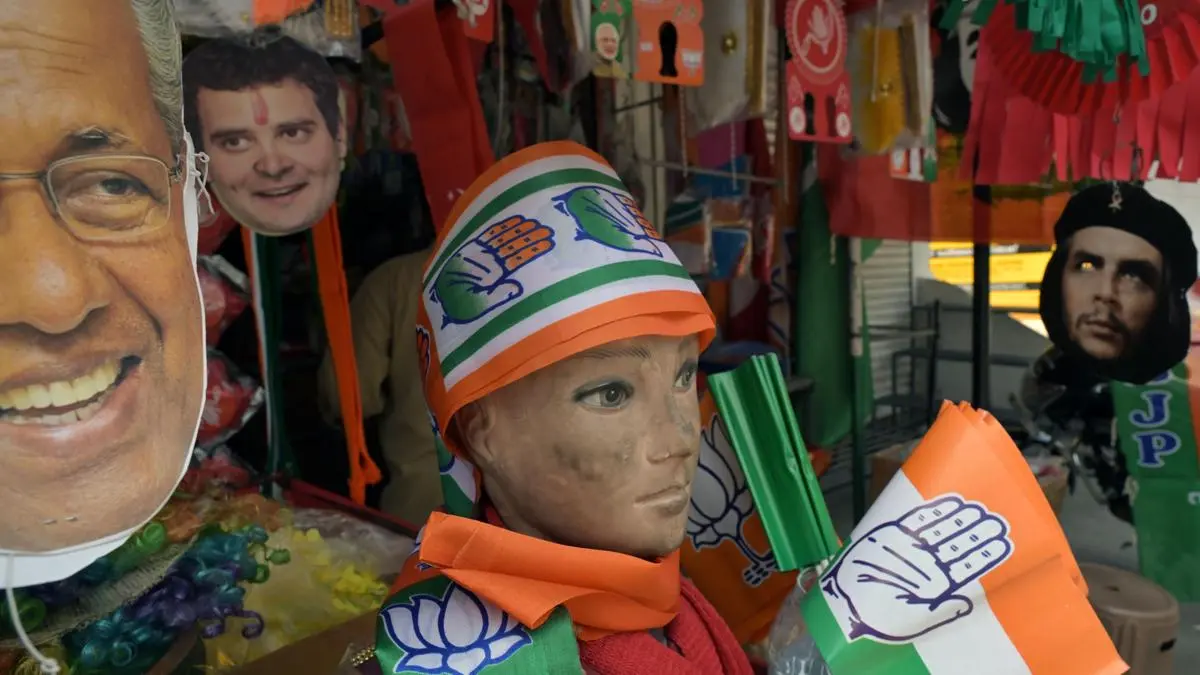
Election campaign scarves and other political party merchandise on display at a shop on Mettupalayam Street in Palakkad, Kerala, on Saturday, March 28, 2026.
| Photo Credit:
K K Mustafah
“Deal” among rival fronts and parties is now the buzzword as date of polling approaches in Kerala. Accusations and counter-accusations of political subterfuge now dominate the discourse, crowding out urgent concerns such as jobs, development and rising prices.
Larger NDA narrative
Political analyst A Jayashankar argues the perceived “undercurrent” between the Communist Party of India (Marxist) and the Bharatiya Janata Party aligns with the latter’s longer-term objective of a “Congress-mukt” Kerala. He traces this narrative back to 2016 when then party president Amit Shah declared that two states—Kerala and Assam—had become “Congress-mukt”: the NDA-BJP secured victory in Assam, while the CPI(M)-led Left Democratic Front (LDF) formed the government in Kerala.
Tacit understanding
From this perspective, the BJP would ideally prefer that the Congress-led United Democratic Front (UDF) does not return to power in Kerala, after a decade in opposition. Instead, the BJP may find it more advantageous if incumbent two-term LDF gets an unprecedented third term, effectively keeping the UDF at bay—something the BJP is not yet positioned to achieve on its own. Viewed in this light, current political context lends itself to speculation about a tacit understanding between the two fronts aimed at sidelining the Congress, Jayashankar surmised.
Strong contender
Analyst Mohan Varghese estimates BJP expects either to win or to emerge as a strong contender in at least 30 to 35 constituencies of the 140-member House. Allegations of a tacit understanding between rivals are not new here; they have surfaced intermittently over the past three to four decades. In the short term, such narratives tend to be amplified during elections, largely to consolidate minority votes.
Satheesan names 7
All three senior-most Congress leaders in the state maintain, in unison, that the CPI(M) and the BJP have an understanding in at least 10 constituencies. Leader of Opposition VD Satheesan goes further, identifying at least seven such seats. He points to Kasaragod and Manjeshwar in the north, where, he alleges, an arrangement is aimed at helping the BJP gain an edge. Palakkad is cited next, with claims of a deal to facilitate a victory for BJP’s Shobha Surendran.
Twenty20 in play
Chengannur is another constituency where such an understanding is said to benefit incumbent minister and CPI(M) leader Saji Cherian. In Ranni, in the foothills of Sabarimala, the alleged arrangement is said to favour the LDF candidate. Tripunithura and Ettumanoor seats are also named in this same breath.
Varghese further notes it is inconceivable the NDA should allot as many as 19 seats to the relatively new outfit Twenty20—barely two months into its political foray—an arrangement he describes as extraordinary. He also dismisses the suggestion that the NDA is using Sabu Jacob’s Twenty20 as a bridge to reach out to the Christian community. The NDA has put strong Christian candidates elsewhere in the state.
Congress allegation
Meanwhile, the Congress has also cited prestigious Vattiyoorkavu seat in Thiruvananthapuram as a test case where there is an implicit understanding between CPI(M) and BJP against it. UDF candidate K Muraleedharan claimed certain BJP councillors are allegedly working for CPI(M) behind the scenes.
They campaign for National Democratic Alliance (NDA) candidate R Sreelekha during the day, but secretly support LDF candidate VK Prasanth at night. Similar “deals” were more prevalent in Thiruvananthapuram district than elsewhere in Kerala. Muraleedharan also questioned LDF’s choice of candidates, saying senior CPI(M) leaders have been overlooked as part of tacit arrangements.
Responding to this allegation, Sreelekha promptly rejected the claims, calling them “baseless” and “nonsensical.” She added that such statements do not merit serious consideration, and chose not to engage further in the controversy.
Published on March 29, 2026







