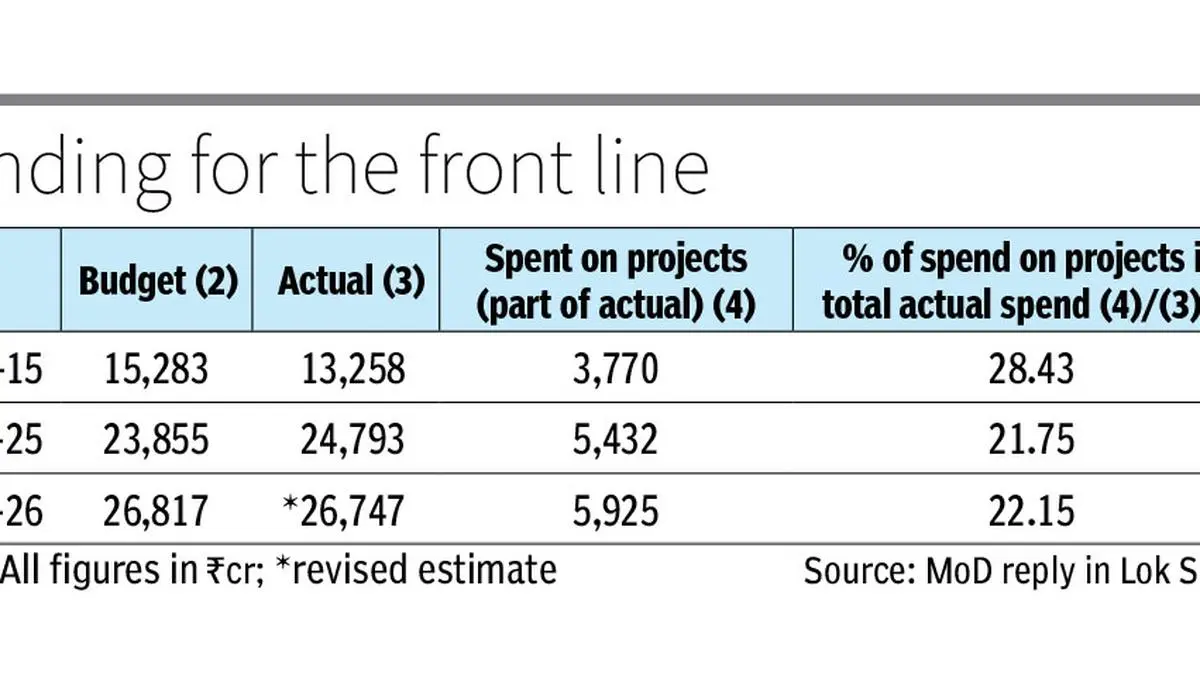
Data from the Ministry of Defence suggests that India’s spend on defence research has grown far less than headline numbers indicate.
The Defence Research and Development Organisation (DRDO) spent ₹13,258 crore on R&D in 2014-15. By 2024-25, this had risen 87 per cent to ₹24,793 crore, which, at first glance, appears to signal a steady expansion of research effort. But this is in nominal terms. Adjusted for economy-wide inflation, using the GDP deflator, the real annual growth is only 1.5–2 per cent.
The picture becomes starker when looking at how this money is spent. The portion devoted to specific projects and programmes — missile systems, aircraft engines, radars and the like — has moved from ₹3,770 crore in 2014–15 to about ₹5,900 crore in 2025–26. After adjusting for inflation, this implies virtually no growth in real terms over the period.
This also suggests a shift in composition: While overall spending has increased, the share going to R&D projects has not kept pace. A growing proportion of the budget appears to be absorbed by establishment costs rather than programme funding.
Budget trends reinforce this concern. In 2025–26, the allocation for defence R&D was raised by 12 per cent, from ₹23,855 crore to ₹26,817 crore. Yet the revised estimate came in slightly lower, at ₹26,747 crore, indicating that even the allocated funds were not fully utilised.
The increase over the previous year’s revised estimate was about 8 per cent.
Spending on projects and programmes grew only about 9 per cent in 2024–25.
The pattern raises a broader question: Is higher allocation translating into more research?
The Budget for 2026-27 provides ₹29,100 crore for DRDO, a 10 per cent increase year-on-year. Whether this results in a meaningful increase in programme spending — or is again absorbed by costs — remains to be seen.
A wider pattern
This scenario is not unique to defence research spending.
Across six key science departments — science and technology, biotechnology, scientific and industrial research, space, atomic energy, and Earth sciences — government R&D spending rose from ₹28,014 crore in 2020–21 to ₹39,057 crore in 2024–25. That translates to a nominal annual growth rate of about 8.8 per cent. Adjusted for inflation, however, the real growth rate is only 2–3 per cent a year.
The pattern is consistent: headline increases mask modest real expansion.
India’s gross expenditure on research and development (GERD) has remained stuck at 0.6–0.7 per cent of the GDP for over a decade. This is not merely because the GDP has grown rapidly, but also because R&D spending has struggled to grow meaningfully in real terms.
Efficiency factor
It can be argued that limited resources have been used efficiently. India’s rank in the Global Innovation Index has improved significantly over the past decade, and government-backed schemes in areas such as biotechnology have helped start-ups raise follow-on funding and generate intellectual property.
But these are, at best, partial indicators. Improvements in innovation rankings reflect a broad set of factors, and start-up success in specific sectors is not a fill-in for sustained investment in core research capabilities. The more fundamental question remains unanswered: What might outcomes look like if real R&D spending grew faster?
For a country seeking technological self-reliance, particularly in sectors such as defence, flat real spending and stagnant programme outlays are not neutral outcomes. They imply a slower build-up of capabilities, regardless of improvements in efficiency at the margins. India may indeed be getting more value out of each rupee. But over the past decade, it has not been putting significantly more real resources into research.
More Like This
Published on March 23, 2026







