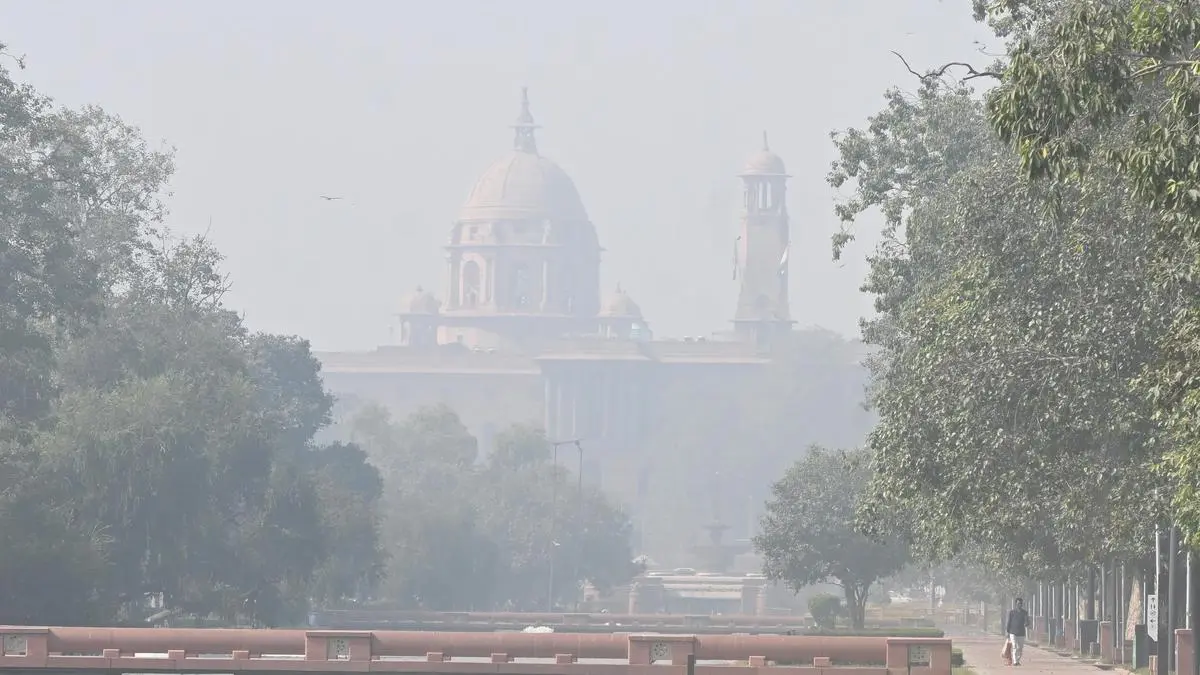
WINTER WOE: Delhi’s annual date with smog and respiratory illness
| Photo Credit:
SUSHIL KUMAR VERMA
Asthma has long been one of India’s public health burdens, a condition that markedly worsens with heightened pollution levels. Each winter, when smog settles over the northern plains and cities like Delhi record some of the world’s highest particulate concentrations, hospital admissions rise and millions struggle to breathe.
A recent study uses artificial intelligence to map the link between polluted air and asthma. The research team — Gauresh Bhandary, Gurleen Kaur and Chandra Mohan Kumar — used a type of AI known as ‘physics-informed neural network’ (PINN) to reconstruct the unseen, time varying forces that link pollution and asthma. Their approach blends epidemiological modelling with machine learning, allowing the system to learn from data while remaining rooted in concepts of asthma biology and environmental behaviour.
They began by building a mathematical model that divides the population into sub-groups such as susceptible individuals, smokers, those exposed to pollution, undiagnosed and diagnosed asthma cases, and people who have recovered. The model also tracks ambient pollutants, treating particulate concentration as a dynamic quantity that rises, falls and influences the movement of people between the health states. Parameters such as the rate at which pollution leads to new asthma cases, or the pace at which pollutants accumulate, were allowed to vary over time. These are quantities that cannot be directly observed in real settings.
While a conventional neural network attempts to learn patterns directly from data, a PINN follows the scientific laws that govern the system under study. In this study, the asthma model is expressed as a set of differential equations that specify how people move between the health states and how pollutants change over time.
The researchers trained the model on synthetic data, which allowed them to control the ground truth while introducing realistic levels of measurement error. They used a numerical solver inside the neural network itself, which made the entire forecasting process differentiable. The PINN learns continuous curves that describe how the pollution-related parameters evolve through the year. These curves must allow the differential equations to generate trajectories that match the observed data and remain physically plausible.
The PINN recovered the time varying pollution effects with an accuracy rarely seen in epidemiological inverse problems. It correctly reproduced the oscillations in pollution-induced asthma during the post-monsoon and winter seasons. It captured the gradual depletion of pollutants through natural processes and the slow build-up associated with agricultural burning, industrial output and heavy traffic. Errors stayed well below two per cent. The PINN was reconstructing the hidden environmental drivers.
By linking real-time pollution readings to evolving asthma risks, the model offers a way to anticipate seasonal surges, to support hospital preparedness and pollution-control policies. Since it works even with limited or imperfect data, it can support regions where health reporting remains sparse.
More Like This
Published on November 17, 2025







