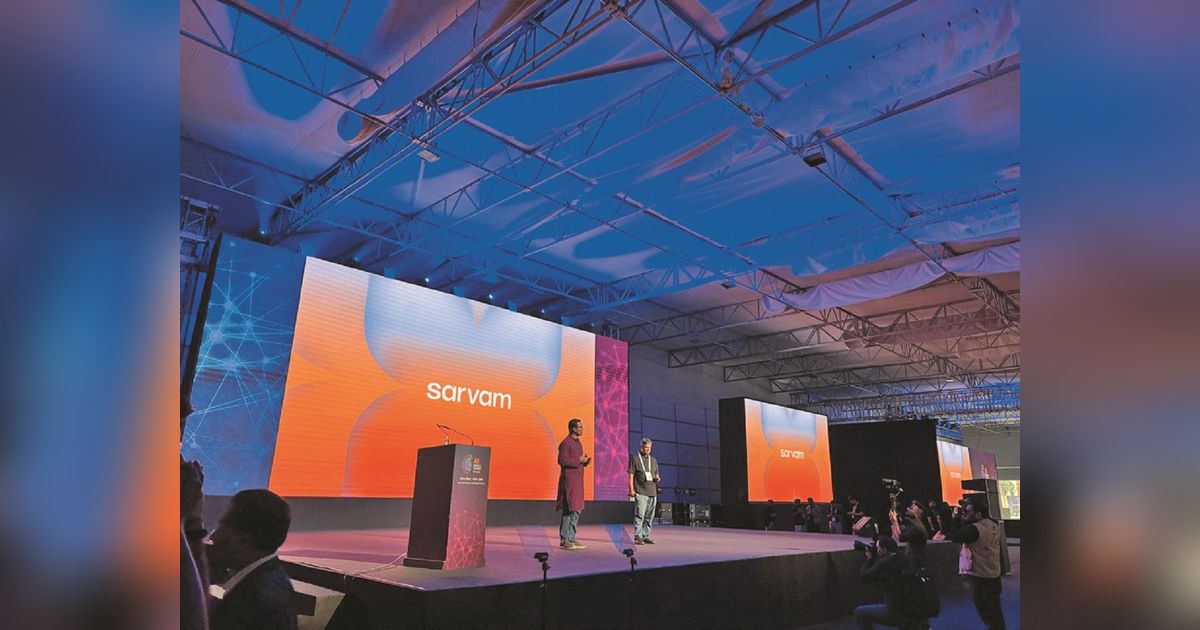
India unveiled three major sovereign artificial intelligence (AI) models at the India AI Impact Summit 2026 in New Delhi on Wednesday, marking a strong push for homegrown AI systems.
The launches signal India’s shift from using global AI tools to creating its own infrastructure powered by local data, languages and computing.
Below is a closer look at what each model offers and their key specifications
Sarvam AI launches two large language models
Homegrown startup Sarvam AI introduced two indigenous large language models (LLMs) trained specifically for Indian languages — a 30-billion-parameter model and a larger 105-billion-parameter model.
The smaller model is designed for real-time conversations with a 32,000-token context window, which helps keep inference costs low. The larger model supports up to 128,000 tokens, allowing it to handle more complex reasoning and long-form tasks.
According to the company, the models performed competitively against global systems such as Gemma-27B, Mistral-32-24B and Qwen-30B, measuring mathematical reasoning, coding accuracy and problem-solving.
Sarvam Co-founder Pratyush Kumar said the company’s 105-billion-parameter model performs well on most benchmarks. He explained that although it is only about one-sixth the size of the 600-billion-parameter DeepSeek R1 model released last year, it was trained from scratch and delivers similar competitive intelligence.
He added that the model is also cheaper than Google’s Gemini Flash while outperforming it on several benchmarks.
At the event, Sarvam also showcased its chatbot Vikram, which demonstrated conversations in multiple Indian languages. The name honours Indian physicist Vikram Sarabhai.
Gnani.ai unveils voice cloning AI system
Bengaluru-based startup Gnani.ai launched Vachana TTS, a text-to-speech system capable of cloning voices and generating speech in 12 Indian languages.
The system can recreate a person’s voice using less than 10 seconds of recorded audio while preserving tone, pitch and speaking style. It also allows the same voice to speak across multiple languages without losing identity.
BharatGen launches 17B multilingual foundation model
India’s sovereign AI initiative BharatGen announced the launch of Param2, a 17-billion-parameter multilingual mixture-of-experts foundational model.
The system is designed to support multiple Indic languages and reflects India’s linguistic and cultural diversity. It is intended for use in governance, education, healthcare, agriculture and enterprise applications.
The model was built in collaboration with Nvidia using its AI software stack and infrastructure to ensure scalability and performance.
India AI Summit: Why these launches matter
The unveiling of these models signals a major shift in India’s AI strategy. The focus is shifting toward AI sovereignty, with an emphasis on local control over data computing power, and core AI capabilities.
The launches signal a strong push for an India-first design approach, with models being trained for Indian languages and real-world local conditions. Efforts are also being made to ensure mass accessibility, as voice-first AI could help expand usage among non-English speakers.







