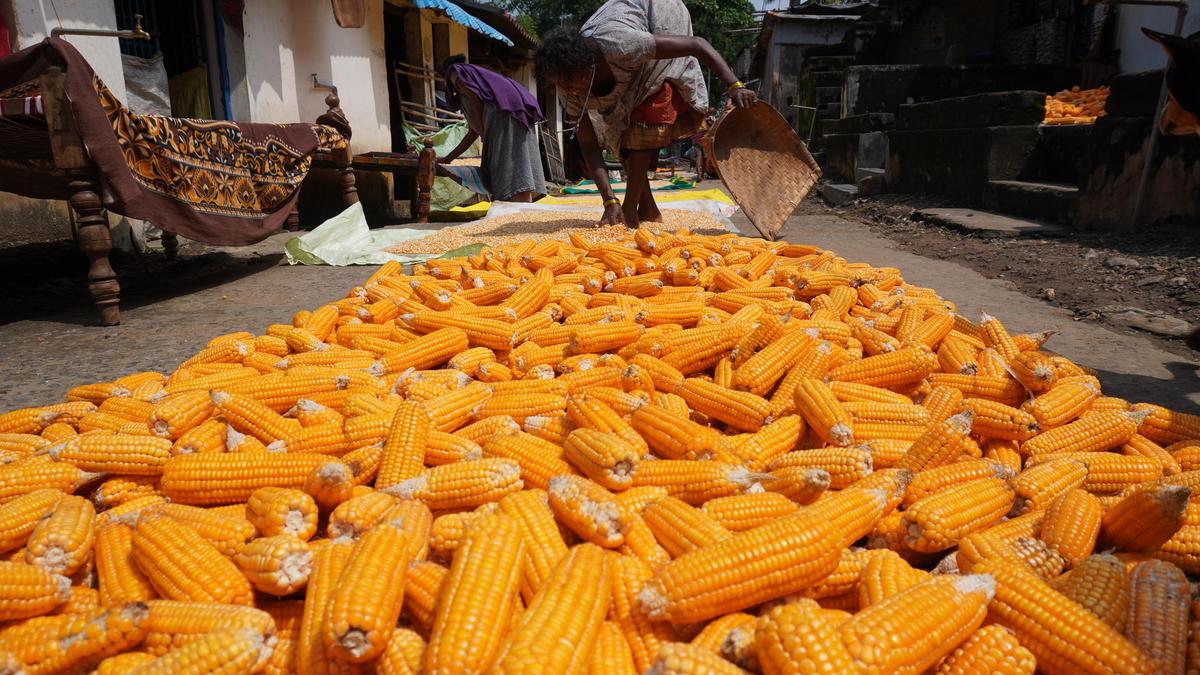
The pan-India average price of maize was ₹1,781/quintal on March 18, according to Agmarknet portal
| Photo Credit:
APPALA NAIDU T
A section of Indian farmers is likely to return to cultivating oilseeds and pulses in the upcoming kharif season as growers have realised lower prices this year. The government is confident that there may be some change in the kharif season.
However, the sowing decision will depend mainly on guaranteed price for oilseeds and pulses as the procurement has highly been insignificant compared with FCI’s purchase of rice and paddy, a senior official said.
During the kharif harvest season (October-December) in 2025-26, when farmers sold their maximum produce, the all-India average maize price was ₹1,684/quintal, down by 30 per cent from the minimum support price (MSP) of ₹2,400. Still, in the hope of a better price, farmers expanded the area in the rabi season to 30.18 lakh hectares (lh) from 27.80 lh in 2024-25.
Record high output
The pan-India average price of maize was ₹1,781/quintal on March 18, according to Agmarknet portal. In its second advanced estimates, the government projected maize production a record high for the kharif season at 302.47 lakh tonnes (lt) and in the rabi season at 159.03 lt.
“Oilseeds and pulses production plan will be discussed with States in the annual kharif conference, and accordingly, an action plan will be prepared based on the targets set by their respective mission. Prices will be a key factor, and recently Madhya Pradesh announced bonus of ₹600/quintal on summer season’s urad as more and more farmers were going for moong crop in the Zaid (summer crop) season. Such intervention may help influence the sowing decision of farmers,” the senior official said.
Earlier, it was expected that there would be demand for maize from ethanol since over 2,000 crore litres of capacity have been created by distilleries. However, the oil marketing companies bought only about 1,000-1,100 crore litres to meet the 20 per cent blending target, resulting in under utilisation of plants. Besides, the government also allotted rice for ethanol, limiting the scope for grain-based plants. The sugar industry also make ethanol and sell to OMCs, though its share was low this year.
Grains’ procurement soon
The Economic Survey also mentioned the point that as per policy decision it was expected that rice farmers would shift to maize, but while rice area increased, maize area too increased because of shifting from pulses and oilseeds.
Meanwhile, Agriculture Minister Shivraj Singh Chouhan on Friday said that government purchase of wheat and paddy would commence shortly, noting that rabi crop production has been exceptionally high this season.
He said agencies including NAFED and NCCF would procure tur, masur and urad, and whatever farmers wished to sell entire quantity would be bought so that market prices do not fall below MSPs.
He also directed officials to coordinate with State governments for accurate assessment of crop losses after unseasonal rainfall and hailstorms damaged standing rabi crops, including wheat in some states.
Chairing a review meeting, Chouhan said the adverse weather had hit several States at a time when crops were ripe and ready for harvest. “Not only did it rain, but many areas also experienced hailstorms, resulting in damage to the crops,” he told reporters after the meeting.
The minister directed officials to immediately establish contact with state governments to identify specific locations where crop damage has occurred due to hailstorms and excessive rainfall, which often leads to crops lodging or flattening on the ground.
“If a farmer has suffered losses, the damage must be assessed accurately and scientifically so that insurance claims can be processed effectively,” he said.
Published on March 20, 2026







