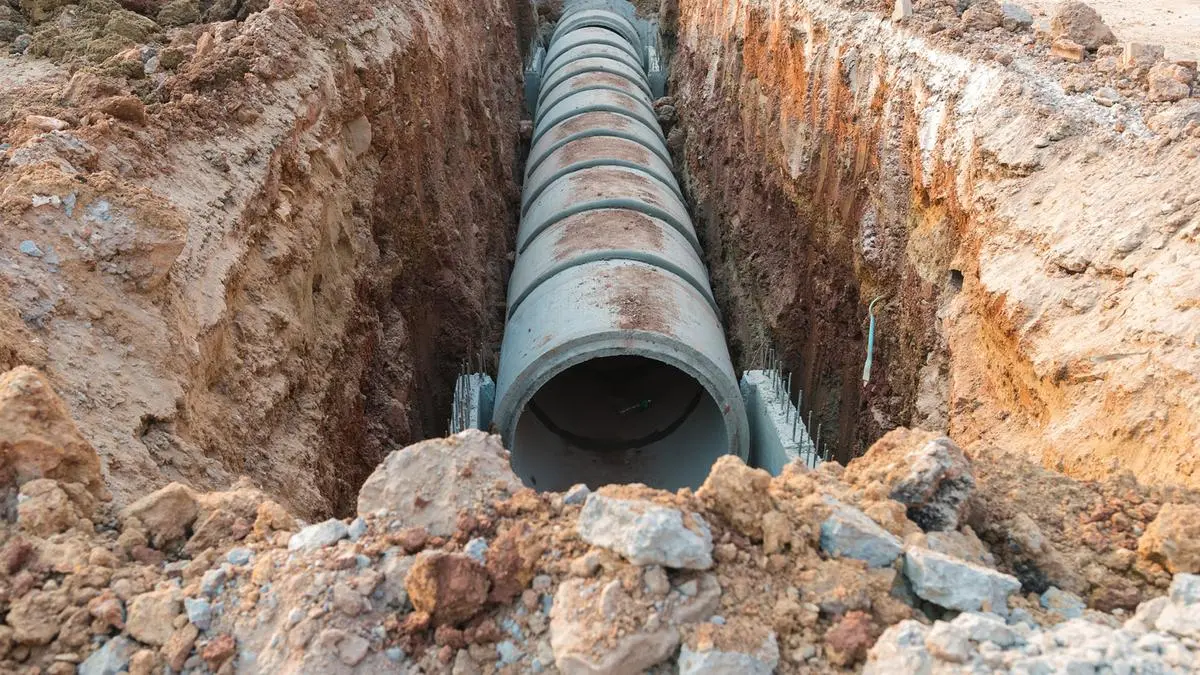
Recent studies by scientists at IIT-Madras and the University of Cape Town, South Africa, have demonstrated that corrosion of sewers is driven not by the overall chemistry of wastewater, but the microscopic zones on concrete surfaces where bacteria generate highly concentrated sulphuric acid. While bulk measurements may indicate only mild acidity, the actual corrosion occurs in tiny pockets with extremely low pH.
The scientists — Piyush Chaunsali and Tom Damion of IIT-Madras, and Alice Bakera and Mark Alexander of University of Cape Town — explain why sewer systems, especially concrete ones, corrode more severely than expected. The main culprit is not just chemicals, but also microbial activity. Bacteria in sewage produce hydrogen sulphide gas, which is then converted by other bacteria into sulphuric acid. This acid attacks the concrete, causing major structural damage — accounting for a large share of sewer failures.
A key puzzle addressed in the study is this: real sewer measurements show moderate acidity (around pH 4), yet the kind of damage observed requires extremely strong acid (around pH 1). The researchers resolve this by showing that at the surface, where corrosion actually occurs, the acid is indeed much stronger — but gets quickly neutralised, making it hard to detect.
By combining lab experiments, modelling and field data, the study clarifies how this hidden, highly acidic micro-environment forms — helping anticipate infrastructure damage and in designing improved mitigation strategies.
A key takeaway from the research is that conventional approaches, such as treating the sewage or monitoring average pH, are not good enough. The implication is that solutions must focus on the surface environment: Controlling the bacteria that produce acid, reducing hydrogen sulphide formation and using corrosion-resistant materials or protective coatings.
3D feed for keyhole surgery
Laparoscopic or ‘keyhole’ surgery is increasingly preferred because it reduces pain and speeds up recovery. However, surgeons must operate using 2D video feeds, relying heavily on experience to judge depth. While advanced systems offer 3D visualisation, they are expensive and limited to top hospitals.
Researchers from IIT-Bombay and IIT-Goa have developed a cost-effective alternative — a software technique that reconstructs 3D information from a standard 2D video feed, without requiring specialised sensors or heavy computing. Using principles of geometry, the system tracks surgical instruments by analysing the changes in their shape, size and angles across video frames. As tools move or rotate, their projected appearance shifts in predictable ways, allowing the algorithm to estimate depth and orientation.
The method achieves high accuracy — within about 1 mm — and runs in real time on a standard computer. It promises to make 3D visualisation more accessible and improve surgical training and assistance systems, especially in smaller centres.
More Like This
Published on March 23, 2026







