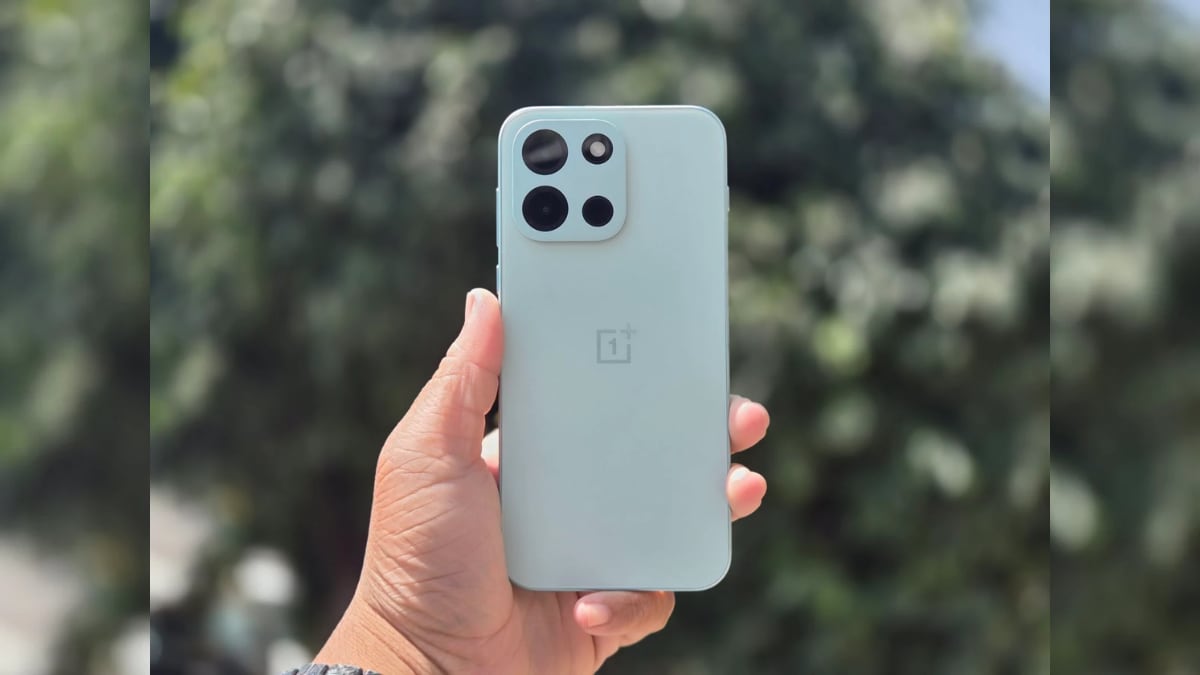
With the OnePlus Nord 6, the company is not trying to reinvent that approach. Instead, it focuses on refining it. On paper, the phone brings a powerful chipset, a massive battery and a high refresh rate display. But specifications only tell part of the story.
I have been using the OnePlus Nord 6 for the past couple of weeks, and here is how the smartphone performs in day-to-day use
Design
The OnePlus Nord 6 follows a clean and minimal design language. It does not try to do anything too flashy, but it still manages to look mature and sophisticated. It strikes a resemblance to the flagship OnePlus 15. The unit I used felt solid and sturdy in my hand. The weight is slightly on the higher side, which is understandable given the large battery inside, but the overall balance is well managed. It does not feel uncomfortable to hold for extended periods, although you do notice the weight after a while.
The button placement is fairly standard. The power button and volume rockers are placed on the right side, while the left side houses a customizable Plus Key. I found this button quite useful in day-to-day use, especially when assigned to quick actions like opening the camera or toggling certain settings.
At the bottom, you get the SIM tray, a USB Type-C port and a speaker grille, while the top houses an additional speaker vent and a secondary microphone. The phone also includes an IR blaster.
One thing that stands out is the durability. The smartphone survived a few drops without any dents or scratches. The Nord 6 also comes with multiple water and dust resistance ratings, including IP68 and IP69K. Though I did not take it for swimming, it did work perfectly despite splashes of water here and there.
Display and audio
The OnePlus Nord 6 features a 6.78-inch AMOLED display with a 1.5K resolution and a 165Hz refresh rate. For most of the applications, the smartphone will offer up to 120Hz of refresh rate. When I tried to check the app-specific refresh rate list, I didn’t come across any app that had an option for a refresh rate above 120Hz. This means that the display only goes above the 120Hz mark in certain scenarios, such as in certain games.
However, despite the limitation, scrolling through apps, navigating the interface or even casual gaming feels very smooth.
In terms of colour reproduction, the display performs well. Colours appear vibrant without being overly saturated. During my testing, I noticed that bright tones like reds and oranges appear slightly punchy, while overall colour balance remains fairly accurate. Blacks are handled well to a certain extent, which adds to the overall viewing experience, especially while watching content. For multimedia consumption, the experience is quite satisfying. Whether it was watching videos or browsing through content-heavy apps, the display consistently delivered a good experience.
Brightness is another area where the display holds up well. Outdoor visibility is not an issue, and the screen remains readable even under direct sunlight. At the same time, the brightness can go sufficiently low in darker environments, making it comfortable to use at night without much strain on the eyes.
Coming to audio, the phone offers stereo speakers, and the output is pretty loud and clear. I did not notice much distortion even at higher volume levels. The overall sound quality is good for casual media consumption, although it does not particularly stand out in terms of depth or richness.
Performance and gaming
The OnePlus Nord 6 is powered by the Qualcomm Snapdragon 8s Gen 4 chipset, paired with LPDDR5X RAM and UFS 4.1 storage. In everyday use, the phone feels fast and responsive.
Apps open quickly, multitasking is smooth and there are no noticeable slowdowns during regular usage. Whether I was switching between multiple apps, browsing or using social media, the phone handled everything without any issues.
Gaming performance is also strong. I tried a few demanding titles, and the phone was able to maintain stable frame rates for the most part. With all settings cranked up, I got around 80-85fps in BGMI. The overall experience felt smooth and reliable, even during extended sessions.
However, I did notice some warmth during longer gaming sessions. It was not uncomfortable, but it was noticeable if you were paying attention. Similarly, while charging, the phone tends to heat up slightly more than usual. It is not alarming, though.
Overall, performance is one of the stronger aspects of the Nord 6. It delivers a smooth and consistent experience across different use cases.
Software and AI features
The Nord 6 runs Android 16-based OxygenOS 16. The interface feels familiar, clean and easy to navigate. There are several customisation options available, allowing you to tweak the layout and appearance based on your preference.
One of the areas where OnePlus is focusing more now is AI features. The phone includes tools like AI Writer, AI Recording and other productivity-focused features. During my usage, some of these features felt useful, especially for tasks like summarising text or transcribing audio.
There is also Mind Space that allows you to save and organise on-screen information into a dedicated space. It can help keep track of things like bookings or notes, although I did not find myself using it very frequently.
Camera
The OnePlus Nord 6 comes with a dual-camera setup on the back, featuring a 50MP main sensor and an 8MP ultra-wide lens, along with a 32MP front camera for selfies and video calls.
Starting with the main camera, the phone does a good job in well-lit conditions. Pictures come out sharp, with a decent level of detail and colours that look slightly vibrant but not overly exaggerated. During my usage, I noticed that overall colour tones remain fairly balanced. The dynamic range is handled well in most situations.
Portrait shots are also handled nicely. The edge detection is fairly accurate, and the background blur is applied in a controlled manner. It does not feel overly artificial. I tried shooting portraits both indoors and outdoors, and the results were largely consistent.
Zoom is usable up to a certain point. At around 3x, images still retain decent clarity, but beyond that, the loss in detail becomes noticeable. This is not surprising, but it does limit how often you would rely on zoom beyond casual use.
Low-light photography is where things start to feel a bit limited. The night mode does improve brightness and visibility, but it takes a couple of seconds to process each shot. Even after processing, the results feel acceptable rather than impressive. There is some loss of detail, and the overall sharpness drops compared to daylight shots. It’s usable, but not something that stands out.
The ultra-wide camera feels like a step down. In daylight, it manages to capture decent shots, but the difference in detail and colour consistency compared to the main sensor is pretty evident. In low light, the drop in quality is even more noticeable, making it less reliable in such conditions.
Coming to the front camera, the 32MP sensor does a good job with selfies. It captures a good amount of detail, and during my testing, I noticed that facial features were reproduced fairly accurately. The portrait mode on the front camera also works well, with proper edge detection around the face and hair. However, in slightly dim environments, the images can appear a bit softer than expected.
For video recording, the phone supports up to 4K at 60fps on the rear camera and 4K at 30fps on the front. The video quality is stable and usable, but I did not notice a significant difference when switching to ultra-steady mode. The results felt quite similar in most situations, which makes the feature feel less impactful.
Overall, the camera system does its job decently for everyday use, but it does not particularly push boundaries. It feels reliable, but not something that would be a deciding factor for most users at this price.
Battery and charging
The OnePlus Nord 6 is powered by a 9,000 mAh battery, which is easily one of its biggest highlights. In real-world usage, the battery life is impressive. With moderate usage, the phone can comfortably last more than two days, and in some cases, even longer. During my testing, I was able to get extended screen-on time without having to worry about charging frequently. Even with heavier usage, the phone easily lasts more than a day.
Charging is handled by 80W fast charging. While it is not the fastest available, it still does a good job of topping up the battery in a reasonable amount of time. A full charge takes a bit longer due to the large battery size, but it does not feel inconvenient given the marathon battery life. It’ll complete a full charge cycle from 0 per cent to 100 per cent in around one and a half hours.
One thing to note is that the phone tends to heat up slightly while charging, especially when fast charging is enabled. Again, it is not alarming, but it is noticeable. Overall, battery life is easily one of the strongest aspects of the Nord 6 and a major reason to consider the device.
Verdict
-
8GB RAM + 256GB storage: Rs 38,999 -
12GB RAM + 256GB storage: Rs 41,999
The OnePlus Nord 6 gets a lot of things right without trying to overpromise. It offers a reliable camera performance in good lighting, a display that feels smooth and comfortable, and performance that remains consistent in everyday usage. The design is clean and practical, and the battery life is dependable enough for most users. It’s the kind of phone that doesn’t demand attention but quietly does its job well.
At the same time, it doesn’t completely avoid compromises. Low-light camera performance could have been better, and the overall experience, while consistent, doesn’t push beyond expectations. This is best suited for users who want a balanced, no-nonsense smartphone for daily use without focusing too much on extremes like gaming or photography. However, if you’re someone looking for standout camera performance or a more distinctive design, this may not fully meet those expectations.







