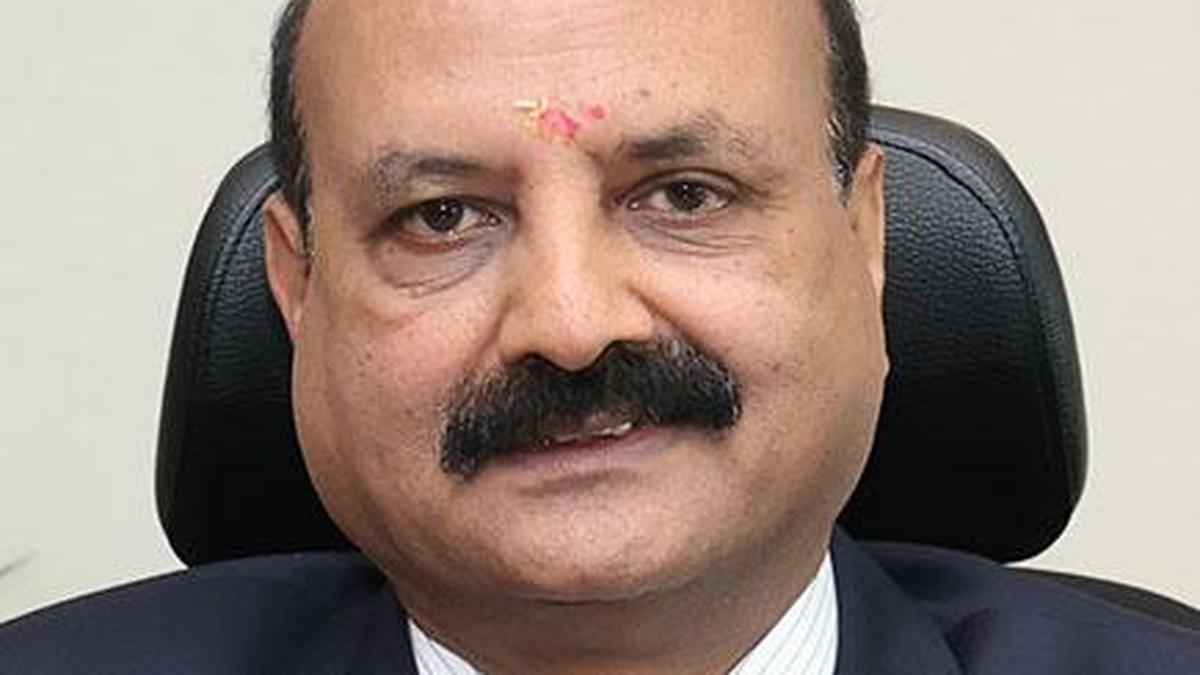
Ashok Chandra, MD & CEO, Punjab National Bank
| Photo Credit:
cueapi
When Prime Minister launched the Pradhan Mantri MUDRA Yojana on April 8, 2015, the stated mission was simple: “Funding the Unfunded.” Eleven years later, the scheme has evolved into one of the world’s largest micro-credit programmes, fundamentally altering how India’s smallest entrepreneurs access formal finance establishing itself as a critical pillar in the nation’s financial inclusion architecture.
As of March 2026, PMMY has disbursed loans worth ₹40.07 lakh crore through more than 57.79 crore accounts. The scale of disbursement—exceeding the GDP of many mid-sized economies—reflects both the latent demand among micro-entrepreneurs and the institutional capacity built to service it.
The scheme emerged from a recognition that India’s micro, small, and medium enterprises (MSME) sector, which contributes approximately 30 per cent of GDP and 45 per cent of exports, remained chronically underserved by formal credit channels. Prior to PMMY, an estimated 5.77 crore micro-units operated outside the formal banking system, relying on informal moneylenders charging usurious rates or foregoing expansion altogether due to capital constraints.
PMMY operates through a three-tier institutional framework comprising the Micro Units Development and Refinance Agency Ltd. (MUDRA), Member Lending Institutions (MLIs) including public sector banks, private banks, regional rural banks, microfinance institutions, and non-banking financial companies, and the beneficiaries themselves. This architecture enables credit flow from formal financial institutions to the last mile without requiring borrowers to pledge collateral — a structural barrier that had historically excluded millions from institutional finance. The scheme has helped strengthen local businesses, supply chains, and rural economies. This structure has enabled scale, reflected in the steady rise in sanctions from ₹1.37 lakh crore in FY16 to ₹5.74 lakh crore in FY26.
The scheme’s graduated loan categories have proven instrumental in enabling enterprise growth. The original three tiers — Shishu (up to ₹50,000), Kishor (₹50,000 to ₹5 lakh), and Tarun (₹5 lakh to ₹10 lakh) — were designed to match credit availability with business maturity. Later on the October 2024
introduction of Tarun Plus, extending loan limits to ₹20 lakh signals a policy intent to support graduation, shifting the focus from subsistence-level activity to enterprise expansion.
Perhaps more significant than aggregate disbursement figures is the scheme’s reach into previously excluded demographics. Over 12 crore accounts belong to first-time borrowers, underscoring PMMY’s role in creating new entrepreneurs rather than merely refinancing existing businesses.
Women have emerged as the predominant beneficiaries, holding two third share in the number of loan accounts sanctioned. Further, more than half of MUDRA loan account holders belong to Scheduled Castes, Scheduled Tribes and Other Backward Classes— a distribution that speaks to the scheme’s effectiveness in reaching economically weaker sections.
Public sector banks have served as the primary delivery mechanism, leveraging their extensive branch networks to reach semi-urban and rural borrowers. The operational efficiency of the lending ecosystem is evident in the narrow gap between sanctioned and disbursed amounts — ₹5.74 lakh crore sanctioned versus ₹5.65 lakh crore disbursed in FY25-26 alone.
The role of Digital cannot be undermined here as the integration has further strengthened the delivery architecture. Platforms such as the Jan Samarth portal have streamlined application and disbursement processes, while credit guarantee mechanisms administered by National Credit Guarantee Trustee Company have mitigated lender risk. These developments are consistent with broader trends in India’s financial system towards digitisation and risk-sharing frameworks.
There are more than 7.94 crore . registered MSME units on Udyam portal out of which more than 7.88 are micro units and as per estimates MSME sector still have a substantial ₹30 lakh crore addressable credit gap. Bridging this gap is key to unlocking India’s full entrepreneurial potential.
Looking ahead to Viksit Bharat 2047, PMMY’s role will be pivotal in realising a $30-trillion-plus economy anchored in formal, resilient MSMEs. With formalisation accelerating via Udyam and digital public infrastructure, the scheme can evolve from micro-credit provider to a full-spectrum enabler—facilitating equity linkages, skill-credit convergence, and green financing for sustainable units. Policy priorities include expanding guarantee covers under CGTMSE, real-time data portals for performance tracking, targeted awareness in low-penetration regions, and incentives for lenders to support higher-ticket, repeat borrowers.
Reducing the residual credit gap through account aggregator frameworks and ONDC integration will be critical. As India transitions from job-seeker to job-creator economy, PMMY’s legacy of trust-based lending offers a replicable model: when the state guarantees potential over collateral, entrepreneurship flourishes at the grassroots. Sustained analytical rigour in monitoring outcomes will ensure the scheme not only survives but drives the next phase of inclusive, self-reliant growth.
After 11 years, PMMY has evolved into a cornerstone of India’s inclusive growth strategy. By enabling millions of small entrepreneurs — especially women and marginalised groups. It has powered MSME-led development, strengthened grassroots economies and advanced the vision of Atmanirbhar Bharat.
The writer is the MD & CEO of Punjab National Bank
Published on April 10, 2026







