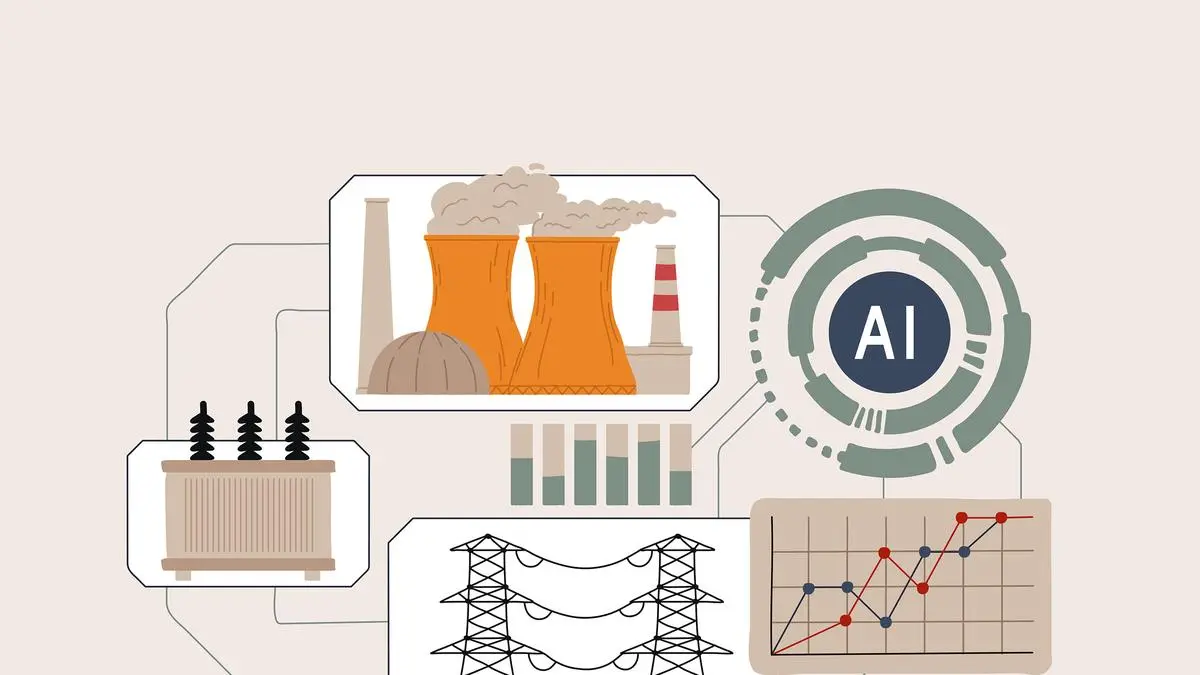
India’s electricity grid has long resisted the forecasting methods that work elsewhere. A recent study, ‘Indian peak power demand forecasting: Transformer-based implementation of temporal architecture’, by Vishvaditya Luhach and Shashwat Jha, applied a transformer-based architecture to Indian peak power demand and achieved a mean absolute percentage error of 4.15 per cent across a six-year daily dataset. The number matters less than what the attempt reveals about the problem.
The structural difficulty of India’s demand curve has several layers. Agricultural irrigation draws heavily on subsidised, largely unmetered power that follows crop cycles and monsoon patterns across States with different cropping calendars, groundwater conditions and seasonal rainfall. Historical consumption data carries all of this embedded complexity without labelling it.
The pre-monsoon months compound this. From April through June, cooling demand peaks as temperatures climb toward their annual high, while reservoirs depleted through the dry season constrain hydro-generation capacity. Supply tightens precisely when demand is most acute. A temperature variable captures one side of this; it cannot capture the reservoir cycle, which moves adversely against it at the same time.
Most fundamentally, India’s observed peak demand strains supply and is hence expensive. Large portions of the population remain underserved or unconnected, and the training signal understates latent consumption by an uncertain margin, which will shift as electrification expands.
Mature grids in western Europe have stable, metered and climatically moderate demand profiles. India’s grid has none of these properties.
The temporal fusion transformer handles this environment better than its competitors for a specific architectural reason: It processes three input types simultaneously — historical observations, known future variables such as calendar dates and public holidays, and static metadata — without requiring the analyst to pre-specify how they interact. It learns the weighting. Its variable selection mechanism highlights which inputs drove a given forecast, making its reasoning available for inspection. For regulators, a model that can be audited is qualitatively different from one that produces only a number.
Domain fit
The study’s most telling result involves a model that did not perform well. The temporal convolutional network, a sophisticated deep-learning architecture with a creditable record in sequence modelling, was outperformed by naive seasonal forecasting: A method that essentially extends yesterday’s pattern with a drift adjustment. The paper is limited enough that a more rigorous investigation — with regional disaggregation, more model comparisons and finer-grained data — might tell a different story about the TCN.
The result still points to something real. General purpose architectures designed to handle heterogeneous, multi-layered inputs fared better on India’s demand curve than a deeper model optimised for sequential pattern extraction. Domain fit outweighed architectural sophistication, and India’s grid exposed the difference.
A more accurate forecast only improves outcomes if the institution receiving it can act on it. Decisions about generation capacity, transmission investment and storage procurement require forecasts that look years ahead; infrastructure takes years to build and decades to pay off. Acting on those forecasts requires procurement flexibility, regulatory frameworks and pricing signals, which most State electricity boards and central planners do not yet have.
The transformer’s migration from language parsing to power grid management reflects something specific: A compact set of mathematical operations, designed to identify which parts of a sequence matter most for predicting what comes next, generalises across domains defined by long-range temporal dependencies. India’s grid, with its accumulated complexity, is among the most demanding tests of that generalisation. Passing it is a result worth examining.
More Like This
Published on April 6, 2026







