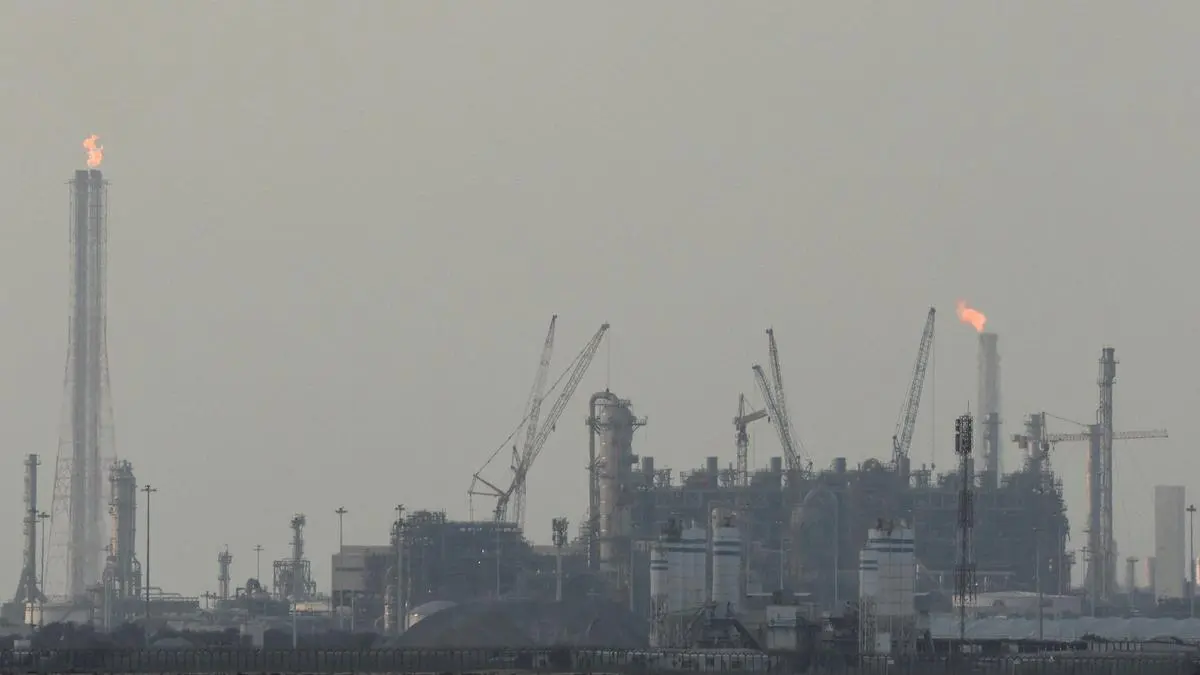
The Ras Laffan facility in Qatar, which is the largest liquefaction facility in the world, has been offline since it was first attacked on March 2 (file photo)
India’s import of liquefied natural gas (LNG) from its largest supplier—Qatar—declined to its lowest on record in March 2026 as the West Asia conflict led to the closure of the Strait of Hormuz (SoH).
Besides, Iran’s attack on QatarEnergy’s LNG facilities, in retaliation for attacks by the US and Israel, led to declaration of force majeure and production shutdowns early last month, further exacerbating India’s natural gas imports, which account for roughly half of its consumption.
India’s total natural gas consumption is about 189 million standard cubic metres per day (mscmd) with 97.5 mscmd produced domestically. About 47.4 mscmd has been affected due to force majeure conditions.
Global real-time data and analytics provider Kpler pointed out that India remains materially exposed to West Asia, with a significant share of its LNG imports tied to long-term contracts with QatarEnergy.
International Energy Agency (IEA) estimates that global LNG supply has reduced by around 20 per cent due to the situation. The disruption of transit via the SoH reduced supplies from Qatar and the UAE by over 300 mscmd since March 1, which is a loss of over 2 billion cubic metres (bcm) of gas supply every week.
Sehul Bhatt, Director at Crisil Intelligence, said, “In March, Brent crude increased to $110-120 per barrel, while spot prices of Asian LNG nearly doubled to $20-25 per millon British thermal units (mBtu). We expect the prices of these two commodities to remain elevated and volatile in April as well.”
Record-low imports
Sonal Ranjan, Kpler’s Insight Analyst for LNG & Natural Gas, told businessline, “In January 2026, Qatar supplied around 1 million tonne (mt) of LNG, accounting for roughly 41 per cent of total imports. However, this fell sharply to just 0.06 mt (about 3 per cent share) by March—a 94.3 per cent decline—as Hormuz transit was suspended.”
To offset the shortfall, imports from the US and Nigeria increased. The US volumes rose to around 0.34 mt in March (up around 144 per cent from January 2026), while Nigeria supplied roughly 0.33 mt (up around 17 per cent). Oman remained a steady supplier and emerged as the largest source in March at around 0.53 mt, she added.
“Overall, total monthly LNG imports declined by around 35 per cent from January to March, driven by elevated spot prices and constraints on physical supply,” Ranjan pointed out.
Impact on Qatar
The Ras Laffan facility in Qatar, which is the largest liquefaction facility in the world, has been offline since it was first attacked on March 2. Regional gas production is also affected by the shut-in of oil fields, which has cut the output of gas associated with oil production, IEA said.
In 2025, Ras Laffan produced 112 bcm of LNG, as well as 300,000 barrels per day of liquefied petroleum gas (LPG) and 180,000 barrels per day of condensate, making it the largest LNG facility in the world by some distance.
Sourcing becomes the next battle ground as markets remained tight during January-February 2026, and depleted storage coming out of the heating season in the Northern Hemisphere is set to increase the call on LNG in the months ahead. Besides, the extended loss of output from QatarEnergy’s Ras Laffan facility could significantly exacerbate this market tightness, IEA said.
More than 110 bcm of LNG passed through the SoH in 2025. About 93 per cent of Qatar’s and 96 per cent of the UAE’s LNG exports transited through the Strait, representing almost one-fifth of global LNG trade. There are no alternative routes to bring these volumes to market, it added.
Most LNG from Qatar and the UAE goes to Asia. In 2025, almost 90 per cent of the total volumes exported via the SoH was destined for the Asian market.
Just over 10 per cent went to Europe. Yet, as with oil, extended disruptions would have global consequences. Countries that have long-term contracts with the UAE or Qatar would need to turn to the spot market for LNG. This, in turn, would drive up natural gas prices around the world.
QatarEnergy said it expects the damage to its Ras Laffan Industrial City caused by missile strikes on March 18-19 to cost about $20 billion a year in lost revenue and take up to five years to repair, impacting supply to markets in Europe and Asia. Damage sustained by LNG facilities will take three-five years to repair. The attacks have also pushed offline around 1.281 mt LPG, which is roughly 13 per cent of Qatar’s exports.
Published on April 2, 2026







