
As per RBI and SEBI requirements, banks are expected to have a well-defined whistleblower policy hosted on their site and must put in place vigilance mechanisms to give employees access to senior management and confidentiality
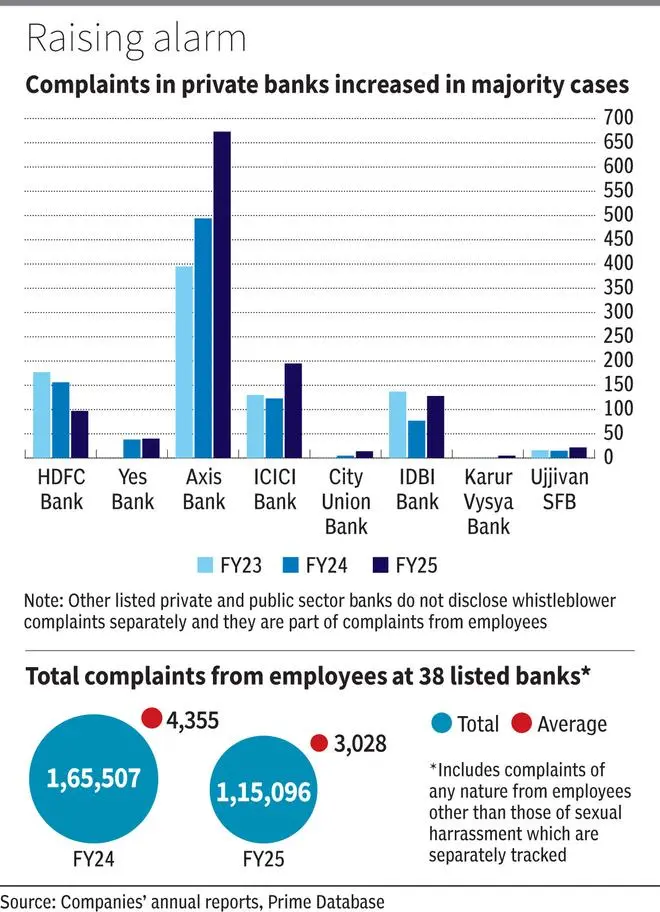
Whistleblower complaints across India’s private banks recorded a broad increase in FY25 with most major players including Yes Bank, Axis Bank and ICICI Bank reporting higher cases in the fiscal compared to FY24. HDFC Bank was the only bank among the top-tier players to report a dip in such complaints.
A businessline analysis of annual reports of listed private banks shows that only eight out of 23 banks reported whistleblower complaints separately, and seven out of the eight saw number of complaints increase in FY25, highlighting either improved internal reporting systems or rising governance concerns.
Axis Bank reported a significant jump to 673 complaints in FY25, up from 494 in FY24 and 395 in FY23. ICICI Bank also recorded a notable rise, with complaints climbing to 195 from 123 a year earlier. Interestingly, HDFC Bank, which is currently in the eye of the storm, saw number of complaints fall by 37 per cent on-year in FY25.
As per RBI and SEBI requirements, banks are expected to have a well-defined whistleblower policy hosted on their site and must put in place vigilance mechanisms to give employees access to senior management and confidentiality. However SEBI’s BRSR (Business Responsibility and Sustainability Reporting) does not require specific identification of such complaints and they get included under broader employee complaints.
Experts say higher whistleblower complaints may indicate a healthy, transparent culture or can also point to underlying governance lapses, in the absence of sufficient disclosures of the nature of complaints.
‘Risky and unrewarding’
Ramesh K Vaidyanathan, Managing Partner at BTG Advaya, said that as a concept, whistleblower complaints could relate to fraud, governance lapses and other unethical conduct. “Overall, compliance requirements exist, but real protection is minimal, making whistleblowing risky and unrewarding. Further, there is no uniform mandate to publicly disclose the number of whistleblower complaints in annual reports.”
Rupinder Malik, Partner, JSA Advocates and Solicitors, says the challenge lies in execution with issues around how complaints are triaged at the initial stage and whether matters are escalated appropriately. “There is a stronger regulatory and governance push now towards making these mechanisms more credible and trusted especially through clearer anti-retaliation safeguards, audit trails, and periodic reviews of how complaints are actually handled on the ground,” Malik added.
Separately, data from primeinfobase.com showed that total complaints from employees (excluding those relating to sexual harassment) fell by 30 per cent in FY25 across the 38 listed banks (public and private). This includes grievances of all kinds including those of governance.
Published on March 27, 2026







