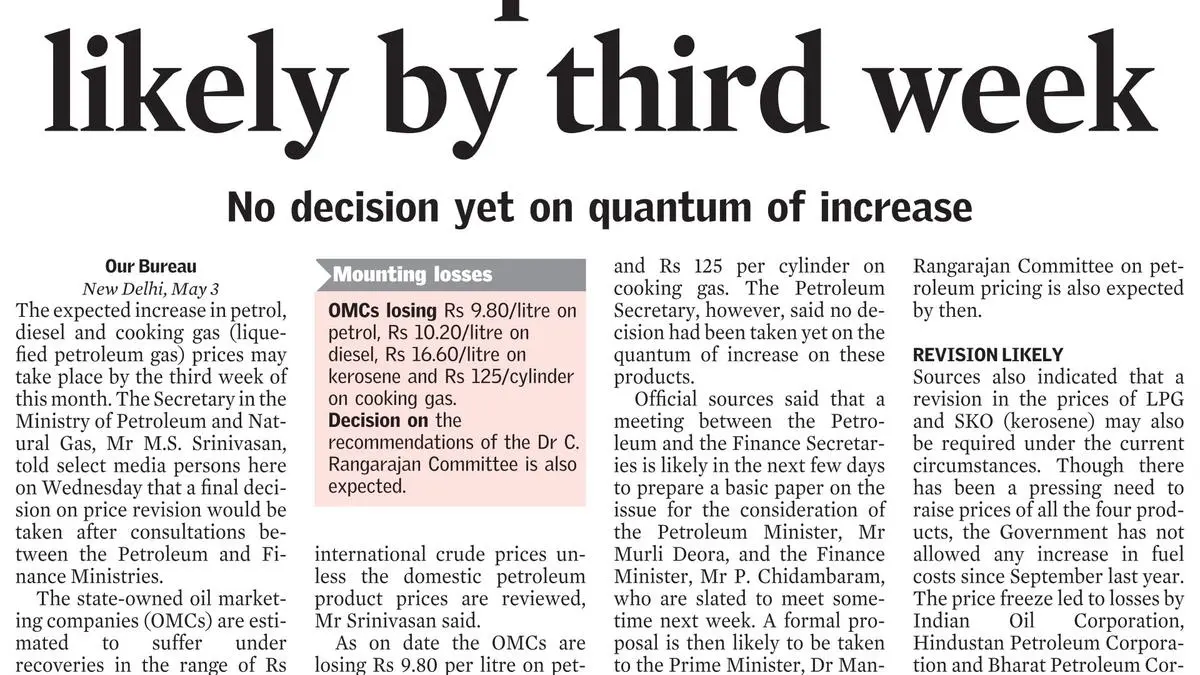
A screen grab of the report carried by businessline in its edition dated May 4, 2006
Two decades ago, businessline was reporting on the same structural tensions in India’s fuel pricing that continue to surface today, as the government once again opts for a status quo on retail oil prices despite rising global crude.
The persistence of this pattern underscores a central contradiction: While petrol and diesel were formally deregulated by the NDA government in 2002 under Petroleum Minister Ram Naik, pricing freedom has remained constrained by political considerations.
Political optics
Back then, as now, oil marketing companies (OMCs) found themselves absorbing the impact of global price swings when domestic prices were held steady.
The intent of deregulation was to eliminate precisely this burden, freeing companies to adjust prices in line with international markets and reducing the need for subsidies. Yet, in practice, electoral cycles, inflation concerns and political optics have repeatedly intervened, preventing full pass-through of costs to consumers.
The result is a system that operates in a grey zone. When crude prices rise sharply, OMCs act as shock absorbers, delaying increases and accumulating losses. When prices fall, tax adjustments often limit the benefit reaching consumers. This asymmetry distorts market signals and undermines the very rationale of deregulation.
What has evolved is the context, not the core issue. India’s import dependence has deepened, and global energy markets have become more volatile. Still, the underlying dilemma remains unchanged: OMCs are neither fully market-driven nor entirely state-supported.
The continuity is telling. Twenty years on, despite policy shifts and changing global dynamics, India’s fuel pricing regime remains shaped as much by political compulsions as by economic logic, leaving OMCs to grapple with the same unresolved challenges.
Published on May 1, 2026







