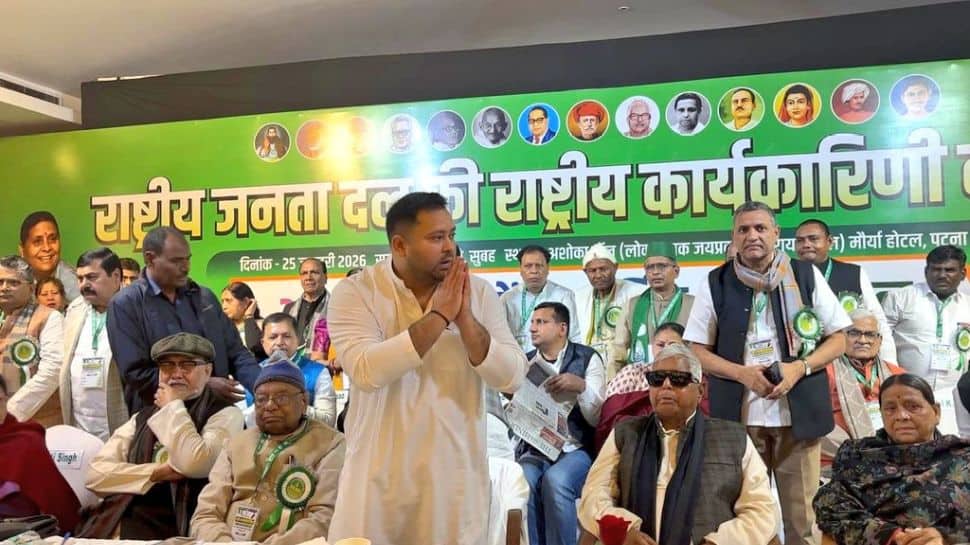
Bihar politics: The Rashtriya Janata Dal (RJD) on Sunday announced that Tejashwi Yadav would be the party’s new national working president. The announcement was made during the RJD’s national executive meeting held in Bihar’s Patna.
The party, in a post on X (formerly Twitter), described the appointment as: “Dawn of a New Era! Tejashwi Yadav Ji has been appointed as the National Working President of Rashtriya Janata Dal!”
The meeting was attended by RJD chief and former Bihar Chief Minister Lalu Prasad Yadav, former CM Rabri Devi, Tejashwi Yadav, Misa Bharti, and other senior party leaders.
Fractured Yadav family and Bihar politics
RJD supremo Lalu Prasad Yadav’s daughter, Rohini Acharya, on Sunday described “Laluvad” in a post on X as a steadfast fight for the marginalised population.
In her post, Acharya questioned those responsible for the party’s decline and criticised leaders for evading accountability.
“Whoever truly embodies Laluvad in the true sense—anyone who has selflessly struggled for the party that Lalu Ji founded to steadfastly fight for the interests of the marginalised population and the deprived—will undoubtedly question those responsible for the party’s current sorry state and raise their voice against the dubious and suspect roles of such people, without caring for the consequences,” she wrote.
She further added that those currently in leadership positions must introspect rather than evade questions, warning that silence would amount to complicity.
Acharya’s relationship with her brother Tejashwi Yadav and the RJD hit rock bottom after the Bihar Assembly election results were announced in November 2025. Tensions escalated following the party’s poor performance in the polls, with Rohini also alleging physical and verbal abuse.
Rohini is not the only Yadav sibling to have strained ties with the family. Earlier, Lalu Yadav expelled his elder son, Tej Pratap Yadav, from the party for six years over what he described as “immoral and irresponsible behaviour”, after a picture of Tej Pratap with his rumoured partner triggered political controversy.
Also Read- Tejashwi Yadav appointed as new National Working President of Rashtriya Janata Dal
Bihar elections and their aftermath
In the Bihar Assembly elections, the BJP emerged as the single largest party with 89 seats, followed by JD(U) with 85 seats, while the RJD managed to secure only 25 seats. The results triggered unrest within the party, with questions being raised over leadership, strategy, and organisational strength.
The setback marked one of the RJD’s weakest electoral performances in recent years and intensified internal fault lines that had largely remained under the surface.
Lalu Prasad Yadav’s rise in politics
Lalu Prasad Yadav founded the RJD and has served as Bihar Chief Minister, Union Railway Minister, and Member of Parliament. His political rise in the 1990s marked a transformative phase in Bihar’s politics, particularly through his emphasis on social justice and empowerment of backward classes.
Lalu first became Chief Minister of Bihar in 1990. From a student leader and young parliamentarian, Lalu rose to become the supremo of the RJD and one of Bihar’s most influential political figures.
In recent years, however, Lalu has largely played the role of a symbolic leader, with limited involvement in day-to-day organisational affairs.
Tejashwi Yadav’s rise and an array of promises
Tejashwi Yadav, Lalu’s son and the Leader of Opposition (LoP) in the Bihar Assembly, has steadily emerged as the party’s principal face. Ahead of the elections, he launched an aggressive campaign against the JD(U) and the BJP, promising large-scale employment generation, welfare schemes, and governance reforms if voted to power.
While the RJD was unable to secure a victory in the Bihar elections, Tejashwi Yadav remained the party’s most visible campaigner and emerged as its central rallying point. His campaign focused heavily on youth-centric issues and economic distress, allowing him to retain relevance despite the electoral defeat and consolidate his position within the party’s organisational hierarchy.
Can RJD rise again under Tejashwi’s leadership?
With Tejashwi Yadav now officially entrusted with the role of national working president, the RJD appears to be signalling a generational transition without formally ending Lalu Prasad Yadav’s influence. The appointment raises a larger question: is this the beginning of a “Lalu Yadav 2.0” era, where the legacy continues through a younger, more administrative leadership style?
Notably, Tejashwi’s challenge will be twofold- healing internal rifts within the party and expanding RJD’s appeal beyond its traditional support base in a politically competitive Bihar. Whether this elevation marks a revival strategy or merely a symbolic reshuffle will depend on several factors.
For now, the move reflects RJD’s acknowledgement that survival and resurgence may hinge on a transition of power, one that continues the legacy of “Laluvad” while attempting to adapt to a changing political landscape.







